Resources
Journal Issue.
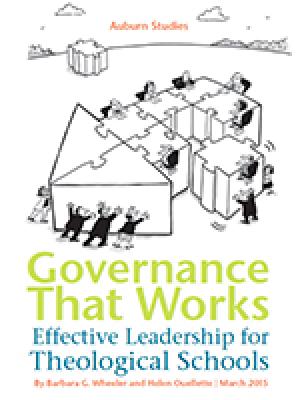
With this report, Barbara G. Wheeler ends a long and distinguished era as a lead researcher and author for the Auburn Studies series, the signature line of publications from the Center for the Study of Theological Education (CSTE). Beginning with Reaching Out (1993) which set a focused and extraordinarily generative vision for the CSTE, Wheeler went on to author or co-author fourteen of the twenty studies in this series. These studies engaged many of the issues central to theological schools and their stakeholders: studies of enrollment and student debt, student recruitment and alumni success, and the status of faculties and senior leadership—both presidents and governing boards. With these and many other publications, lectures, and consulting projects, Wheeler established Auburn as a respected source for those wanting to understand the dynamics of this very particular set of institutions of higher education which prepare faith leaders for their vocations. Governance That Works: Effective Leadership for Theological Schools exhibits Barbara Wheeler’s characteristically clear prose and keen insight readers of past Auburn Studies have come to expect. At a time when many theological schools are experiencing significant challenges, the report helpfully exegetes several schools as notable cases of effective governance. In general, the story is one of gradual change towards better governance policy and practice. Yet many boards struggle with improving board composition—including minority and gender inclusion but also people with the right skills and a capacity to be substantial donors to the school. Among a number of notable trends, the increasing power of chief executives—with generally strong support from their faculty and boards—greatly heightens the salience of interpersonal skills on the part of those executive leaders. In a related insight, the report shows how such an interpersonally wise senior executive develops stronger leadership within the faculty and board, and a more vital partnerships between the two. (Christian Scharen)
One page Teaching Tactic: dividing up students into separate "expert groups" helps them master difficult reading assignments.
This is an edited transcript of a conversation between two founding women on the delights and demands of teaching and learning within and beyond traditional institutional life, facilitated by Lisa M. Hess of the journal's Editorial Board. The conscious feminine practices of a women's writing school, Women Writing for (a) Change (Cincinnati, Ohio), created the circle-container for the sharing of words and wisdom. Narrative, pedagogical, and organizational issues arose as the circle listened and examined the realities of contributing as a woman in higher education, yesterday and today.
In this essay, I examine the following pedagogical question: how can we unlock students' mistaken notions that religious “traditions” are monoliths, and instead help them to recognize, puzzle over, and appreciate the complex multiplicity and vibrant set of doctrinal and ritual conversations that characterize religious traditions? More specifically, how can we teach students to recognize these differences with respect to a religion's notions of god? And how can we do so even when students are particularly stuck on, invested in, or trained to see homogeneity? In answer to these questions, I present an exercise that I have used in my World Religions courses. This exercise – which I call the “Council of Newton” (named for the building in which I first taught it) – is particularly effective because it helps students uncover and wrestle with this diversity at two levels: conceptually and historically.
Working with undergraduate students invites teachers into relationship and conversation with young people at a time when they are emerging as adults and forming their identities. Faith is one area of identity formation often attended to by scholars, college professors, and their institutions. But within that, little attention has been paid to those who do not identify as religious. Additionally, “the overwhelming presence of Christianity at American institutions maintains it as the spiritual norm on campus. … Those within the spiritual norm gain a level of privilege that is often unconscious” (Seifert 2007, 11). This has an effect not only on nonreligious students but on any student who identifies as anything other than Christian; and it has a unique effect on teaching and learning in the religion classroom. In this article, I will explain what Christian privilege is, why it is a unique problem in the undergraduate religion classroom, and what teachers of religion might do in response to it. In the end, I argue that educators need to better understand the effects of Christian privilege in our classrooms and become allies to the nonreligious in particular by using pedagogies that include and support all students, in their many religious affiliations and unaffiliations.
This article considers the challenges inherent when teaching about new religious movements (“cults”), how successful instructors have surmounted them, and how teacher-scholars in other fields of religious studies can benefit from a discussion of the successful teaching of new religions. I note that student-centered pedagogies are crucial to teaching new religions, particularly if students disrupt and defamiliarize the assumed and reified categories of “cult” and “religion.” I argue that what works in a classroom focusing on new religious movements will work more broadly in religious studies classrooms, since the challenges of the former are reproduced in the latter.
A commitment to empathetic understanding shaped the field of religious studies; although subject to critique, it remains an important teaching practice where students are charged with the task of recognizing, and perhaps even appreciating, a worldview that appears significantly different from their own. However, when the focus of the course is historical trauma there are significant epistemological and ethical reasons empathetic understanding may not be our best pedagogical strategy. Drawing primarily on my experience teaching a general education class “The Holocaust and Its Impact” at California State University, Bakersfield, I advocate replacing empathetic understanding with engaged witnessing as a pedagogical framework and strategy for teaching traumatic knowledge. To make this case, I delineate four qualities of engaged witnessing and demonstrate their use in teaching about the Holocaust.
This essay presents Moses, the protagonist of the biblical books of Exodus and Deuteronomy in the Hebrew Bible, as a playful but generative metaphor for current teaching practices and experiences in higher education, including my own. Among numerous similarities (such as the fact that Moses, other teachers, and I are all bound by context), the most humbling insights come from Moses's role as a mediator or intermediary. It is a role that we also inhabit – standing, as it were, between our students and the knowledge of our discipline – and that we might consider further, particularly in terms of our responsibilities.
One page Teaching Tactic: in an introductory Biblical Hebrew course, students master one word, study passages in which it occurs, and preach on it.