Book Reviews
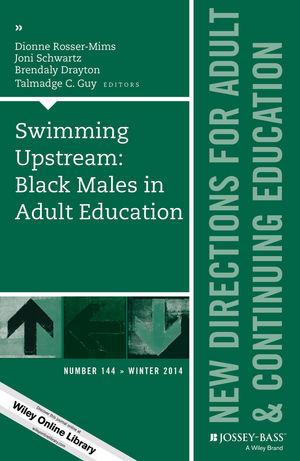
What person of sound mind would make a conscious decision to swim upstream against the current of turbulent waters? The correct answer is “probably no one.” Swimming upstream requires not only excellent navigational skill but perhaps, more importantly, demands that one possess the tenacity and spirit of a survivor. That is precisely why the metaphor “swimming upstream” is so appropriate in describing the plight of scores of African-American men who elect to enter and succeed in higher education (1). Swimming Upstream: Black Males in Adult Education is one volume in the series entitled: New Directions for Adult and Continuing Education. This anthology is intended “to make space for the experience and voices of Black men in the canon of adult education literature, to promote a critical assessment of institutional policies and practices, and to foster awareness and involvement among adult educators” (89). The format of this book is well-suited for academic settings. Each essay is preceded by a short introductory paragraph. At the close of each chapter the authors provide a robust list of reference sources that should prove helpful for students and educators alike. The first chapter discusses the impact of race and racism in the American adult educational system. Chapter two addresses myths and stereotypes employed to depict Black men and their influence on educational attainment. Chapter three explores the reasons for entering adult basic education programs and the role of gender identity. The topic of high school equivalency is discussed in chapter four. Chapter five addresses young Men of Color and engagement in adult learning. Chapter six is concerned with college reentry for African-American males. Chapter seven addresses the sobering topic of Black male college study following a term of incarceration. Chapter eight discusses military veterans and access to the GI Bill to pay educational expenses. The final essay, chapter nine, culminates with a call to action for educational practitioners. Understanding context is critical. In recent years a growing constituency has emerged that believes society has entered a post-racial or “colorblind” era. They advance the proposition that one’s race or ethnicity has no bearing on one's ability to survive and prosper in modern America. I strongly disagree with the post-racial theorists but recognize that it would be helpful for books like Swimming Upstream to squarely confront the legitimate concerns of post-racial proponents. In so doing one hopes that individuals on both sides of the argument will ultimately reach a consensus that the mission of ensuring equal educational opportunities for every individual remains a struggle that must still be waged today. Swimming Upstream moves that discussion forward with compelling statistical and anecdotal evidence. In 1903, the late W.E. B. DuBois prophesied in The Souls of Black Folks that the problem of the twentieth century would be the “color line” – the invisible yet palpable line of demarcation between Caucasians and African-Americans that was often characterized by overt discrimination and bigotry. More than one century later the question of whether “Black lives matter” is, in my view, a logical extension of DuBois’ central thesis. It can be argued that Swimming Upstream may unintentionally serve to remind us that certain remnants of the issues raised by DuBois remain unresolved today. For some readers this will speak to the relevance and timeliness of Swimming Upstream. An average book informs and a good book intrigues the reader. But an excellent book sparks self-reflection and may even compel one to act in new and bold ways. As a college instructor I routinely survey students to ascertain why they decided to embark on a college education. The primary responses from students generally, and African-American males specifically, are: “I want to make my parents proud of me” and “I want to set a positive example for my children/siblings/family.” Those learners confirm what I have long known to be true: that given equality of economic and institutional opportunities, African-American males have no less potential to achieve academic and vocational success than any other segment of the American population. College study may not be right for everyone but it must become accessible for anyone. Arguably that is the controversial and exciting rationale for Swimming Upstream. It is an excellent anthology that serves to affirm our collective belief in the basic humanity and intellectual capacity of every individual.
Two university educators who have led campus teaching and learning centers and worked as academic administrators have served us all well with their Facilitating Seven Ways of Learning. Davis and Arend seek explicitly to connect teaching practices to specific learning goals chosen for university classes. Not only do I recommend this book to you, but I will use it in my January PhD Teaching Seminar. At times the language of the book is a bit grand, talking about being “trapped” in a “lecture paradigm” with an “obsolete” view of learning (5, 8). They claim “confusion reigns as the paradigm crumbles (15).” I forgive them, for it does not continue too long. Perhaps the assumption was that a grand view was necessary to sell books to skeptical readers. Nevertheless, the book delivers what it promises: to help faculty, trained as scholars, researchers, and writers, to focus additionally on being effective teachers concerned about learning – for citizenship, personal development, and the ongoing generation of knowledge. Conversation about teaching is increasing in graduate schools, professional schools, and universities. At a recent consultation, I heard faculty members talk among themselves about how they trusted their colleagues, knew that individual classes were faithful and effective, and yet were concerned that their overall curricular goal for critical, integrative practical theological wisdom was not occurring. One mentioned that they all worked hard at fulfilling goals for individual classes, but had not attended to specific integrative commitments of their curriculum together. Facilitating Seven Ways of Learning is a way to begin addressing that concern. After assisting faculty to define course learning goals, the authors take seven explicit learning commitments and demonstrate effective pedagogical practices. The seven ways of learning are: building skills; acquiring knowledge; developing critical, creative, and dialogical thinking; cultivating problem-solving and decision-making abilities; exploring attitudes, feelings, and perspectives; practicing professional judgment; and reflecting on experience. One can see the influence of Bloom and Shulman here. The authors help faculty clarify how learning goals connect with these seven ways of learning and offer concrete strategies for teaching. To quibble: I am not certain that simply reflecting on experience is a goal. Is it not more a learning strategy for professional judgment, acquiring knowledge, or practicing decision-making skills? Regardless, this book will generate conversation among faculty members and will assist them to make the move from learning commitments to classroom strategies. As mentioned, I will use this book in my next PhD teaching seminar. Faculty are committed to assisting doctoral students to consider the vocation of teaching, connect academic study with teaching, and gain practical skill in course design and teaching practices. I have brought together bibliographies on theological education, course design, and learning strategies that I routinely share with graduate students. With Facilitating Seven Ways of Learning, students can practice naming commitments of their disciplines and their own scholarship, explore the learning goals they have for their students, dialogue with faculty mentors about the particular concerns of classes, and connect teaching practices to learning commitments. Clearly this book was written after years of experience in a college teaching center, empowering faculty colleagues. I recommend it.
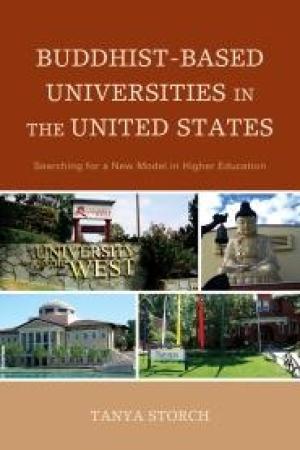
Expressing her concern about the current direction of higher education in the West, Dr. Storch argues that we can learn from the pedagogical principles of four “Buddhist-inspired” universities in the U.S. The first four chapters of this slim book each focus on one of these universities. Each is “a university that is state-accredited, which offers degrees in liberal arts and professional fields, and at the same time uses Buddhist pedagogical principles” (vii). Each chapter begins with a one to two page description of the school’s campus and the values its landscape and architecture embodies. This is followed by a brief biography of the male leader who founded the University or its parent Buddhist organization. These biographies, which occupy roughly a third of each chapter, are taken from official materials published by the organizations. The final two sections of each chapter review describe the historical founding of the school, its curriculum, and the impressions of its students. Data is drawn from websites and other promotional materials, and a few interviews. The last section of each chapter outlines the Buddhist pedagogical principles used at these universities, and the impact the author sees these having on students. The fifth and final chapter is the most engaging part of the book. Here the author discusses Buddhist pedagogical principles in three categories. (1) “Mindfulness”: Even though traditional meditation practice is not required, or even taught, at all of these schools, an atmosphere of mindful engagement is cultivated, and this is beneficial for students and faculty. (2) “Interconnectedness of all life”: These schools emphasize this principle inside and outside the classroom. Students are treated as real people, not as consumers; there is plenty of green space and fresh air in the classrooms; and values of environmental protection and vegetarianism are promoted. (3) “Right motivation for giving and receiving education”: These schools resist the pervasive contemporary tendency toward the commodification of all things, especially education. Students are taught values instead, and faculty and administrators treat students with compassion. This book concludes with a reflection on two of the pedagogical themes of the book: the teaching of meditation and ethical education (meaning an education that is both ethical toward students, and that teaches students to be ethical themselves). There are many places where the author could have deepened her inquiry. For example, how much do the educational models described here, which focus on educating the whole person and a commitment to values, represent a novel approach to education, and how much do they repeat already well-established models of liberal arts education? Also, although other Asian religions have not established comparable schools in the U.S., there is a long history of religiously-based liberal arts education, such as Jesuit Universities. How do these different approaches compare? Ultimately, this book is short in length and narrow in scope. The first four chapters range between thirteen and eighteen pages, without notes. The most substantial chapter is the fifth, and it could easily have stood alone as a journal article. This chapter raises a few important points about Buddhist pedagogical principles, but the book as a whole seems only half finished, and at this price it is difficult to recommend it to the readers of this site.

Better Worlds: Education, Art, and Utopia does not immediately relate to theological education. However, it does cover interesting and thought-provoking topics of potential use for those working in the theological school classroom. Yearnings for utopia express a desire akin to awaiting the Kingdom of God. Therefore, looking at ways the trope of utopia is formulated in the fields of education and the arts can provide interesting parallels for the theological school classroom. The core question is what would a better world look like? Roberts and Freeman-Moir take the reader through a sweeping survey of topics. In one section, John Dewey and William Morris’s utopian philosophies provide a backdrop for the discussion of utopias as places where each person can practice skilled craftsmanship, developing a craft to the point where it becomes artisanal. In chapter 2, visual art as a dystopian tool is regarded as something that can evoke true sympathy. The authors invite readers into various imaginative spaces to consider how imaginative sympathy can propel us into action, or at least into moral discomfort caused by the difference between the present world and imagined utopian dreams. Chapter 4 discusses the role of images, showing their power as pathways to action that open the imagination to craft a space of deciding and reflecting. This is similar to the praxis-theory-praxis loop championed by many theologians and seminary educators. For the theological educator, perhaps the most à propos chapters are those concerned with the liberation pedagogy of Paulo Freire and the literature of Fyodor Dostoevsky and Hermann Hesse. The chapter on Freire’s liberation framework provides a useful overview of his life and work with a focus on his utopian realism. The chapters on Dostoevsky and Hesse provide interesting analyses of their theologies and philosophies. I have two main critiques of this text. First, the authors spotlight too few female utopian visionaries. Chapter 3 focuses on writer and philosopher Iris Murdoch, but this is by far the weakest chapter in the book. The authors are clearly aware of feminist (or at least female scholars’) viewpoints in the various fields they describe. The book would have been stronger had they chosen at least one compelling female figure’s utopian or dystopian vision to unpack and describe. My second criticism is that the chapters are fairly disjointed, each chapter representing a different topic and field, and there is no final conclusion that draws all the themes together. The authors put forth education as “utopian curiosity” (107), where each opportunity for knowledge-building provides entry into a world larger, more spacious, and more creative than the one in which the student previously lived. Allowing these alternate worlds to wash over faculty imagination may provide ways to take critical looks at the contemporary roles of theological educators and to invite questions such as: What are the aims and purposes of theological education and how do they compare to utopian and dystopian visionary aims and purposes? What is the role of the theological educator in this process? What does pedagogy look like if faculty seek to go beyond simple information sharing to something more complex and critically reflective?
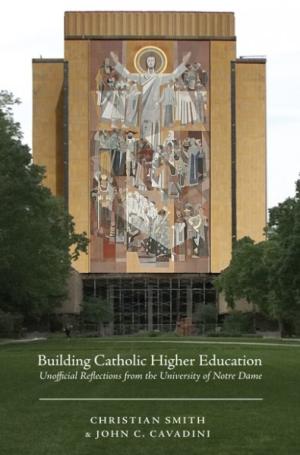
In this slim volume, Christian Smith, a sociologist of religion on the faculty of the University of Notre Dame, takes on a pivotal question for the future of Catholic higher education: faculty engagement with Catholic intellectual tradition. Exploring the convergence of Notre Dame’s three strategic goals – to provide an unparalleled undergraduate education, to gain recognition as a globally premier research university, and to remain thoroughly and distinctively Catholic – Smith brings into sharp focus two fundamental issues: (1) that any faith-grounded university’s capacity to fulfill its mission rises and falls on the knowledge, quality, and dispositions of its faculty; and, (2) that Catholic universities must wrestle with how their faculties engage Catholic intellectual tradition in their academic disciplines. His wrestling with these issues makes the book worth reading for anyone involved in faith-based higher education. In the first chapter Smith lays out the texts from which he will work: the University of Notre Dame’s mission statement, Fr. John Jenkins’ inaugural presidential address, excerpts from Jenkins’ annual addresses to faculty, and Provost Tom Burish’s letter announcing a committee to explore hiring outstanding Catholic faculty. In four subsequent chapters Smith details the assumptions behind these texts with their implications for faculty; elaborates a range of ways that faculty, whether Catholic or not, can support Notre Dame’s mission; proposes what the pursuit of social science disciplines might entail in a context where Catholicism matters; and, takes a hard look at whether it is possible for Notre Dame, or any other faith-grounded university, to pursue three goals simultaneously – unparalleled undergraduate education, premier research status, and robust engagement with the Catholic thought across all disciplines. (He doubts that it is.) A paper by John Cavadini on the role of theology in a Catholic college or university serves as the appendix. Smith’s dialectical approach emphasizes boundaries. He asserts that universities “cannot meaningfully call themselves ‘Catholic’” unless “Catholicism as a distinctive approach to life and the world” significantly influences intellectual inquiry, scholarship, and teaching; initiatives in valuing social justice or in spiritual formation will not suffice (65). His chapter detailing the “tensions, trade-offs, and dangers” involved in attempting to achieve excellence in undergraduate education and premier research status “in an institutional, cultural, and pedagogical context that is robustly Catholic” is refreshingly practical and pragmatic (78). Smith recognizes the challenge involved in an academic department attempting to maintain coherence with some faculty focused on teaching, others on research, and still others on Catholic dimensions of a discipline. At points Smith is nostalgic for an era when Catholic universities were Catholic by virtue of their enmeshment in the webs of a subculture. He is far more anxious about the prospects for maintaining the Catholic character of universities than is John Haughey, S.J., whose Where is Knowing Going? The Horizons of the Knowing Subject (Georgetown University Press, 2009) offers an alternative, analogical approach to the question. Still, Smith makes his case that Catholic universities cannot maintain a robust Catholic identity without a critical mass of faculty members who both understand and engage Catholic thought and life critically and faithfully. Read together, Smith and Haughey could animate a vital conversation in which Catholic college and university faculties need to participate.
Lois J. Zachary and Lory A. Fischler’s Starting Strong is an accessible book that has varying use depending on one’s institution. The book is composed in two sections. The first is a fable situated within a large corporation that has multiple divisions and an official mentoring program. The main characters are Cynthia, a VP of Marketing and Communications, and Rafa, a newly hired financial analyst. The fable follows them through six mentoring conversations and maps their mutual development. The second section is a summary and strategy for having those same conversations in your own mentoring relationships. Zachary and Fischler’s writing is easily absorbed and their ideas about mentoring presented in the form of a dialogue allow readers to imagine themselves in similar conversations whether they are a mentor or mentee. Scholars who are in institutions with formalized mentorship programs may find this to be a helpful book because it can assist with structuring early mentorship meetings, setting boundaries and goals, and setting the stage for both mentors and mentees to benefit from a mentoring relationship from the beginning. Starting Strong’s weakness for those teaching and learning in Religious Studies and Theology is that the book’s corporate setting results in some mentoring relationships that are hard – if not impossible – to copy to the relationships in which most professional academics will engage. For example, Cynthia has no power over Rafa. She is only a mentor, there for his development. This model excludes the teacher-student relationship in which mentoring takes place -- where assessment is a significant obstacle to overcome toward building rapport with students. So long as teachers hold the power to evaluate students, then the mentorship relationship Zachary and Fischler imagine does not happen in academia. By the same token, unless your institution has a formalized mentorship program that explicitly takes people out of their colleges and departments and into relationships with people in other faculties, the risks to tenure and promotion from a mentor who works closely with one’s supervisors does not allow for the kinds of open exchanges and risks Cynthia and Rafa take in developing Rafa’s leadership skills. Zachary and Fischler did not write this book for academics, but if academics are going to think about mentorship and the development of students and faculty then the question of how that might be done within higher education’s hierarchies needs to be asked. It is worth the time to think about how to formalize mentorship programs into specific institutions – both for students and faculty – and this book can help once those programs are implemented. For those who are looking for a book that can help start the process of mentoring someone, including graduate students, then this is a useful book to mine for ideas, especially the second section in which the authors summarize the conversations one needs to have to achieve mentoring success in the first ninety days. I recommend Starting Strong as a resource for graduate student supervisors, but its assumptions do not translate as well into undergraduate mentorship.
Andrea R. English’s Discontinuity in Learning re-links the work of Johann Friedrich Herbart with that of John Dewey. Dewey criticized Herbart’s work, causing, English argues, future critics to separate Dewey’s thought from its European predecessors (xx). English argues for continuity, that both thinkers want to identify and develop ways “for learners to recognize and respond to the other in judgments and actions” (104), through the experience of discontinuity. English’s excellent analysis of Herbart focuses on discontinuity, offering frameworks to analyze educational theories and practices that ignore discontinuity and reconnecting Anglo-American and Continental philosophies of education (xxiii-xxiv). I cannot do justice to this rich book here. I will focus on its main idea: education as discontinuity. English examines Herbart’s analysis of the educational possibilities in his contemporary’s (Kant’s) Categorical Imperative. To act so as not to treat others as things and as any other ethical person would act, one engages in moral choice. Herbart argues that educators can work with the experience of the discontinuous that emerges in encounter with the “other,” identifying where a learner already acts out of inner freedom (46) to move that learner to greater freedom, the capacity beyond “self-interested desires,” in recognition of and respect for the other (7). Discontinuity causes a pause (34) at the limits of one’s abilities and/or knowledge (xxii). This “in-between” (Dewey), “distance” (Herbart 16, 27), or “break” (English, 17) is a site of struggle (59) to transcend a limit. There, the learner can “identify and potentially change” her relation to the other (65). A teacher does not choose for the student, but designs an intellectual experience, to use Donald Finkel’s term, to scaffold the struggle (17), while, simultaneously, being open to improvisation on the design. Dewey agrees with Herbart: discontinuity is to “undergo or suffer the world” that upsets stable understandings (66), a starting-point for reflection (68). In learning, teacher and student struggle together in ongoing “critical self-relation.” For Dewey, the classroom is not just a site of moral struggle but of democratic action (89). Arriving at the social, as well as personal, “limits of thought and ability” (102), one learns, potentially, to choose for the good of all. Both the classroom and democratic society should support the deep learning that ensures freedom. For Dewey and Herbart, the goal of learning is right orientation to the other (105) through disorientation and reorientation, guided by the teacher who listens intently and generates dialogue, moving students to greater inner freedom and just action. The skilled teacher deploys “pedagogical tact” (50ff, 126ff.), discerning when to intervene in student learning and when to improvise (129) on the learning design. Neither teaching nor learning, therefore, can be determined as complete in outcomes and measured fully by evaluations. Nowadays we experience such “urgency” (55) about measures that we want to “predetermine” and “guarantee” learning (156). English argues, instead, for cherishing the discontinuous and valuing the improvisational space of the classroom in which teachers “acquaint the next generation” with their present world and prepare them for a “future yet to be discovered” (160).

National and global cultural constructs are changing faster than ever, oftentimes faster than those who educate can keep apace of. The challenge presented in this volume is clearly stated in Haynes’s introduction: Education leaders “must accept responsibility for accessing and mobilizing all available resources to support students’ total development and for demonstrating that they are making a significant and measurable positive difference in turning present educational trends around” (viii). A popular mantra of leadership theory as first proposed by James McGregor Burns, John Maxwell, and Max De Pree, and later repopularized by Jim Collins, Malcolm Gladwell, Chip and Dan Heath, and Michael Hyatt, is that leaders are responsible for creating organizational culture. Therefore it is imperative that educators, both those who are currently in leadership positions (discipline chairs, principals, superintendents, school board representatives, and so forth) and those who aspire to leadership positions, take seriously this challenge of creating a culture for effective learning by demonstrating that they are effective leaders and worthy of being followed. Following the challenge-laden Introduction, the volume is divided into three sections, with each section focusing on a different aspect of educational leader development. Each section opens with a short introduction from one of the editors. The first section (chapters 1 to 4) focuses on “core knowledge” elements for teachers and educational leaders, such as public policy (chapter 1), Knowles’ theory of self-directed andragogy (chapter 2), Goleman’s theory of emotional intelligence (chapter 3), and education as social justice (chapter 4). The second section (chapters 5 to 9) focuses on professional development for educational leaders, such as developing an ecological framework for the educational setting (chapter 5), leading educational reform (chapter 6 and 8), developing a global perspective on education (chapter 7), and seeking continuing education once on the field (chapter 9). The final section (chapters 10 to 14) suggests strategies for improving the learning experience, such as utilizing applied research (chapter 10) and program evaluation (chapter 11), developing a multicultural approach to learning (chapter 12), and implementing balanced curriculum (chapter 13) and technology (chapter 14) into the teaching model. This volume would be most applicable to a course in educational leadership development. It certainly draws from the wealth of the experience provided by the contributors. It is most appropriate for elementary and secondary educators and educational leaders (and those who instruct in that field). However it does have value for those who teach in other disciplines at the undergraduate or graduate level. I found the chapters on policy and balanced curriculum to be most helpful. There are a couple of concerns that should be noted: First, while it is subtle, there is a tinge of socialist rhetoric used throughout the volume. It is most prominent in chapter 4 where the co-authors equate social justice with socialist reform. Second, there is a sense of almost blind acceptance, despite the growing amount of evidence-based literature to the contrary, of Common Core standards throughout the book. Both of these concerns go hand-in-hand and should be considered by the prospective reader.
Ralph Brockett has spent his career on the leading edge of adult learning theory and practice. He is widely published, a master in the classroom, and – having been inducted into the International Adult and Continuing Education Hall of Fame in 2005 (among other accolades) – has earned the respect and admiration of his peers. In Teaching Adults: A Practical Guide for New Teachers, Brockett takes the posture of a caring mentor to provide a succinct and accessible introduction to the dynamic field of adult learning. His style is conversational, his expertise evident, and he is clearly most interested in helping to equip you, the teacher, with very practical advice for teaching adults in a wide variety of formal and informal learning contexts. Teaching Adults is written for a variety of readers. Brockett suggests an audience that may include a professional tasked with offering a training session in her field, a layperson asked to teach an adult Sunday School class, and a scout leader needing to orient a cadre of adult volunteers. In addition, the book is applicable to those who may not primarily think of themselves as teachers, but who nevertheless spend a fair amount of time teaching – such as ministers, social workers, and health care professionals. Further, higher education professors and instructors will find this book valuable. As Brockett rightly points out, these educators are not always equipped to meet the unique needs of an ever-increasing population of adult learners. Finally, this book can benefit graduate students in the field of adult education, helping to further define and map the foundational concepts of adult learning. Teaching Adults is organized around a simple formula: effective teaching leads to successful learning! To illustrate this, Brockett weaves together (1) seven essential attributes of effective teachers and (2) four keys to effective teaching. To describe the qualities of effective teachers, Brockett continually reinforces seven characteristics: trust, empathy, authenticity, confidence, humility, enthusiasm, and respect. Attending to these essential qualities has a distinctive impact on the success of an adult learning event. Similarly, the four keys of effective teaching (know the content, know the adult learner, know about teaching, and know yourself) help to steward learning for maximum transfer and impact. Especially helpful in processing these concepts are the end-of-chapter “think about it” exercises and focused listings of additional resources. Teaching Adults is an accessible and valuable primer. New and seasoned teachers alike will find practical resources for honing their skills, whatever their educational context. As a basic, introductory text, this book is not peppered with citations and endnotes; however, its bibliography serves as an essential reading list for those new to the field of adult learning theory. I would venture to suggest one drawback: despite its focus on new teachers there is a noticeable lack of discussion of new and emerging learning modalities (such as online environments). The concepts from the book are certainly applicable to all forms of teaching and learning, but an explicit mention of how these could be worked out in the online environment would have reflected the educational learning experiences for many new teachers and learners. The book does contain a self-made remedy, however. The end-of-chapter reflection questions provide teachers from any background with the implicit wisdom needed for addressing the diverse and ever-changing landscape of teaching and learning.
Arminio, Grabosky, and Lang (2015) provide a comprehensive overview of student veterans and service members from interviews and analyses of higher education institutions. This book speaks from history and experience of the U.S. military to present outreach opportunities for the modern reader. The best audience for this book would be higher education administrators and counselors because it primarily discusses the challenges of transitioning to student life in higher education. More importantly, the authors consider the life of the students beyond school, what the students have seen, the makeup of the military world, and how it sheds light on this one. The study consisted of semi-structured interviews of sixteen higher education employees and fourteen students, and included a military spouse, and students at a community college and a public research-intensive institution with multiple campuses. Although this is a small set from which to draw specific conclusions, the volume provides valuable insights about service veterans and members enrolled in higher educational contexts. Student veteran and service members did not have direct support services at the research-intensive institution until after 9/11. The book documents how this change came about when students organized themselves and the campuses responded. The authors provide helpful lists of behaviors of facilitation (53) and advocacy of the student (61) and the system (65). Drawing on an advocacy model put forth by Lewis, Arnold, House, and Torporek (2002) of the American Counseling Association, Arminio, Grabosky, and Lang describe best practices in higher education for this target student group. For example, there should be regular review of degree progress corresponding to military financial benefits and possible deployment. The authors also give weight to possible needs for counseling and disability services. The three predominant cultural transitions between the military and higher education are the loss of collectivism, hierarchy, and masculinity. According to the study, student veteran and service members perceive themselves as outsiders in this environment (105). At the same time, "the military experience influences the college experience, but how it does depends on the individual and his or her experiences and contexts" (106). While the U.S. military is historically less tolerant of the LGBT community, one student participant in the study who identified as a lesbian felt accepted by her military colleagues (107). Higher education could further offer her the advocacy available at campus LGBT resource centers (89). If we continue to take her example, she still might find the individualistic culture of academics as a source of isolation when she once found quick comradery in the military world. A few of the interviews in the study mention that academics are a source of concern because they differ from the hierarchy and structure of the military in their exercise of power as teachers, with one person commenting that they prefer instructions for assignments to be more direct about resources and expected outcomes. A lack of specific directions can be disconcerting to past and present military-related students. Although the book gives insight into specific teaching styles for student veterans and service members transitioning into higher educational contexts, it does not offer as much as it might. On the whole, the book is geared toward the student as a part of the higher education community.