Book Reviews
This bookadvocates civic engagement and service learning in higher education to provide students with transformative learning experiences. Linking service learning with online learning the authors present eService-Learning – a high-impact modality of learning for the twenty-first century. Contributors to the volume present research on teaching and learning as it relates to eService-Learning and provide best practices on how to incorporate eService-Learning experiences in courses and curricula. Divided into three parts, the first part of the book consists of four chapters setting forth “Essentials, Components, and Nuts and Bolts of eService-Learning.” Contributors present a rationale for civic engagement and service learning in higher education (7-19) and provide theoretical foundations for service and experiential learning, coupling both theory and practice to the emerging field of online learning (20-39). Authors guide readers in creating syllabi and learning experiences that facilitate the development of aptitudes and skills for service in online courses (40-57) and address the technology requirements for implementing eService-Learning (58-66). The second part, “Models for eService-Learning,” introduces readers to five different models for implementing eService-Learning as illustrated by universities that have implemented it at course or program levels. Models described leverage online and on-site learning in the following ways: (1) instruction online, service-learning on-site (69-88); (2) e-portfolio and reflection online, instruction and collaboration with service partners in class (89-104); (3) instruction and service partially on-site and online (105-118); (4) instruction and service conducted online (119-129); and (5) a mixed hybrid of models (130-143). Research in part two provides a critique and analysis of these five models of eService-Learning and step-by-step guidance for implementing each model. The third part, “Next Steps And Future Directions” provides advice to administrators and faculty interested in implementing eService-Learning at the course or program level. The first of two chapters describes the challenges that universities face if they question the relevance of higher education. The author skillfully argues that eService-Learning can reassert the relevance and worth of higher education in the twenty-first century (149-163). The final chapter expands the horizons of eService-Learning beyond the borders of higher education, suggesting possible applications for K-12 education, workplace training, learners with disabilities, and senior adults (164-166). This book is to be commended for articulating a rationale for including outcomes related to civic engagement and service-learning in higher education and best practices for using online technologies to implement eService-Learning in courses and curricula. A conspicuous strength is the description of various eService-Learning models. As such, the volume is particularly valuable for faculty and administrators in higher education.
Neuroscience is a burgeoning field, and Kathleen Taylor and Catherine Marienau mine it skillfully to craft Facilitating Learning with the Adult Brain in Mind. This book is not structured like many teaching books – it begins, after all, with a drawing of “The Theater of Knowing,” to which the authors refer throughout. But to write it off because it is unfamiliar would be a mistake – this is a valuable book for any teacher of adults, no matter the subject. Taylor and Marienau had been searching for a book that would “describe in language accessible to non-neuroscientists… how the adult brain works and also how to use this understanding to construct more brain-aware approaches that help adults learn and perform more effectively in diverse settings” (ix). Eventually they discovered that “the book we wanted to read was the one we would have to write” (x). Readers are the beneficiaries here; the research is fresh, the applications diverse, and Marienau and Taylor model brain-aware approaches in how they structure the book. Part One distills brain science for the lay reader. For example, we learn that anxiety and curiosity function simultaneously in the brain, and good teaching should both stimulate the curious brain and reassure the anxious brain. “The science in Part One is grounded in brain research; however, we frequently use stories and metaphors to illuminate technical ideas. In similar fashion, we often describe the brain and its functions in analogical rather than anatomical terms,” the authors describe (xv). Part Two sets forth an array of practices – embodied, metaphorical, verbal, theoretical, and more – to enhance adult learning. Taylor and Marienau interviewed a number of practitioners whose best practices are illustrated here. Part Three brings theory and reflection into dialogue with both the neuroscience from Part One and the practices introduced in Part Two. “Rather than begin our book with theory, which is typical, we first illuminate practice in part Two because… theories are more meaningful when the brain can connect them to concrete experiences” (xvi). Key ideas are reviewed at the end of each chapter; visual illustrations and boxed examples enhance and expand on ideas introduced in the main text. The authors suggest additional reading at points, rather than devoting too much time to subthemes. They also provide opportunities for reflection at the conclusion of the chapters, encouraging readers to draw or sketch reflections as a way of accessing different brain functions. At various points, the reader will experience recognition: “Ah, that’s why this happens.” Other sections will inspire new approaches to try. “Without necessarily identifying them as such, many experienced facilitators use embodied, analogical activities in their workshops, classes, or coaching and consulting settings because they have found them to greatly enhance adults’ grasp of key concepts as well as their own practice” (175). Many college and seminary professors, by contrast, were never trained in teaching. Sections on multiple intelligences and Kolb’s model of experiential learning, then, offer an added boon to readers with less experience in educational theory. Parenthetically, reviewing this book was so influential that it has now become assigned reading for all adjunct faculty in a department to which I recommended it.
Experiential Education in the College Context provides a useful introduction to both the theoretical underpinnings and the practical application of experiential education. Roberts, Associate Vice President of Academic Affairs and Director of the Center for Integrated Learning at Earlham College, writes out of his experience as a faculty member, administrator, and philosopher of education. His volume is well-equipped as a guide for leaders in higher education interested in “harnessing the power of the live encounter between students and teachers” (xi). Roberts divides the volume into two main sections, the first covering theoretical aspects of experiential education and the second exploring its practical facets. Each section is comprised of four chapters. Chapter one introduces the reader to the current educational landscape, noting that it is not merely a time of “disruption and destabilization,” but a time of “tremendous opportunity” (18). Chapter two defines experiential education, teasing out some of its many implications through three curriculum models. In chapter three, Roberts sorts experiential education models into “four core methodologies”: active learning, community-based learning, integrative learning, and problem and project-based learning (63). Chapter four identifies models such as the seat paradigm and the teacher as expert paradigm that educators should leave behind as they embrace an experiential approach. In chapters five through eight, Roberts shifts to the practical application of the theoretical principles discussed in the first half of the book. Chapter five considers design, chapter six facilitation, chapter seven assessment, and chapter eight the integration of experiential education in the college classroom and across the campus. Finally, the Afterword places experiential education in the wider world of the academy, and an Appendix offers a reference list for a variety of experiential education programs. My one critique – and it is a small one – of Roberts’s work is that he quotes too many secondary scholars at length. Block quotes fill the pages and definitions abound. The volume would have been infinitely more accessible had he compiled the many definitions in a glossary in the back of the volume and confined his extensive dialogue with other scholars to the footnotes. Still, Roberts’s volume provides rich descriptions of the variety of practices that fit under the experiential education umbrella and offers useful examples for incorporating these models in the classroom. In short, the text offers a fine introductory resource. Roberts wrote this book “for students who wish to learn more about the theoretical concepts behind the approach, for faculty who might be interested in what experiential education looks like in practice, and for administrators trying to respond programmatically and creatively to a rapidly changing landscape in higher education” (xi). While I am not convinced that many students will wade through its theoretical waters, the volume does address the needs of faculty and administrators investigating the possibilities that experiential education offers. I will carry Roberts’s image of “teachers as curators of experience” rather than “content providers” with me for a long time (81).
The Council for Undergraduate Research (CUR) wonders why undergraduate research (UR) – which has been shown to increase student retention, graduation rates, and post-graduation achievement – is not practiced more broadly. What can be done to encourage this pedagogical shift? This book advances the cause by providing a reference for academic decision makers showing the benefits of UR, featuring systems and consortia that have successfully implemented the practice. CUR has championed undergraduate research from 1978 to the present, through publications, awards, and outreach activities, such as holding workshops for consortium leaders. This book is an overview of a series of workshops in which six particular systems and consortia participated. There is a chapter from each workshop with a synopsis of their UR experience and a focus on distinct aspects. The workshop participants included: California State University System (CSU), University of Wisconsin System (UW), the Council of Public Liberal Arts Colleges (COPLAC), Pennsylvania State System of Higher Education (PASSHE), City University of New York System (CUNY), and the Great Lakes College Association (GLCA). The editors arranged the volume so that the first chapter provides an introduction to CUR and the workshops that brought these groups together, providing a context for the book with specific topics following. Chapter 2 introduces the effective system/consortia practices found across the six groups in focus. Chapters 3 through 8 focus on the experiences and successes of these particular groups. Chapter 3 highlights the increased success of underrepresented students through UR at CSU and Chapter 4 illustrates how at UW it positively affected economic development in the region. Chapter 5 considers the impact on faculty workload and compensation at COPLAC, while Chapter 6 addresses meeting fiscal and enrollment challenges through successful institutionalization at PASSHE. In Chapter 7, CUNY shares their funding strategies, with Chapter 8 revealing how GLCA incorporated research skills into their curriculum. The book concludes with Chapter 9, which considers which aspects of UR belong at the campus level and which are better suited for the systems and consortia. This compilation reveals how challenges such as faculty and administrative support, funding, and changing institutional culture can be overcome through creating UR system leaders and strategic plans. In these examples, this was accomplished through CUR workshops, outside funding, community support, successful program branding, UR offices, and by providing consistent and meaningful communication to stakeholders. By having the six different groups share their own challenges and strategies, the book successfully models the viability of UR and provides concrete examples others can build on to create their own programs. An additional strength is also a weakness – the compact nature of the book is appreciable, but leaves the reader wishing that some of the topics had been expanded. This work is an invaluable resource for higher education decision-makers considering whether to incorporate or expand UR on their college campuses, as they consider creative and attainable solutions to the changing academic landscape.
What is “religion”? Many would argue that religion is the single most important element of a person’s existence: “I am [Christian, Buddhist, Jewish, et cetera] and my understanding of reality is predicated by my religious affiliation.” Others would argue that it is nothing more than a sociological aspect of a person’s existence. “I am [Christian, Buddhist, Jewish, et cetera], and it is important to me in the same way that my Irish, Indian, or Russian heritage predicates my social interactions.” On one hand, we have persons who understand themselves within the context of their religion. On the other hand, we have persons who understand their religion within the context of themselves. Yet, how does one define religion? One definition that I have found helpful for many years is from Winfried Corduan’s tome Neighboring Faiths: “A religion is a system of beliefs and practices that provides values to give life meaning and coherence by directing a person toward transcendence” (InterVarsity, 1998, 21). This definition provides a simple construct for understanding what religion is and what it does without taking sides. Whether one is on the devout or the affiliated end of the spectrum, people might generally agree that the purpose of religion is to teach people values that will give life meaning. The next question, then, is how should students in higher educational classroom contexts study religion? Talk about a tricky wicket! Any student of religion is going to have shelves of books that all make the same claim – this one has the answer! Some offer tremendous analysis on the all-encompassing and captivating nature of religion. Others provide summative studies of various religions that may stir the reader’s appetite for meaning and transcendence. Still others provide a sociological approach to the study of religion, a field manual for understanding why persons cling to religious belief and practice that belief as they do. Authored by religious studies professors Stephen E. Gregg (University of Wolverhampton) and Lynne Scholfield (St. Mary’s University, Twickenham), Engaging with Living Religion offers a practical introduction to the field study of religion. The intention of the book is not to develop religious ideation or affiliation in its readers, but to provide a professionally-appropriate way for researchers to analyze and comprehend why Christians pray with their eyes closed, why Muslims pilgrimage to Mecca, and why Jews light a menorah. While this last statement may sound simplistic, it is anything but – each of these actions are essential expressions of that religion and, as the authors argue, one cannot understand Christianity, Islam, Judaism, or any other religion without understanding the liturgy and locations that provide structure to the world’s religions. Designed as a guide for the fieldwork student (or as a study companion in a lecture course on religious sociology), Gregg and Scholefield create not only a keen eye for studying religion but also a deep respect for religious adherence. Although the volume does take more of a sociological stance – religion is more akin to a social activity or organizational membership than a guiding force for one’s life – the authors keep the idea that religion is living ever before the reader/researcher. Each chapter is bursting with sidebars, such as passages from foundational readings or case studies, discussion questions, recommended bibliographies, and websites for further research. Although this is a book about the study of religion, one thought comes through subversively on every page – Religion, however it is defined, is living and active, and it provides meaning and direction to individuals seeking transcendence. Therefore, treat it with care and respect. Overall, I found this volume to be both intriguing and engaging. In addition to a chapter that advocates why studying religion is important, there are chapters on where to study religion, how to study religion through class field trips or study-abroad programs, how to use case studies and social media to understand religion practically, and how to develop an ongoing appreciation for the sociological study of religion. My recommendation would be that this volume be read alongside a more extensive volume on ethnography. Van Maanen’s Tales of the Field (University of Chicago, 2011) or Emerson, Fretz, and Shaw’s Writing Ethnographic Fieldnotes (University of Chicago, 2011) would constitute good choices.
Sherry K. Watt has assembled talented “conscious scholar practitioners” to address the growing need to design university policies, programming, and classroom pedagogies that address difference. This book addresses both the theoretical and practical aspects of multicultural teaching. As the preferred term “conscious scholar practitioners” suggests, both aspects are vital for developing multicultural policies and teaching practices. Watt explicitly places the book within the model of radical pedagogy most commonly associated with Paulo Freire’s Pedagogy of the Oppressed and bell hooks’ conception of teaching for liberation. The challenge of the book is to translate the theoretical principles of this tradition into policies that shape institutions and to provide practical models for how these principles can be actualized on today’s university campuses. The book is organized into four parts. The first part lays out the guiding principles for transformative multicultural initiatives. Here the main terms found throughout the volume are laid out clearly and the general theoretical ground is set. Part two moves to the practical question of design and provides helpful tools that should be used during the beginning phases of design as well as how best to evaluate such programs at their conclusion. Since assessment is often difficult to conceive of in the midst of radical pedagogical models, this section struck me as particularly helpful for navigating such a pedagogy within the managerial space of the contemporary university. Part three provides six case-studies in which conscious scholar practitioners present their own programs. This is a valuable section because of the examples given, but perhaps most importantly because they offer valuable lessons learned in their unflinching self-analysis of their programs. Part four provides important reflections on the institutional challenges that exist for those trying to carry out the programs advocated and modeled in the volume. While reading this chapter I had hoped for more constructive advice for dealing with the various forms of institutional and individual resistance to multicultural initiatives, but many of the stories in these chapters highlight the main forms of resistance to radical pedagogical models in the contemporary university. This volume is not specifically directed towards educators in theology and religious studies. However, all of the chapters are intended to be adaptable to various contexts. For those scholars who want to deepen and center difference in their classroom and across their university this book strikes me as incredibly valuable. For departments of theology and religious studies seeking to form stronger links with other departments, staff members, and administrators, this volume can provide a common vocabulary and methodology. The volume may in fact be most valuable as a model that can facilitate interdisciplinary work as special attention is paid to multicultural initiatives within the physical and mathematical sciences. These fields are often neglected in radical pedagogy models, but as theologians and scholars of religion are encouraged to carry out more interdisciplinary teaching this volume may help frame such work within radical pedagogical models.
This book poses a central question: “What can Cultural Historical Activity Theory (CHAT) contribute to the solution of the problems facing higher education today?” For faculty teaching in theology and religion, there are further questions: do faculty agree on what the authors propose are higher education’s problems? Is CHAT theory valuable as an organizing resource in our field? And if so, is this the book that will be most useful to faculty for their work? Wells and Edwards have assembled contributions from scholars from all over the world, many in education and many with some interest in sociocultural approaches to teaching and learning. They take a long view on changes in higher education: “[I]n the past two centuries, there have been several specific changes in the ways higher education has been expected to perform its functions for the benefit of the larger society” (1). For example, higher education now functions more like a business than it has in the past (which diverts faculty energies to grant-writing and its associated research). There is more student diversity, although “several categories of young people are still largely excluded” (3). In larger universities, huge class sizes create teaching that amounts to little more than “delivering the curriculum” – which then affects not only pedagogical strategy, but student learning outcomes as well. The editors call for different kinds of pedagogy to meet the new kinds of learning that are needed, such as active learning, undertaken in collaboration with others, in which relationships, emotions, and motivation are taken into consideration as much as cognitive dimensions (4). Higher education should be “not only a preparation for a career but also a basis for lifelong learning as an informed and engaged contributor to the wider society” (4). The book has two main sections. The first section is focused on teaching and learning, the second on “relations between institutions of higher education and the professions for which they prepare their students” (12). This is where some of the disadvantages of this text for theological educators become apparent. First, there is a heavy emphasis on undergraduate education – and enormous lecture classes are not necessarily the context in which most teach. Second, the lens through which educational trends and needs are explored is a somewhat esoteric theory (CHAT) not widely discussed in theological education circles. Finally, the majors the authors use in their examples are not related to theology and religion. When a book costs as much as this one, it needs to be worth the cost. For most faculty in theological institutions, this is probably not the best investment to make. That is not to say this is not a good book; it simply is not the best investment when choosing teaching resources tailored for theological school contexts.

This is a book finding its time, perhaps just in time. A sequel to Microaggressions in Everyday Life: Race, Gender, and Sexual Orientation (2010), Race Talk and the Conspiracy of Silence offers the fruits of a ten-year period of research and observation of participants engaged in difficult conversations on race, racism, Whiteness, and White privilege. The purpose is fivefold: (1) to uncover the reasons that race talk is difficult, (2) to expose the explicit and hidden rules that govern how race is discussed in U.S. society, (3) to illuminate the detrimental consequences of a failure to honestly dialogue about race, (4) to outline the benefits of successful conversations on race, and (5) to propose solutions in overcoming obstacles to honest racial dialogues (xii). Sue accomplishes this purpose with clarity of style and balanced tone. The first section defines race talk, its characteristics and dynamics, and then explores in chapter three the conflicting race realities in White Talk and Back Talk. “Race talk is truly a clash of different racial realities in which people of color and Whites perceive race issues in opposition to one another” (xiii). Through vignettes, questions, and psychologically adept analysis, Sue offers a compelling view of the ideological, psychological, and historical factors that do create radically opposed racial realities. He gently uncovers the realities whites are disinclined to see, and demonstrates the lived realities of people of color – all while shaming none. I particularly valued his argument for and demonstration of the importance of emotions in the classroom, with any redress of race talk requiring truly receiving and sitting with the wisdom that arises within emotional connection and disconnection. The second section highlights the hidden ground rules embedded in society, academic settings, and one’s self that serve as barriers to honest race talk. Here you can find guidance and modeling for academic habits that consistently cloak racial realities. The third and fourth sections address, separately, why it is difficult to honestly talk about race. For people of color, “What are the consequences for saying what I mean?” and “To speak or not to speak, that is the question.” For whites, “I’m not racist!” and “I’m not White, I’m Italian.” Group considerations are also examined, difficult dialogues between groups of color. The final section invites reflection by parents and teachers talking about race with children; namely, “taking responsibility for change means overcoming the inertia and feeling of powerlessness on a personal level” (214). Racial awakening happens in encounters that challenge preconceived notions, so Sue encourages such encounters with guidelines: (1) learn about people of color from sources within the group; (2) learn from healthy and strong people of the culture; (3) learn from experiential reality; (4) learn from constant vigilance of your biases and fears; and (5) learn from being committed to personal action against racism. To encourage you to get the book, I particularly appreciated Sue’s list of ineffective strategies, “Five Things Not to Do,” followed by eleven potentially positive actions. A lengthy volume, Race Talk and the Conspiracy of Silence should be required reading for educators of all levels.
Part of the series “New Directions for Adult and Continuing Education,” Meeting the Transitional Needs of Young Adult Learners is the first entry to address young adult learners in thirty years. As such, it is a welcome contribution to the series, as well as a valuable resource in its own right. Faculty teaching traditional undergraduates, as well as those in continuing and adult education roles, will find much of value here. The terms “young adult” and “youth” are used across the essays in the volume, though without a single common definition. Generally, “young adult” refers to individuals from ages eighteen to twenty-five, though with some flexibility on both sides; adult education may begin at sixteen, as Davis notes (chapter 6). Chapter 1, by Joanna Wyn, introduces several key concepts that recur in subsequent chapters. Wyn offers a nice overview of the scholarship of youth transitions, new adulthood, and age. She argues that the “metaphor of transition” — a frequent feature in discussions of young adulthood — should be replaced with a “metaphor of belonging” that emphasizes relationships and connections (9). Indeed, many of the following chapters take up this call for an emphasis on relationships and belonging. Chapters 2 through 8 follow a basic model of identifying a specific community, reviewing the literature, data, or relevant theoretical work relating to that community, and concluding with suggestions for instructors. Thus Brendaly Drayton (chapter 2) introduces and theorizes cultural difference, with special attention to ethnic difference and the experience of young adults positioned in multiple cultures. Drayton encourages instructors to use texts from a range of cultures as well as collaborative learning practices. Rongbing Xie, Bisakha (Pia) Sen, and E. Michael Foster (chapter 3) offer a similar introduction to “vulnerable youth,” a broad category that encompasses socio-economic disparities, mental health, welfare, and involvement with the justice system. Noting the problem of youth who “age out” of social services, they call on educators to be informed and competent allies for vulnerable youth and to provide social support. Jessica Nina Lester (chapter 4) makes a similar argument with respect to “youth with dis/ability labels.” The pedagogical emphasis in these chapters is on the affective and relational, encouraging instructors to engage beyond course material. Steven B. Frye’s contribution addresses young adults in faith communities (chapter 5). Instructors in confessional contexts may find his insights helpful; in other contexts, less so. The final three chapters are the work of the editors, C. Amelia Davis and Joann S. Olson. Davis (chapter 6) discusses adult education programs as they serve young adult learners, and offers some helpful suggestions for strengthening these programs. Olson (chapter 7) takes up the transition from school to workplace, arguing that educators can intentionally create classroom and school experiences that prepare students for, and ease the transition to, the workplace. She also offers a number of useful examples, including discussing class assignments. A final chapter by Olson and Davis (chapter 8) offers a concise overview of key themes from the preceding chapters. This is a valuable collection of essays, which much to offer all educators working with young adults.
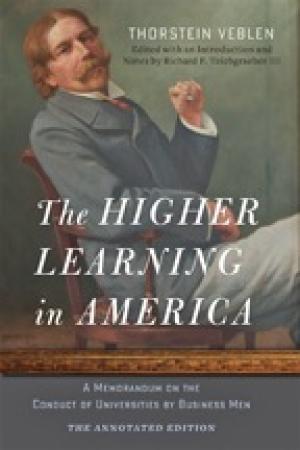
While often repeated, at least by scholars of the original 1918 document, it bears retelling here that the original subtitle of Thorstein Veblen’s The Higher Learning in America was “A Study of Total Depravity.” And while such language was sanitized for publication the author’s irritation with the “bootless meddling” of governing boards and the “skilled malpractice” of university presidents, was no less strident and prevalent throughout his text. The recently published, first-ever annotated edition of Veblen’s important – and, unfortunately, still timely – report put this reviewer in mind of much more recent such studies, and thus will be reviewed here in the context of these recent contributions to what Veblen called “the professors’ literature of protest” (for example, see Ginsberg [The Fall of the Faculty, Oxford University Press, 2011] and Menand [The Marketplace of Ideas, Norton, 2010]). Richard F. Teichgraeber’s excellent “Introduction,” as well as his editorial notes throughout, make this timeliness clear. Veblen retrospectively joins a host of prominent scholars who have engaged a broad institutional critique of higher education, and he was by no means the first to caution against the threat to the American university’s independence, by its uncritical adoption of the methods – and its serving the needs – of the business community. In this Veblen presages the pessimistic diagnosis of American undergraduate education offered in 1996 by the late Bill Readings in his much-quoted University in Ruins (Cambridge, Mass., Harvard University Press), in which the author excoriated the contemporary American “corporatized” university as a “ruined institution” hopelessly “enmeshed in consumerist ideology” (Veblen’s “salesmanlike proficiency”). Many have since echoed this sentiment, not least among them Harvard professor, James Engell, who in 1998 painted a similarly discouraging picture of the current state of affairs for undergraduate study, calling particular attention to higher education’s rush to fall in line with business and government calls for greater “relevance,” “application,” and “preparation for working life” outside the academy – all measured by metrics of cost, efficiency, and productivity. In an article entitled “The Market-Model University: Humanities in the Age of Money,” (Harvard Magazine) Engell cites persuasive evidence that economic pressures have negatively, if not irrevocably, impacted American collegiate education – for instance, declining enrollments in traditional liberal arts disciplines,with the corresponding reality for faculty equally gloomy: the lowest faculty salaries compared to colleagues in the pre-professional disciplines (full-throatedly denounced by Veblen), the most onerous teaching loads (“notoriously underpaid and so scantily filled as seriously to curtail their working capacity,” according to Veblen), and the least academically prepared and intellectually engaged students. Such a move toward “aggressive mediocrity,” with faculty “managed according to the principles of the consumer-driven marketplace,” as Veblen put it in 1918, has resulted, as essayist and critic William Deresiewicz would have it, in American higher education “slouching toward a glorified form of vocational training” (“Faulty Towers: The Crisis in Higher Education,” The Nation, 2011). “The liberal arts university,” argues Deresiewicz, “is becoming the corporate university, its center of gravity shifting to technical fields where scholarly expertise can be parlayed into lucrative business opportunities.” “Vocational training,” Veblen had long ago warned, “is training for proficiency in some gainful occupation, and has no connection with the higher learning” (168). These and numerous other recent interventions, all resonant of Veblen’s prophesies, have contributed to a complex and increasingly polarizing debate on the future of higher education in America. They argue that an increasingly career-focused (market-driven) education has pressured colleges – even those with strong liberal arts traditions – to become more occupation-focused, and they offer a spirited defense of the value of liberal (Veblen’s “higher”) education on its own terms against the encroachments of economic justification, assessment paradigms, the uncritical embrace of digital technology, and the general misalignment between scholars and professional higher education. “The underlying businesslike presumption accordingly appears to be that learning is a merchantable commodity, to be produced on a piece-rate plan, rated, bought and sold by standard units, measured, counted and reduced to staple equivalence by impersonal, mechanical tests,” Veblen writes in 1918 (190). While in tone Veblen implicitly seems to hold out some hope that genuine compromise could be made between the needs of “higher learning” and the demands of the marketplace, he offers little in the way of solution beyond indignant critique. What he does suggest is that any effort at meaningful reform in higher education will have to originate from within the domain itself, and from a clear understanding of what constitutes academic organizational culture. Any such understanding will have to begin internally with a frank reevaluation of basic missions and standards, systems of reward and sanction, and the patterns of decision-making and praxis. To what degree, we need to ask, are the social realities of higher education structured, shared, and perhaps contested by the participants in the organization? Yet the domain of higher education, if it is to survive current public scrutiny, must look externally as well. It must consider, for example, how it defines and what its attitude is toward its external environment – that is, those critical forces that can positively or negatively influence the profession’s effectiveness. The imposition of standards set outside the university goes counter to the concept of the university as an autonomous institution that sets its own standards, free from external pressures. The result is an inevitable clash of views, then, regarding the relationship between the university providing the service and the society that demands it. And to the extent that university performance is measured by external institutions, autonomy is compromised. The question, presciently suggested by Veblen, is should the profession of higher education engage with its external environment in order to give expression to the latter’s interests, ideas, and needs which are marginalized by self-protective “ivory tower” mentality? If yes, to what extent? Some believe this type of outward focus will ensure the power of the organization to engage practically with the environment’s present concerns in a way that addresses a wider social base as “public” – the true measure of accountability. Others believe this “service to the community” leads only to myopic special interest, bowing to temporary fluctuations in social climate and environmental (political and economic) influences. Until we agree on what the profession is now, and how institutional priorities should be aligned with public needs, it will be difficult to determine how higher education is to engage with its environment, and what direction its leaders are to take.