Resources
Religion, Education and Society details research on the role of religious education (RE) in the secondary school system in the United Kingdom. The book is a selection of papers first presented at the conference “Religion in Education: Findings from the Religion and Society Programme” held at the University of Warwick (July 2011). The collection of contributions examines young people as they relate to religion in various settings. The study is diverse in terms of the religions included (Christianity, Islam, and Sikhism). Chapters reveal how young people reflect on religion in the classroom, with peers, in their families, in religious communities, and in wider society. Chapters report on findings related to three research areas. The first part consists of four chapters reporting on “Young People’s Attitudes to Religious Diversity.” Findings reveal that young people’s attitudes toward religion in general and to religious diversity are more strongly influenced by the practice and perceptions of religion in the broader community than by RE in the classroom (13-26). Research exposed a potentially negative result of school-based RE in contexts characterized by low levels of religious literacy; that information learned can be used to ridicule religious peers rather than to further mutual understanding (27-30). Contributors paint a picture of factors that influence religious faith among young people including religious affiliation, participation in public worship, personal faith practice and belief, and perceptions of God (31-60). The second part includes two chapters addressing the question, “Does Religious Education Work?” In the introduction to the volume, the editors identify two primary reasons for RE in public schools: (1) that religion is an integral part of human experience and worthy of examination, and (2) that the study of religion is instrumental in promoting social cohesion and enhancing the personal development of young people (5-11). Unfortunately, RE often suffers from a lack of clarity in purpose – thus hindering its intended outcomes. Findings provide insight on how postmodern thought, a constructivist philosophy of education, and contemporary societal realities have made it difficult to maintain a unified purpose for RE (61-80). The third part comprises seven chapters exploring the role and impact of RE in diverse contexts (81-169). Research presented describes the impact of various aspects of RE programs including curricula, teaching methodology, and the role of instructors in shaping the religious identities of young people. Emerging from these pages are practical guidelines for administrators, curriculum developers, and instructors. Chapters provide religious communities with workable models for partnering with RE programs in passing faith traditions on to future generations. A conspicuous strength of this book is critical analysis looking at factors influencing the effectiveness of RE in public schools. As such, the volume is particularly valuable for faculty teaching in RE programs. Consequently, the work is a significant contribution to both theory and practice of RE. Religion, Education and Society is to be commended for clarifying the purpose and presenting best practices in RE in public educational settings. Working through this volume will reward those engaged in teaching religious studies.
This volume is designed more like a handbook than a piece of prose. Aside from the preface that details how the volume is arranged and how each successive chapter is outlined, each chapter (twenty-five in total) represents a stand-alone essay that describes how an instructor can integrate a piece of social media into her or his curriculum and assignment portfolio. The essays are divided into four parts. The essays in Part 1, “Research, Writing and Information Fluency,” focus on applications of social media that challenge students to develop effective research and writing skills. The essays on “sharing” sites are of note because they offer instructors insight on how to use social media sites that students are already using to share research through bookmarking cultural artifacts. Part 2, “Communication and Collaboration,” is divided into two sections. The first section focuses on instructional communication through social media. Each social media outlet examined in this section is a communicative tool (for example, Wimba or YouTube) that can be re-allocated for educational purposes. The second section of Part 2 concerns issues of collaboration in terms of students working together on educational projects through social media tools such as Google Docs, study blogs, and group-designed wikis. Part 3, “Critical Thinking and Creativity,” is also divided into two sections. The first section considers how students can demonstrate critical (and, I might add, culturally perceptive) thinking through social media outlets such as Tumblr and Facebook. Students are challenged in these sections to examine social trends and personal expressions offered by users of these social media outlets to ascertain how persons learn and demonstrate social ethics or personal and professional development. The second section focuses on creative final course projects such as digital storytelling or video streaming presentations. Part 4, which concludes the volume, focuses on integrative learning, on integrating research, communication, collaboration, critical thinking, and creativity into one social media project. The final essay is of note here because it describes how students conducted a “social media campaign” through Twitter (xxvii). The students researched a client, communicated with opinion leaders in the client’s field, and promoted the client’s cause through critical reflection and creative engagement. The Plugged-In Professor clearly articulates that learning can be promoted in a host of ways through the use of social media. Therefore this is a valuable resource. The social media savvy instructor will be able to wade through the technical language with ease and find projects that he or she can use in class. However, the digital immigrant or digital alien may be overwhelmed at first. This volume can be read straight through, but one is likely to get bogged down in the various approaches and creative projects. It may be more helpful to read this volume like a tasting menu, sampling this Twitter-based exercise or that exercise for Google Docs. Perhaps it could be seen in a similar light as the Teaching Theology & Religion “Teaching Tactics.” Regardless of how one reads the material, the instructor should be careful to assess each project’s usefulness before implementing a social media project. The only real limitation to this volume is that the field of religious studies and theology was not represented, but religion and theology faculty can adapt these projects for their courses. For example, I was challenged by some of the essays in Part 1 to develop a wiki group project for my Pentateuch course. That said, it would be have useful and encouraging to see at least one sample of how social media has been used in a religious studies or theology course.
If you are looking for a book on teaching in higher education that does not scare you off with its heft, or frustrate you with its discipline-specific content, or confuse you with so many tips your head spins, then this little book might be just the thing for you! The authors combine their 110 years of faculty development and educational experience to offer their “Ten Top Traits for Terrific Teachers,” targeting the basic dispositions, skills, and strategies that have the greatest impact on deep student learning. Furthermore, they encourage teachers to reflect on their practice with a series of rubrics and action plans: “To improve by increments you must do something” (108). Throughout, they give snapshot summaries of the best research, all in a conversational tone. In an unusual turn, the first half of the book deals, not with mastery of content or course design, but with the internal drivers of the teacher. According to the research, teachers in the classroom have the most impact on students’ success, especially those teachers who exhibit a set of dispositions, or “positive ideologies of self, others, and the very act of teaching” (17-18). More specifically, these teachers demonstrate passion for their subject, professing, and student success; they care deeply, build excellent rapport with students and colleagues, and demand excellence from students and themselves. These dispositions can be learned. The second half of the book addresses the more external markers of excellent teaching. The authors promote solid organization that clearly identifies student learning outcomes and directly links related assessment and learning activities (47). They promote the use of CRISP to create a unity of purpose in individual classes: Contextualize; Review; Iterate; Summarize; and Preview (49-54). They encourage teachers to be “mentors from the middle,” to assume as necessary such roles as facilitator, coach, artist, critical reflector, model, and scholar (61). The authors encourage the use of technology in service of higher-level learning goals, and they recommend the most useful and cost-effective strategies (71-77). They encourage teachers to integrate their teaching, scholarship, and service in order to stimulate student interest and to model scholarly behavior (95). They promote experimentation and welcome creativity into the classroom both by accident and by design. Finally, they invite teachers to consider their teaching environments – everything from the space in which they teach to the psychological space they create for student risk-tolerance (105-109). While not specifically addressing educational strategies in religion and theology, this little volume compacts significant research on teaching and learning into accessible portions – enough to get started but not too much to overwhelm – with support from a concise and pertinent bibliography. And it invites readers to set plans in place for improvement and on-going assessment with its set of rubrics. The book is a useful entry point for both new and seasoned teachers to revitalize and to enhance their teaching practice. It is my choice for use in faculty development initiatives.
The purpose of higher education is widely debated, both inside and outside of the academy. The major contribution offered to these discussions by Robert Thompson, a professor of psychology with much experience in administration, lies in his summary and synthesis of findings from the fields of psychology and neuroscience as they relate to the cognitive development of students. In Beyond Reason and Tolerance, Thompson focuses on students within the age range of “emerging adulthood” (late teens to mid-twenties), and he summarizes recent scholarship on this group in Chapter 2. He argues that colleges and universities have a civic responsibility to emphasize education that assists student development in three areas: personal epistemology, empathy, and self-authorship. Separate chapters are dedicated to discussing current research in each of these areas, and they form the core of the book. For example, in Chapter 3 Thompson argues that humans’ attitudes toward knowledge change as they age. First, they see knowledge in absolute, black and white terms. Around the time of emerging adulthood, most move to the opposite extreme, and see knowledge as mostly contingent, and based upon one’s perspective. Thompson says that higher education should work to help students reach the third stage, in which they recognize the contingency of knowledge but still understand that there are better and worse arguments, and better and worse forms of evidence one can use to validate one’s ideas. The need to help students develop metacognitive skills about their own knowledge-making is related to one of the main themes of the book, which gives it its title. This is the notion that colleges and universities should be working to help students develop the skills needed to approach difference – ethnic, racial, cultural, and religious – in a more nuanced way than the uncritical position best exemplified by the now-common expression “It’s all good.” Giving students the opportunity to take positions and defend them with sound, rational arguments is essential for them as they develop their epistemology, empathy, and self-identity, all of which correlate strongly to increased levels of post-college success. This book does an excellent job arguing for the continued relevance of higher education in society, and its summary of current work on cognitive development is stimulating. That said, the recommendations it gives on how to help students in their cognitive development are generally aimed at larger questions of university structure. Chapter 6 focuses on campus culture, especially in terms of diversity and the modes of diverse connections that most positively impact students’ development. Chapter 7 focuses on developing new curricula and the new degrees they may support. This chapter also emphasizes the positive benefits of undergraduate research, study abroad, and service learning. Beyond pointing to studies showing the benefits of these kinds of programs, little is said that is applicable at the level of the classroom. This was the greatest missed opportunity in the book. I would have liked to see more concrete suggestions about activities and strategies that could be incorporated into existing courses to encourage cognitive development. Classroom instruction does not appear to have been his primary target, however, and he should be praised for what he does do: give faculty and administrators useful ways to speak about the importance of education in terms of current cognitive science.

Roger S. Nam Last week, Kate Blanchard challenged us to think about our roles as religious educators in light of Chapel Hill. How can I, as a biblical studies professor, teach students to think critically about the events that transpired?...
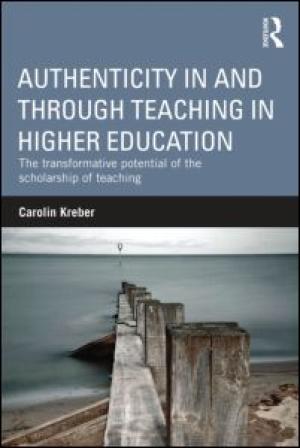
This book explores the role of authenticity in higher education. Kreber’s work contributes to the Scholarship of Teaching and Learning movement, which includes post-secondary educators from a variety of disciplines who emphasize teaching as a scholarly discipline in its own right (Huber and Morreale, Disciplinary Styles in the Scholarship of Teaching and Learning: Exploring Common Ground [Washington, D.C.: AAHE] 2002). Kreber criticizes the movement, however, for being insufficiently attentive to issues of power and social justice, and she posits her research as a corrective (5). Authenticity, Kreber argues, involves not only reflective awareness of one’s own inner motives and dispositions, but also critical consciousness of the power relations that determine one’s place in the social order (26-27, 38-39). Authenticity inteaching promotes awareness of one’s positionality as a teacher (50-52, 133-140, 171), and it leads one to serve the best interests of one’s students. Authenticity through teaching, meanwhile, defines, and ultimately attains, the students’ ultimate interest: coming into their own authenticity. Higher education thus comes to promote a more just and sustainable world (44-49). Authenticity In and Through Teaching unfolds in eight chapters, plus a conclusion. Chapter 1 engages philosophical and pedagogical literature to interrogate the concept of authenticity. Chapter 2 contains Kreber’s core argument, summarized above. In Chapter 3, Kreber explores the implications for the Scholarship of Teaching and Learning movement, arguing that it is distinguished from pedagogical theory by its reflective stance: it involves the application of research to one’s own teaching practice (75). For these reasons, in Chapter 7 she challenges the notion of the scholarship of teaching as an evidence-based practice. In Chapter 4, she draws on Alasdair MacIntyre’s unique connection between practice and virtue to argue for a moral imperative in teaching practice (MacIntyre, After Virtue: A Study in Moral Theory [Notre Dame, Ind.: University of Notre Dame Press] 2007). Chapters 5 and 6 invoke the critical self-reflection inherent to authenticity as a means to counteract the distorting effects of power in the university classroom. Chapter 8, finally, argues that authentic scholarship of teaching and learning demands public engagement. Operating within the framework of engaged pedagogy, Authenticity In and Through Teaching provides a useful, coherent, and comprehensible framework for conceptualizing the practice of teaching. It also serves as a point of entry to contemporary scholarly literature in several disciplines, including pedagogical theory, moral and existential philosophy, and critical social theory. Finally, the moral imperative that Kreber derives from her understanding of authenticity, rooted as it is in virtue theory, would be particularly applicable in liberal arts and seminary contexts (where the moral shaping of the student is part of the educational process). I recommend this book for scholar-teachers who want to expand their awareness of theoretical literature on pedagogy and bring it to bear on their teaching practice.
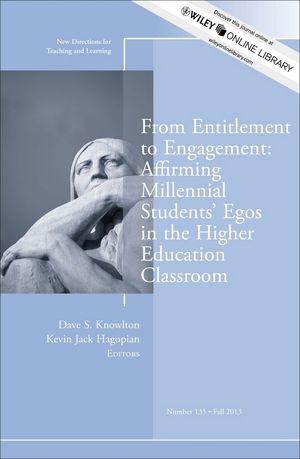
“How bad has it gotten in your class?” the first article’s author asks. “Students eating steaming plate lunches, kissing passionately, conducting loud phone conversations, playing video poker?. . . Asking to be excused from class to barbecue chicken at the go-kart track for a radio station where the student interned last summer?” (7). If these examples sound even remotely familiar, you may find this issue of New Directions for Teaching and Learning helpful. This volume addresses the challenge of teaching millennial students, born between 1982 and 2001, who are often labeled as coming to higher education with an attitude of entitlement that can frustrate professors. The first three chapters explore the theory behind this volume. The first two chapters reframe the concept of entitlement by reflecting on the structure of higher education classrooms (chapter 1) and seeing the psychological vulnerability of students (chapter 2) as an opportunity for ego engagement – a process that the editors describe as “productively affirming student’s egos” to offer “new opportunities for deep learning and ever-strengthening intellectual rigor” (2). The third chapter is an empirical study that explores how students feel they deserve entitled treatment in higher education. The second cluster of articles explore practice and application of reframing entitlement into ego engagement in specific areas. Chapter 4 explores ways to construct a syllabus that invite student engagement proactively, and chapter 5 lays out several practical suggestions professors can utilize to conceptualize their pedagogies. Chapters 6 and 7 provide case studies of actual classroom assignments that engage millennial students’ egos successfully: chapter 6 describes an assignment that immersed millennial students in discipline-based political activities to foster positive ego engagement and chapter 7 describes an assignment that engaged students in narrative pedagogy through digital storytelling. Chapters 8 and 9 explore ways to engage students through already existing classroom practices. For example, chapter 8 provides specific insights about engaging students through technological gadgets and provides practical suggestions for teaching. Chapter 9 explores ways to engage students before and after class periods to affirm their egos. The rest of the three chapters explore ways to engage the moral sense of millennial students by involving them in social justice issues and student-directed goal setting. The author invites faculty to consider their own reactions to student incivility as possibly a response to a professor’s bruised ego ? an over-dependence on official authority based on position rather than on their ability to help students learn effectively. While graduate level professors may experience students’ sense of entitlement less bluntly than is described in some of the articles, I have sensed in my own teaching that the vocation of religious leadership tends to attract people with a sense of self-importance that poses challenges similar to those described in this volume. What the authors conceptualize as ego engagement is a model for empowering students who appear to be aloof to the subject matter but who are seeking meaningful engagement that leads them to deeper growth. From Entitlement to Engagement offers practical advice for fostering creative teaching that meets students’ psychological needs and motivates them to find growth through their own learning tasks.
The enterprise known as collegiate education is at a crossroads. This statement should not be a surprise to those involved in higher education. The playing field has changed drastically over the last decade since the advent of online learning. Debates continue to rage in the academic community regarding issues related to accreditation, how courses are delivered, faculty credentials, and the cost of a degree program. These questions confront present-day educators and administrators located in U.S. higher educational institutions. These debates are keenly felt in the U.K. and in other global contexts, although each context will address them from different perspectives depending on teaching and learning needs. Towards Teaching in Public is primarily focused on addressing these questions head on. As the book details, there is a seismic shift occurring in the educational institutions of the U.K., and it is likely that these shifts will be felt here in the U.S. sometime in the not-too-distant future. That said, understanding how these shifts are impacting British schools before they impact American institutions could aid administrators and faculty in how to plan for the forthcoming changes. The place to begin, then, is in understanding what is meant by “public.” In the U.K., “public” and “private” have less to do with religious affiliation and more to do with where tuition dollars come from in higher educational contexts. In the British system, education in “private” institutions is provided at the expense of the student. “Public” institutions, then, primarily receive money from the government to provide education to students. These students can be degree-seekers, lifelong learners, tradesmen who are looking to pick up some new information, or individuals interested in taking a class now and then. The question the book raises is whether this remains an effective endeavor in a perpetually struggling economy. A secondary question concerns higher educational institutions as the loci of learning – teacher, student, and community. In answering these two fundamental questions, the contributors to this volume contend that the university could serve as the central hub of political, societal, and cultural reform. The volume is divided into three major sections. The first section (chapters 1-3) focuses on education as “a public good.” The essays in this section recount the modern history of education in the U.K., noting how the public university was established to provide free education to all and how that morphed into the private universities that sought to offer degrees to paying students who would be held to more rigorous academic standards. The second section (chapters 4-6) focuses on the relationship between teacher and student. This section argues for a higher value to be placed on students. The chapter entitled “The Student as Scholar” was particular insightful as it mapped out a program for developing undergraduate researchers who could benefit the university in a number of ways. The final section (chapters 7-10) seeks to answer the questions raised previously. First, the university should continue to offer free education to the general public through workshops, public lectures, and continuing education offerings. However, the book advocates for requiring stricter regulations for degree-seeking students. Second, the locus of learning has moved to the community, although the concept is more Marxist in nature. This would be my only critique of the material in the volume. In the end, the authors seem to say that the purpose of education is simply to share our collected knowledge. The modern university, then, will be a place where the discussion of ideas will occur but little else. Although this volume was an insightful read, it would most benefit those involved with administration or international policy discussions rather than faculty.
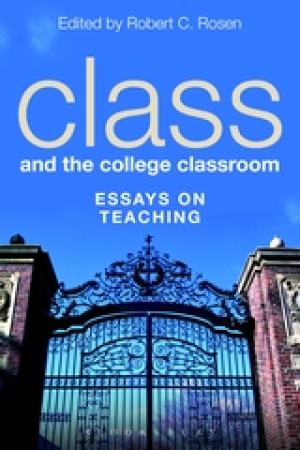
These essays, reprinted from Radical Teacher, analyze class in the classroom. Editor Robert Rosen recognizes that, in teaching about race, class, and gender, class often receives the least nuanced attention. With the 2008 economic downturn, class reemerged strongly: in the extreme inequalities in capitalist society; in the recognition that college is no longer the guaranteed “path to upward mobility” (1); and, in recognizing the functions of class in education’s many facets, from colleges to for-profits. Often, for poor (30-39) and immigrant, particularly undocumented (19-29), students, we are failing. This is true, as Susan Jhirad points out, even in community colleges, which have been the open door to college for many “non-traditional” students (40-48; 67-71). The book also gives voice to the working poor in the academy itself: alienated adjuncts (67-71; 78-86). We perform class as well as live it. Richard Ohmann writes about his students’ arguments against Jane Austen’s sense that one should strive to marry according to or up in class. His students, nevertheless, will enact her class vision. They come from the “professional-managerial class (PMC)” (12), and college, Ohmann suggests, lets them engage diversity, “for a while” (13), as they move back to the PMC. Class, he argues, is complex and powerful: an identity, “a script you act out daily, a bundle of habits and feelings and ways of relating lodged deep in your psyche and broadcast by your talk and conduct…[that] is [neither] easy to revise [nor to] conceal” (13). Erin Smith demonstrates this truth as she tells her current, less privileged, students about a white, male student from an elite university who refused to accept inclusive language, announcing “that when he was out in the real world, he would make all of those women and minorities working for him write the way he told them to” (113, emphases mine). While her less privileged students thought the young man was wrong, his example did not lead them to analyze class as a factor. Smith suggests, “a reliance on experience can effectively locate individuals in history, but it cannot – by itself – enable individuals to see history in themselves” (115-116): how they perform class. This book offers many teaching strategies, framed by the awareness that a classroom encounter with otherness often “‘substitutes’” for the real thing (147), “sanctioning,” as Ohmann writes, “all kinds of nonthreatening nonconformity” (147). The strategies unsettle class assumptions, such as Janet Casey’s teaching literature in terms of how it is marketed and Ohmann’s having his students write about their “imagined” best and worst jobs and whom they imagine works those jobs. This volume is valuable for its unflinching look at the current academy and for its warning that higher education, even as it works to be inclusive, can reproduce “class structures and relations” (146) appropriating “lower” class artifacts and making students confront class only within safe boundaries, changing nothing but the items on our syllabi.
Innovating Teaching and Learning is the final product of a summer program and an extended follow-up Inquiry into Student Learning initiative based in Slovakia in 2011 and 2012. Participants from a wide range of disciplines were required to identify a specific learning challenge within an existing course, design a “pedagogical innovation” (8) that would address this challenge, implement the innovation during the following teaching semester, and document the results of the innovation in a report for the program coaches. The editors identify the core chapters of Innovating Teaching and Learning as the best reports emerging from the innovation projects. “Innovation” in the context of this volume refers to a shift in focus from an instructional paradigm to a learning paradigm. In short, this means placing students at the center of teaching practice: “teachers should focus more on how their students learn rather than placing importance on their own performance as teachers” (8). Following principles of student-centered practice, participants in the program applied pedagogical theory to specific course challenges, challenges organized into five overall sections in the volume: improving student pre-class preparation, teaching large classes, teaching courses rich in complex terminology, enhancing student abilities of theory application, and making assessment an effective tool for student learning. Their reports include a brief introduction to the particular pedagogical challenge in question, an outline of the theoretical background for the innovation, descriptions of research design and findings, discussion of areas of difficulty, and suggestions for future improvement. For example, Katarína Hrnciarová (33–40) introduced blog assignments as a way to motivate students to read assigned literature in her philosophy course, applying theoretical work on student motivation, blended learning, and the use of blogs in higher education. Anna Vallušová (83–91) designed worksheets for students in her microeconomics class in order to encourage students to actively make connections between economic models and real-world practice. Vallušová reports that students who had failed the course in the previous year reacted most notably to the innovation, showing “surprise and enthusiasm when they had realized that certain theories corresponded with phenomena they knew from real life” (88). The main strength of this book is its presentation of “small innovations”: targeted learning strategies designed to meet a particular learning challenge or outcome within a course based on applied pedagogical theory. The theoretical work behind the innovation projects moves the volume beyond a simple “teaching tips and tricks” manual, balancing practice with theory. Each project was fairly small within the scope of a course, the idea being not to overhaul a course but to introduce change gradually in order to effectively ensure that learning activities and assessment align with learning outcomes. As each project was small, teachers were able to easily document and reflect on the impact of their respective changes. Innovating Teaching and Learning is an important resource for stimulating critical reflection on teaching practice. For example, after implementing a project similar to Hrnciarová’s blog assignment, I discovered new strategies for advancing student learning by motivating students to read. This reflection also enabled me to think about collecting documentation on my discussion starters project in order to critically evaluate the results. The editors themselves recognize the major limitations of Innovating Teaching and Learning in their concluding chapter. The most frustrating limitation for participants, receiving comment in a number of reports, was the limited control of the instructors involved (mostly graduate students) over their courses; seminar leaders or those teaching from a pre-set syllabus could change small components of a course, but could not change content or major components of student assessment. Findings sometimes indicated disconnections between the objective of the innovation and the course methods of assessment. The volume is, however, an accessible starting point for those wishing to more thoughtfully integrate classroom activity with pedagogical research.
Wabash Center Staff Contact
Rachelle Green, Ph.D.
Associate Director
Wabash Center
greenr@wabash.edu