Resources
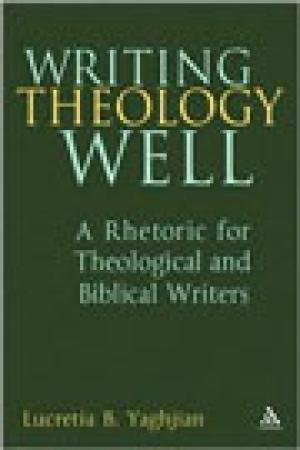
In its creative integration of the disciplines of writing, rhetoric, and theology, Writing Theology Well provides a standard text for theological educators engaged in the teaching and mentoring of writing across the theological curriculum. As a theological rhetoric, it will also encourage excellence in theological writing in the public domain by helping to equip students for their wider vocations as writers, preachers, and communicators in a variety of ministerial and professional contexts. (From the Publisher)
University teaching and learning take place within ever more specialized disciplinary settings, each characterized by its unique traditions, concepts, practices and procedures. It is now widely recognized that support for teaching and learning needs to take this discipline-specificity into account. However, in a world characterized by rapid change, complexity and uncertainty, problems do not present themselves as distinct subjects but increasingly within trans-disciplinary contexts calling for graduate outcomes that go beyond specialized knowledge and skills. This ground-breaking book highlights the important interplay between context-specific and context-transcendent aspects of teaching, learning and assessment. It explores critical questions, such as: What are the ‘ways of thinking and practicing’ characteristic of particular disciplines? How can students be supported in becoming participants of particular disciplinary discourse communities? Can the diversity in teaching, learning and assessment practices that we observe across departments be attributed exclusively to disciplinary structure? To what extent do the disciplines prepare students for the complexities and uncertainties that characterize their later professional, civic and personal lives? Written for university teachers, educational developers as well as new and experienced researchers of Higher Education, this highly-anticipated first edition offers innovative perspectives from leading Canadian, US and UK scholars on how academic learning within particular disciplines can help students acquire the skills, abilities and dispositions they need to succeed academically and also post graduation. Carolin Kreber is Professor of Teaching and Learning in Higher Education and the Director of the Centre for Teaching, Learning and Assessment at the University of Edinburgh (From the Publisher)
Reflective practice has moved from the margins to the mainstream of professional education. However, in this process, its radical potential has been subsumed by individualistic, rather than situated, understandings of practice. Presenting critical perspectives that challenge the current paradigm, this book aims to move beyond reflective practice. It proposes new conceptualisations and offers fresh approaches relevant across professions. Contributors include both academics and practitioners concerned with the training and development of professionals. Definitions of reflection (which are often implicit) often focus on the individual's internal thought processes and responsibility for their actions. The individual - what they did/thought/felt – is emphasised with little recognition of context, power dynamics or ideological challenge. This book presents the work of practitioners, educators, academics and researchers who see this as problematic and are moving towards a more critical approach to reflective practice. With an overview from the editors and fourteen chapters considering new conceptualisations, professional perspectives and new practices, Beyond Reflective Practice examines what new forms of professional reflective practice are emerging. It examines in particular the relationships between reflective practitioners and those upon whom they practise. It looks at the ways in which the world of professional work has changed and the ways in which professional practice needs to change to meet the needs of this new world. It will be relevant for those concerned with initial and ongoing professional learning, both in work and in educational contexts. (From the Publisher)
Has higher education been transformative over the last three decades? Miram David’s question is double-edged, based on her educational experience and her social research. What influences have second wave feminists, drawing on feminism as the key social movement of the twentieth century had on the pedagogies and practices in global higher education? As aspiring academics, their aims were for gender and social justice through inclusive pedagogies in higher education or lifelong learning. Ideas about inclusive pedagogies have begun to percolate into forms of mass higher education in the 21st century, linked to widening access and participation in higher education. Yet the expansion of higher education and the knowledge economy has been more about transforming global labor markets than it has been about social or gender justice. Higher education has indeed expanded and afforded diverse opportunities for participation as students and as researchers or academics yet these transformations maintain systemic inequalities. (From the Publisher)
What's the problem with literacy at college? How might everyday literacy be harnessed for educational ends? Based on the first major study of literacy practices in colleges in the UK, this book explores the reading and writing associated with learning subjects across the college curriculum. It investigates literacy practices in which students engage outside of college, and teaching and learning strategies through which these can help support the curriculum. With insightful analyses of innovative practices, it considers ways of changing teaching practices to enable students to draw upon their full potential. Recent research work has challenged the myth of individual student deficit, arguing cogently that people have ‘funds of knowledge’ from diverse and vibrant cultural roots, and that these have been misguidedly disqualified by the education system. It has claimed that different ‘ways with words’ can provide valuable resources for learning. However, the empirical exploration of this claim has lagged far behind the theoretical debate. Improving Learning in College resolves this by showing the integrity and richness of the literacy practices of a significant population, not previously the focus of such research: those who take vocational and academic college courses in colleges. It addresses an issue which has not until now been developed within this research tradition: that of how these practices can not only be valued and validated, but mobilised and harnessed to enhance learning in educational settings. This book will interest all teachers, teacher-educators and researchers concerned with post-compulsory education and vocational education in compulsory schooling. (From the Publisher)
Praise for Harnessing America's Wasted Talent President Obama offered America and the world renewed hope for a better tomorrow. With decades of experience in alternative forms of higher education, Peter Smith grabs that optimistic spirit and seizes the moment to reveal to us the exciting age of Web-based teaching and learning, which is opening access to untold numbers of learners while harnessing the previously wasted talents of millions of people in America and billions around the world. Those seeking insights, a vision of the future, and a chance to join this educational revolution should look forward to Harnessing America's Wasted Talent. Anyone who wants to understand where American higher education is headed should read Harnessing America's Wasted Talent. Peter Smith's vision of the future of higher education is based on several decades of experience—at the national, state, and international levels. He brings a rare perspective that will interest students, educators, politicians, and those American business leaders who are worried about the future of our workforce and the health of our democracy. Harnessing America's Wasted Talent is a must-read for those of us concerned about the increasing economic and education gaps in our country. Peter Smith takes on an important American disconnect: the need for an educated workforce and the fact that most working Americans lack a college degree. Drawing upon his experience in higher education and politics, Smith dissects the problem and presents a contemporary, practical plan to enhance the learning capacity of our country. (From the Publisher)
What is the place of corporate warship in theological education? Certainly it is not unexpected to have ministry students attending seminary chapel, but what are the expectations for the students who attend chapel? Is it to form their liturgical sensibilities into conformity with a particular worship tradition or style? Or is it to provide a safe place to try things that one would be reluctant to experiment with in congregational worship? Although common worship for ministry students is almost a given in all theological schools, there are few common understandings about it goals and purposes. Common Worship in Theological Education is the first book to address the theological, pedagogical, and political issues involved in the planning and execution of seminary chapel. It offers voices from across the theological and ecumenical spectrum about chapel, as well as involving multiple disciplines in the conversation. This volume provides the first comprehensive survey of the worship issues at stake in seminary education today. The essays in this collection provide the foundation for a productive conversation within a seminary faculty or among colleagues within a theological discipline. This volume makes the case that the chapel ought to have a seat at the table when the education mission of a theological school is being discussed. So pull up a chair and prepare for a fascinating conversation. (From the Publisher)
This book provides distinctive analysis of the full range of expressions in global education at a crucial time, when international competition rises, tensions with American foreign policy both complicate and motivate new activity, and a variety of innovations are taking shape. Citing best practices at a variety of institutions, the book provides practical coverage and guidance in the major aspects of global education, including curriculum, study abroad, international students, collaborations and branch campuses, while dealing as well with management issues and options. The book is intended to guide academic administrators and students in higher education, at a point when international education issues increasingly impinge on all aspects of college or university operation. The book deals as well with core principles that must guide global educational endeavors, and with problems and issues in the field in general as well as in specific functional areas. Challenges of assessment also win attention. Higher education professionals will find that this book serves as a manageable and provocative guide, in one of the most challenging and exciting areas of American higher education today. (From the Publisher)
The sustainability of Networked Collaborative Learning (NCL) is a key topic of discussion amongst the institutions where it has been or may potentially be introduced. In order to determine the extent of NCL's sustainability, the added value university education may yield by adopting collaborative learning strategies must be quantified. In turn, an understanding of the implications NCL produces in terms of design and management is gained. After comparing NCL with other Technology Enhanced Learning (TEL) approaches and discussing the possible reasons for adopting it, a multidimensional model for the sustainability of NCL is proposed. The model is characterized by four dimensions: pedagogical approaches, e-teacher professional development, instructional design models and valuation/assessment approaches. Each of these dimensions is examined on the basis of the authors direct experience gained through applying NCL to his university teaching. (From the Publisher)
The first textbook to offer novice and experienced teachers guidelines for the “how” and “why” of self-study teacher research Designed to help pre- and in-service teachers plan, implement, and assess a manageable self-study research project, this unique textbook covers the foundation, history, theoretical underpinnings, and methods of self-study research. Author Anastasia Samaras encourages readers to think deeply about both the “how” and the “why” of this essential professional development tool as they pose questions and formulate personal theories to improve professional practice. Written in a reader-friendly style and filled with interactive activities and examples, the book helps teachers every step of the way as they learn and refine research skills; conduct a literature review; design a research study; work in validation groups; collect and analyze data; interpret findings; develop skills in peer critique and review; and write, present, and publish their studies. Key Features • A Self-Study Project Planner assists teachers in understanding both the details and process of conducting self-study research. • A Critical Friends Portfolio includes innovative critical collaborative inquiries to support the completion of a high quality final research project. • Advice from the most senior self-study academics working in the U.S. and internationally is included, along with descriptions of the self-study methodology that has been refined over time. • Examples demonstrate the connections between self-study research, teachers’ professional growth, and their students’ learning. • Tables, charts, and visuals help readers see the big picture and stay organized. (From the Publisher)
Wabash Center Staff Contact
Sarah Farmer, Ph.D.
Associate Director
Wabash Center
farmers@wabash.edu