Resources
Five perspectives on diversity are provided here for reflection and discussion in your institution. Jack Seymour and Julia Speller offer observations drawn from discussions at the March 2002 ATS Workshop on Diversity. Two fictional cases explore negotiating cultural differences from a faculty member's and a dean's perspectives. Daniel Aleshire's column on "Good Work" is reprinted from the ATS newsletter, Colloquy (From the Publisher)

Journal Issue. Full text is available online.
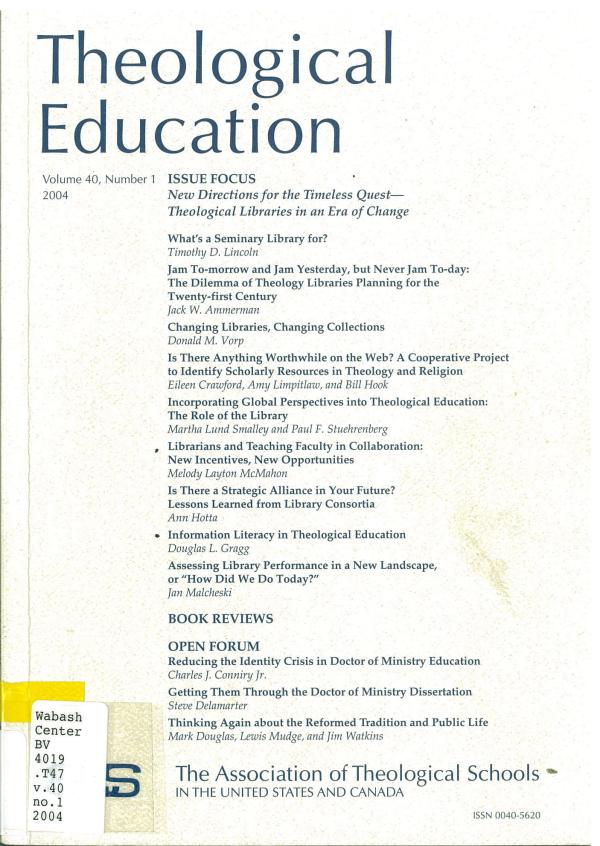
Journal Issue. Full text is available online.
Journal Issue. Full text is available online.

In a rapidly changing congregational and professional environment, how will churches and their institutions of theological education prepare ministers for diverse contexts? Barker and Martin affirm the theological school's continued role yet claim that American Protestantism can no longer rely on graduate theological schools as the sole educational institutions charged with providing curricula for theological study related to ministerial preparation. To support their thesis, the authors researched the graduate theological education programs of The Episcopal Church, the Evangelical Lutheran Church in America, the Presbyterian Church (USA), the United Church of Christ, the United Church of Canada, and The United Methodist Church; and compiled essays that show powerful new models for successful ministry preparation. Contributors: Janet Silman, Carol Bell, Isaac McDonald, Richard Sales, Bert Affleck, Minka Shura Sprague, Glenn Miller, Ken McFayden, and Thomas Ray. (From the Publisher)
The present study sought to investigate the perceptions of 300 ministers, 85 recent graduates from theological colleges, and 954 church members regarding (a) the effectiveness of ministry education, (b) priorities for ministry education, and (c) the acquired competencies of ministers. Participants were surveyed using the Inventory of Ministry Education Perceptions and Priorities (IMEPP), which displayed good validity and reliability in the study. Results of the study indicate that participants were largely satisfied with the effectiveness of ministry education and the acquired competence of ministers. However, on the whole, ministers and recent graduates were less satisfied with their ministry education and acquired competence than were church members. The study also identified significant differences between ministers, recent graduates and church members with regard to the priorities they perceived theological colleges should pursue.
Journal Issue.
Over the years, thousands of students have left Africa to pursue theological doctorates in Christian institutions of higher learning around the world. The study reported in this paper endeavored to understand their experiences and articulate their needs and aspirations. Data were collected through semistructured interviews with 23 African students and were analyzed using grounded theory procedures. The emerging profile revealed African students in pursuit of theological doctorates to be mature in age and experience with rich and variegated backgrounds. While a desire for increased competence, access to employment opportunities, and a greater voice in church and society were motivating factors in their educational quests, the dominant motivation expressed by research participants was a passion to help Africa and the African church. Students viewed increased competence and access as enhancing usefulness. Consequently, students preferred doctoral programs perceived as Africa-relevant and internationally credible. Nevertheless, they demonstrated a readiness to compromise the ideal in favor of the achievable, particularly in terms of program affordability. (From the Publisher)
This book emerges from the Carnegie Foundation for the Advancement of Teachings study of the most pressing concerns involved in preparation of clergy across all faiths and denominations. Working with accrediting bodies and professional associations as well as the educational institutions themselves, the findings reported in this book can be used to improve the quality of education for future ministers, priests and rabbis. (From the Publisher)