Resources
What are some of the things teachers can do to help support the full and healthy maturation of learners’ brains? Here are few ideas.
The research discussed in this article looked at the impact of students having laptops in class that were being used for non-course related tasks, such as surfing the web.
By “Decoding” what an expert does so that he or she does not get stuck at the bottleneck, we can spell out crucial operations, the “critical thinking” of a discipline.
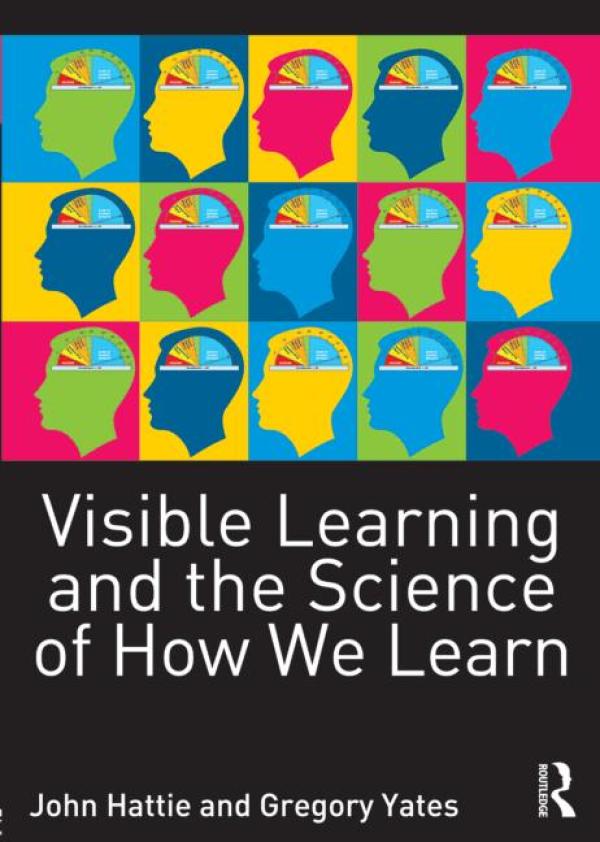
Click Here for Book Review Abstract: On publication in 2009 John Hattie’s Visible Learning presented the biggest ever collection of research into what actually work in schools to improve children’s learning. Not what was fashionable, not what political and educational vested interests wanted to champion, but what actually produced the best results in terms of improving learning and educational outcomes. It became an instant bestseller and was described by the TES as revealing education’s ‘holy grail’. Now in this latest book, John Hattie has joined forces with cognitive psychologist Greg Yates to build on the original data and legacy of the Visible Learning project, showing how it’s underlying ideas and the cutting edge of cognitive science can form a powerful and complimentary framework for shaping learning in the classroom and beyond. Visible Learning and the Science of How We Learn explains the major principles and strategies of learning, outlining why it can be so hard sometimes, and yet easy on other occasions. Aimed at teachers and students, it is written in an accessible and engaging style and can be read cover to cover, or used on a chapter-by-chapter basis for essay writing or staff development. The bookis structured in three parts – ‘learning within classrooms’, ‘learning foundations’, which explains the cognitive building blocks of knowledge acquisition and ‘know thyself’ which explores, confidence and self-knowledge. It also features extensive interactive appendices containing study guide questions to encourage critical thinking, annotated bibliographic entries with recommendations for further reading, links to relevant websites and YouTube clips. Throughout, the authors draw upon the latest international research into how the learning process works and how to maximise impact on students, covering such topics as: teacher personality; expertise and teacher-student relationships; how knowledge is stored and the impact of cognitive load; thinking fast and thinking slow; the psychology of self-control; the role of conversation at school and at home; invisible gorillas and the IKEA effect; digital native theory; myths and fallacies about how people learn. This fascinating book is aimed at any student, teacher or parent requiring an up-to-date commentary on how research into human learning processes can inform our teaching and what goes on in our schools. It takes a broad sweep through findings stemming mainly from social and cognitive psychology and presents them in a useable format for students and teachers at all levels, from preschool to tertiary training institutes. (From the Publisher)
Click Here for Book Review Abstract: Research has identified the importance of helping students develop the ability to monitor their own comprehension and to make their thinking processes explicit, and indeed demonstrates that metacognitive teaching strategies greatly improve student engagement with course material. This book -- by presenting principles that teachers in higher education can put into practice in their own classrooms -- explains how to lay the ground for this engagement, and help students become self-regulated learners actively employing metacognitive and reflective strategies in their education. Key elements include embedding metacognitive instruction in the content matter; being explicit about the usefulness of metacognitive activities to provide the incentive for students to commit to the extra effort; as well as following through consistently. Recognizing that few teachers have a deep understanding of metacognition and how it functions, and still fewer have developed methods for integrating it into their curriculum, this book offers a hands-on, user-friendly guide for implementing metacognitive and reflective pedagogy in a range of disciplines. Offering seven practitioner examples from the sciences, technology, engineering and mathematics (STEM) fields, the social sciences and the humanities, along with sample syllabi, course materials, and student examples, this volume offers a range of strategies for incorporating these pedagogical approaches in college classrooms, as well as theoretical rationales for the strategies presented. By providing successful models from courses in a broad spectrum of disciplines, the editors and contributors reassure readers that they need not reinvent the wheel or fear the unknown, but can instead adapt tested interventions that aid learning and have been shown to improve both instructor and student satisfaction and engagement. (From the Publisher)
Click Here for Book Review Abstract: The authors of Teaching Applied Creative Thinking: A New Pedagogy for the 21st Century believe this book to be the first in the field about teaching creative thinking in the new millennium. While many books talk about creativity and provide the justification for adding creative thinking as a student learning outcome, this book focuses on applying creativity to the teaching and learning process. The authors ask, “does anyone truly believe the world’s problems are going to be solved by students with only a high proficiency in common core competencies?” With student learning outcomes as a goal, we must rethink teaching and learning to include creativity. Posed for the 21st-Century learner, their new paradigm, Mentor-from-the-Middle, replicates scholarly inquiry by developing a scholarly frame of mind. The teacher assumes new roles in this paradigm of scholar, mentor, facilitator, coach, model, and critical reflector. These roles in turn combine to help transform the learner into an active creative thinker. "The authors’ goals in writing this book are to fill a void, to transform teaching, to create a new model, and to develop a new approach to teaching and learning. In the old world, before the coming of Google, the transfer of knowledge was the work of the teacher; now knowledge is available at the tip of our fingers. But the Google cannot solve the world’s problems. We will always need great teachers to transform and synthesize knowledge into skills, to teach creative thinking, to apply learning, and to create a love for learning that lasts a lifetime. The authors discuss new brain research, advanced technologies, the teaching environment, and pedagogy. They synthesize this knowledge in a wonderful way to encourage the reader to think deeply about how this research might affect the teacher and the learner. (From the Publisher)
In this article I propose a method of selecting and assigning readings in the religious studies or theology classroom, such that these readings complicate one another, rather than standing in opposition or as simple alternatives. Such a strategy emulates key pedagogical insights of twelfth-century sentence collection, an activity at the very heart of the earliest universities in Europe. It also draws support from the theories of intellectual development advanced by William G. Perry, Jr. and the Women's Ways of Knowing Collaborative. Both precedents suggest a principle of “complicating views” that can be flexibly employed in a variety of ways and diverse pedagogical contexts, as illustrated by examples from several classes. Such strategies aim to avoid reinforcing intellectual patterns of dualism or undifferentiated relativism; instead, they attempt to promote students' ability to integrate discordant voices and to appreciate diverse points of view, while also staking their own claims relative to them.
When Cathy Davidson and Duke University gave free iPods to the freshman class in 2003, critics said they were wasting their money. Yet when students in practically every discipline invented academic uses for their music players, suddenly the idea could be seen in a new light-as an innovative way to turn learning on its head. This radical experiment is at the heart of Davidson's inspiring new book. Using cutting-edge research on the brain, she shows how "attention blindness" has produced one of our society's greatest challenges: while we've all acknowledged the great changes of the digital age, most of us still toil in schools and workplaces designed for the last century. Davidson introduces us to visionaries whose groundbreaking ideas-from schools with curriculums built around video games to companies that train workers using virtual environments-will open the doors to new ways of working and learning. A lively hybrid of Thomas Friedman and Norman Doidge, Now You See It is a refreshingly optimistic argument for a bold embrace of our connected, collaborative future. (From the Publisher)
This new book from the award-winning author of Psychology and Adult Learning puts the spotlight on the kind of learning that brings about significant personal change. Tennant explores the techniques, processes, and practices educators can use to promote learning that leads to change and examines assumptions about self and identity, how we are formed, and our capacity for change. Throughout the book, Tennant posits that individuals can be agents in their own self-formation and change by understanding and acting on the circumstances and forces that surround and shape them. Educators, he argues, must be open to different theoretical ideas and practices while simultaneously valuing these practices and viewing them with a critical eye. The book aims to: • promote, among educators and others with an educational dimension to their work, a more critical approach to their learning designs and practices; • equip individuals with a framework for understanding and being agents of their own self-formation and change.