Resources
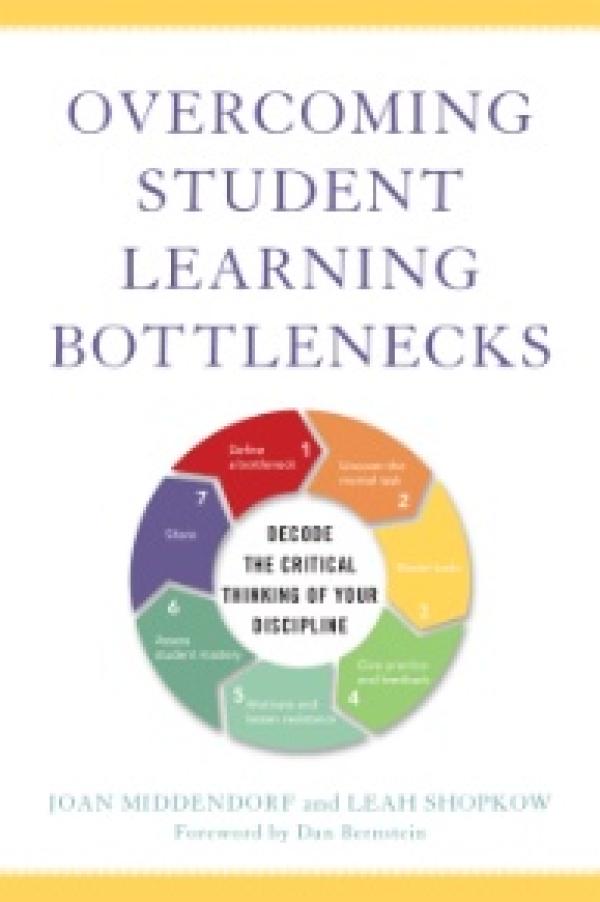
Decoding the Disciplines is a widely-used and proven methodology that prompts teachers to identify the bottlenecks – the places where students get stuck – that impede learners’ paths to expert thinking in a discipline. The process is based on recognizing the gap between novice learning and expert thinking, and uncovering tacit knowledge that may not be made manifest in teaching. Through “decoding”, implicit expert knowledge can be turned into explicit mental tasks, and made available to students. This book presents a seven-step process for uncovering bottlenecks and determining the most effective way to enable students to surmount them. The authors explain how to apply the seven steps of Decoding the Disciplines – how to identify bottlenecks, unpack the critical thinking of experts, teach students how to do this kind of thinking, and how to evaluate the degree to which students have learned to do it. They provide in-depth descriptions of each step and, at the end of each chapter, at least one exercise the reader can do on his or her own. Because the decoding process works well with groups, they also provide exercises for leading groups through the process, making available to informal groups as well as groups led by professional developers, the tools to transform their understanding of teaching and learning by getting the student view that they refer to as “the bottleneck perspective.This book uses research and personal stories from university lecturers to explore pedagogical strategies that illuminate how students’ minds can be ‘switched on’ in order to unlock their extraordinary potential. It presents diverse ways to create inspiring learning environments, in chapters written by internationally respected experts in the broad field of the social sciences. Because it focuses on the mental moves that underlie the cognitive competencies we want students to develop, spelling out what critical thinking consists of for any field, the methodology helps teachers to get beyond focus on content delivery and transmission and provides criteria to select from the bewildering array of teaching tools the methods most appropriate to what they are teaching. This is a book for faculty who want their students to develop disciplinary forms of reasoning, and are moreover interested in a methodology with the potential to transform and reinvigorate their teaching. It is particularly suitable for use in communities of practice, and should be indispensable for any one engaged in cross-disciplinary teaching, as it enables co-teachers to surface each other’s tacit knowledge and disciplinary assumptions. (From the Publisher)
Many courses in higher education rely on the hierarchical organization of Bloom's taxonomy to categorize and sequence learning. Introductory courses on scripture often emphasize remembering content and background as a basis for applying the sacred text to one's life. However, a review of the literature demonstrates little support for the widely assumed hierarchical nature of Bloom's taxonomy. Furthermore, this study examined the performance of traditional and non‚Äêtraditional students in a New Testament survey course on a comprehensive exam (a Remember task) and an application assignment (an Apply task) and found no correlation between the two. Furthermore, students struggled most with the interpretation portion of the application assignment, prompting the realization that interpreting a sacred text is a complex hermeneutical enterprise incorporating multiple levels of the taxonomy. Thus, introductory scripture courses may be better organized around the central, integrating practice of interpretation supported by needed information and application skills.
Click Here for Book Review Teaching and learning in higher education can evoke strong feelings, including confusion, anxiety, boredom, curiosity, surprise and exhilaration. These emotions affect students’ learning, progress and overall success. Teachers’ emotions affect how they teach and their relationships and communication with students. Yet the emotional dimensions of teachers’ and students’ experiences are rarely discussed in the context of improving higher education. This book addresses that gap, offering short, evocative case studies to spark conversation among university teachers. It challenges readers to reflect on how higher education feels, to explore the emotional landscape of courses and programmes they create and consider the emotional effects of messages embedded in various policies and practices. Following the student lifecycle from enrollment to reunion, each of the main chapters contains 10 to 15 accessible, emotionally-engaging poems that serve as succinct case studies highlighting how some aspect of learning, teaching or development in higher education feels. Each chapter also contains an expert scholarly commentary that identifies emergent themes across the cases and establishes connections to theory and practice in higher education. The poems-as-case-studies are ideal for use in faculty or educational development workshops or for individual reflection. A variety of theoretical perspectives and associated reflection prompts provide lenses for variously interpreting the poems. An appendix offers suggestions for structuring case discussions as part of educational development activities. The book promotes a person-centered discourse, giving voice to previously neglected aspects of higher education and reminding us that education is essentially a human endeavor. (From the Publisher)

We have an uneasy relationship with the relentless deluge of information gushing out of academia and our media outlets. To turn it off is escapist, but to attempt to cognitively grapple with it is overwhelming. In Unforgettable: Enabling Deep and Durable Learning, a nationally recognized master teacher gives professors and their students the means to chart a clear path through this information explosion. Humans crave explanatory patterns, and this book enables teachers to think deeply about their academic disciplines to find and articulate their core explanatory principles and to engage their students in a compelling way of thinking. An alternative title for this book could be Why the Best College Teachers Do What They Do because the author articulates a compelling rationale that will equip faculty to create and deliver transformative courses. Students in transformative courses grapple with essential questions and gain mental muscle that equips them for real world challenges. (From the Publisher)

The complexities of 21st-century life- personal, social, cultural, and environmental - demand thoughtful responses, responses fostered and enhanced through contemplative experience. Contemplative education includes studies of the history, psychology, and socialcultural context of such experience, as well as the development of experiential knowledge through one or more personal practices. Contemplative education has recently emerged in the academy. Although there has been significant published discussion of postsecondary courses and programs that incorporate contemplative views and practices, there have been few studies of relevant curricula and pedagogy. This volume integrates research, theory, and practice through a fusion of perspectives and approaches, giving readers the opportunity to review contemplative educational concepts and applications in academic, social, and institutional domains. This is the 134th volume of this Jossey-Bass higher education series. New Directions for Teaching and Learning offers a comprehensive range of ideas and techniques for improving college teaching based on the experience of seasoned instructors and the latest findings of educational and psychological researchers. (From the Publisher)
Click Here for Book Review However personally committed faculty may be to helping students learn, their students are not always as eager to participate in this endeavor, and may react with both active and passive resistant behaviors, including poor faculty evaluations. The purpose of this book is to help faculty develop a coherent and integrated understanding of the various causes of student resistance to learning, providing them with a rationale for responding constructively, and enabling them to create conditions conducive to implementing effective learning strategies. In this book readers will discover an innovative integrated model that accounts for student behaviors and creates a foundation for intentional and informed discussion, evaluation, and the development of effective counter strategies. The model takes into account institutional context, environmental forces, students’ prior negative classroom experiences, their cognitive development, readiness to change, and metacognition. The various chapters take the reader through the model’s elements, exploring their practical implications for teaching, whether relating to course design, assessments, assignments, or interactions with students. The book includes a chapter written entirely by students, offering their insights into the causes of resistance, and their reflections on how participating on this project has affected them. While of great value for faculty, this book is also useful to faculty developers advising future and current faculty, as well as to administrators, offering insight into how institutional values impact teaching practice and student attitudes. (From the Publisher)
Click Here for Book Review Abstract: In the World Library of Educationalists, international experts themselves compile career-long collections of what they judge to be their finest pieces – extracts from books, key articles, salient research findings, major theoretical and practical contributions – so the world can read them in a single manageable volume. Readers will be able to follow the themes and strands and see how their work contributes to the development of the field. This volume brings together the selected works of Knud Illeris. Leaving a promising business career at age 27 to begin his higher education, Knud Illeris exemplifies the true spirit of youth and adult education that has resulted in him having published in almost twenty countries, including the UK, Germany, China, Korea and Brazil. Knud Illeris’ work revolves around the way learning takes place and in some cases does not take palce. Split into five parts; - Learning Theory - Lifelong Learning as a Psychological Process - Special Learning Issues - Various Learning Approaches to Education - Learning in Working Life Learning, Development and Education: From learning theory to education and practice is arranged thematically and examines youth and adult learning through Illeris’ model based on three dimensions of learning and competence development– emotional, cognitive and social, and four kinds of learning. In this collection of his papers, written over a period of almost five decades, and published in multiple languages, spanning from Faroese to Chinese, some of his most important works are chronicled. This compelling overview of Illeris’ contribution to educational thinking and theory charts the challenges and obstacles faced by disciplination and selection, and offers a genuine impression and understanding of an almost lifelong engagement with a wide range of topics in the field of learning – an engagement which has been the central area of Illeris’ academic life. (From the Publisher)
Is higher education preparing our students for a world that is increasingly complex and volatile, and in which they will have to contend with uncertainty and ambiguity? Are we addressing the concerns of employers who complain that graduates do not possess the creative, critical thinking, and communication skills needed in the workplace? This book harnesses what we have learned from innovations in teaching, from neuroscience, experiential learning, and studies on mindfulness and personal development to transform how we deliver and create new knowledge, and indeed transform our students, developing their capacities for adaptive boundary spanning. Starting from the premise that our current linear, course-based, educational practices are frequently at odds with how our neurological system facilitates learning and personal development, the authors set out an alternative model that emphasizes a holistic approach to education that integrates mindful inquiry practice with self-authorship and the regulation of emotion as the cornerstones of learning, while demonstrating how these align with the latest discoveries in neuroscience. The book closes by offering practical ideas for implementation, showing how simple refinements in classroom and out-of-classroom experiences can create foundations for students to develop key skills that will enhance adaptive problem solving, creativity, overall wellbeing, innovation, resilience, compassion, and ultimately world peace. (From the Publisher)
Click Here for Book Review Abstract: Miriam, a freshman Calculus student at Louisiana State University, made 37.5% on her first exam but 83% and 93% on the next two. Matt, a first year General Chemistry student at the University of Utah, scored 65% and 55% on his first two exams and 95% on his third—These are representative of thousands of students who decisively improved their grades by acting on the advice described in this book. What is preventing your students from performing according to expectations? Saundra McGuire offers a simple but profound answer: If you teach students how to learn and give them simple, straightforward strategies to use, they can significantly increase their learning and performance. For over a decade Saundra McGuire has been acclaimed for her presentations and workshops on metacognition and student learning because the tools and strategies she shares have enabled faculty to facilitate dramatic improvements in student learning and success. This book encapsulates the model and ideas she has developed in the past fifteen years, ideas that are being adopted by an increasing number of faculty with considerable effect. The methods she proposes do not require restructuring courses or an inordinate amount of time to teach. They can often be accomplished in a single session, transforming students from memorizers and regurgitators to students who begin to think critically and take responsibility for their own learning. Saundra McGuire takes the reader sequentially through the ideas and strategies that students need to understand and implement. First, she demonstrates how introducing students to metacognition and Bloom’s Taxonomy reveals to them the importance of understanding how they learn and provides the lens through which they can view learning activities and measure their intellectual growth. Next, she presents a specific study system that can quickly empower students to maximize their learning. Then, she addresses the importance of dealing with emotion, attitudes, and motivation by suggesting ways to change students’ mindsets about ability and by providing a range of strategies to boost motivation and learning; finally, she offers guidance to faculty on partnering with campus learning centers. She pays particular attention to academically unprepared students, noting that the strategies she offers for this particular population are equally beneficial for all students. While stressing that there are many ways to teach effectively, and that readers can be flexible in picking and choosing among the strategies she presents, Saundra McGuire offers the reader a step-by-step process for delivering the key messages of the book to students in as little as 50 minutes. Free online supplements provide three slide sets and a sample video lecture. This book is written primarily for faculty but will be equally useful for TAs, tutors, and learning center professionals. For readers with no background in education or cognitive psychology, the book avoids jargon and esoteric theory. (From the Publisher)
Click Here for Book Review Abstract: Facilitating Learning with the Adult Brain in Mind explains how the brain works, and how to help adults learn, develop, and perform more effectively in various settings. Recent neurobiological discoveries have challenged long-held assumptions that logical, rational thought is the preeminent approach to knowing. Rather, feelings and emotions are essential for meaningful learning to occur in the embodied brain. Using stories, metaphors, and engaging illustrations to illuminate technical ideas, Taylor and Marienau synthesize relevant trends in neuroscience, cognitive science, and philosophy of mind. Readers unfamiliar with current brain discoveries will enjoy an informative, easy-to-read book. Neuroscience fans will find additional material designed to supplement their knowledge. Many popular publications on brain and learning focus on school-aged learners or tend more toward anatomical description than practical application. This book provides facilitators of adult learning and development a much-needed resource of tested approaches plus the science behind their effectiveness. - Appreciate the fundamental role of experience in adult learning - Understand how metaphor and analogy spark curiosity and creativity - Alleviate adult anxieties that impede learning - Acquire tools and approaches that foster adult learning and development Compared with other books on brain and learning, this volume includes dozens of specific examples of how experienced practitioners facilitate meaningful learning. These "brain-aware" approaches can be adopted and adapted for use in diverse settings. Facilitating Learning with the Adult Brain in Mind should be read by advisors/counselors, instructors, curriculum and instructional developers, professional development designers, corporate trainers and coaches, faculty mentors, and graduate students—in fact, anyone interested in how adult brains learn. (From the Publisher)