Home » Resources » Scholarship on Teaching » How Higher Education Feels: Commentaries on Poems That Illuminate Emotions in Learning and Teaching
Scholarship
June 6, 2017
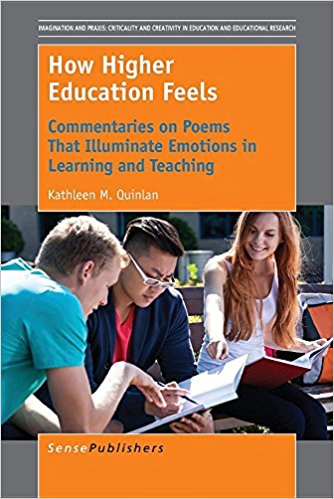
How Higher Education Feels: Commentaries on Poems That Illuminate Emotions in Learning and Teaching
- Author
- Quinlan, Kathleen M.
- Publisher
- Sense Publishers, The Netherlands
- ISBN
- 9789463006347
- Table of Contents
-
Acknowledgments
ch 1. Introduction
ch 2. Seven Stances on Emotion in Education
ch 3. Transition to Higher Education–In Search of Belonging(Expert Commentary by Terrell Strayhorn)
ch 4. Remaking Self-in-World 53 (Expert Commentary by Marcia B. Baxter Magolda)
ch 5. Taking Care of Students and Ourselves (Expert Commentary by Celia Hunt)
ch 6. Teaching in the Real World 107 (Expert Commentary by Michalinos Zembylas)
ch 7. For Love of People, Culture and Society (Expert Commentary by Monica McLean with Sarah LeFanu and Susan Bruce)
ch 8. For Love of Humanities and Arts (Expert Commentary by David Keplinger)
ch 9. For Love of Science (Expert Commentary by John Bowden and Pamela Green)
ch 10. Success and Failure – Achievement-Related Emotions (Expert Commentary by Reinhard Pekrun)
ch 11. Where We’ve Been, Where We’re Going
ch 12. Conclusion
Appendix 1: Using the Cases as Discussion Prompts – A Sample Discussion Guide
Index by Contributor
Index by Poem Title
Click Here for Book Review
Teaching and learning in higher education can evoke strong feelings, including confusion, anxiety, boredom, curiosity, surprise and exhilaration. These emotions affect students’ learning, progress and overall success. Teachers’ emotions affect how they teach and their relationships and communication with students. Yet the emotional dimensions of teachers’ and students’ experiences are rarely discussed in the context of improving higher education.
This book addresses that gap, offering short, evocative case studies to spark conversation among university teachers. It challenges readers to reflect on how higher education feels, to explore the emotional landscape of courses and programmes they create and consider the emotional effects of messages embedded in various policies and practices.
Following the student lifecycle from enrollment to reunion, each of the main chapters contains 10 to 15 accessible, emotionally-engaging poems that serve as succinct case studies highlighting how some aspect of learning, teaching or development in higher education feels. Each chapter also contains an expert scholarly commentary that identifies emergent themes across the cases and establishes connections to theory and practice in higher education. The poems-as-case-studies are ideal for use in faculty or educational development workshops or for individual reflection. A variety of theoretical perspectives and associated reflection prompts provide lenses for variously interpreting the poems. An appendix offers suggestions for structuring case discussions as part of educational development activities.
The book promotes a person-centered discourse, giving voice to previously neglected aspects of higher education and reminding us that education is essentially a human endeavor. (From the Publisher)
Teaching and learning in higher education can evoke strong feelings, including confusion, anxiety, boredom, curiosity, surprise and exhilaration. These emotions affect students’ learning, progress and overall success. Teachers’ emotions affect how they teach and their relationships and communication with students. Yet the emotional dimensions of teachers’ and students’ experiences are rarely discussed in the context of improving higher education.
This book addresses that gap, offering short, evocative case studies to spark conversation among university teachers. It challenges readers to reflect on how higher education feels, to explore the emotional landscape of courses and programmes they create and consider the emotional effects of messages embedded in various policies and practices.
Following the student lifecycle from enrollment to reunion, each of the main chapters contains 10 to 15 accessible, emotionally-engaging poems that serve as succinct case studies highlighting how some aspect of learning, teaching or development in higher education feels. Each chapter also contains an expert scholarly commentary that identifies emergent themes across the cases and establishes connections to theory and practice in higher education. The poems-as-case-studies are ideal for use in faculty or educational development workshops or for individual reflection. A variety of theoretical perspectives and associated reflection prompts provide lenses for variously interpreting the poems. An appendix offers suggestions for structuring case discussions as part of educational development activities.
The book promotes a person-centered discourse, giving voice to previously neglected aspects of higher education and reminding us that education is essentially a human endeavor. (From the Publisher)