Scholarship on Teaching
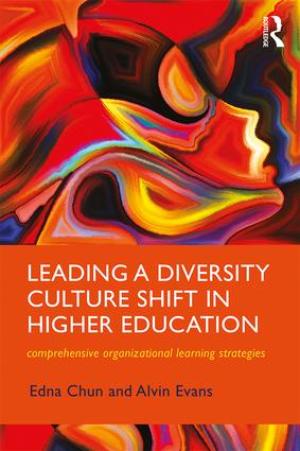
Leading a Diversity Culture Shift in Higher Education offers a practical and timely guide for launching, implementing, and institutionalizing diversity organizational learning. The authors draw from extensive interviews with chief diversity officers and college and university leaders to reveal the prevailing models and best practices for strengthening diversity practices within the higher education community today. They complement this original research with an analysis of key contextual factors that shape the organizational learning process including administrative leadership, institutional mission and goals, historical legacy, geographic location, and campus structures and politics. (From the Publisher)
This conversation between the editors of Teaching Theology and Religion and Joanne Maguire Robinson continues an occasional series of interviews that has previously featured Jonathan Z. Smith, Stephen Prothero, Mary Pierce Brosmer, and Mary Elizabeth Mullino Moore. The exchange takes as its point of departure the teaching statement that Professor Robinson produced in support of her candidacy for the American Academy of Religion's Excellence in Teaching Award. Issues addressed include the impact of institutional context on one's teaching, teaching the humanities in universities that are ever more focused on job training, making the transition from a graduate program focused on research to teaching undergraduates who are unlikely to take even a second course in the study of religion, and ways in which women are challenged to navigate multiple responsibilities while striving to make their way in a male‚Äêdominated academy.
“Greenscreen Teaching” explores how the stresses of institutional and social change impact teaching and learning, and the creative resourcefulness born out of instability. In precarious institutions and social contexts, relevant outcomes for theological learning include developing attentiveness, robust moral discernment, and courageous speech seasoned by maturing convictions and pastoral sensitivities. I utilize greenscreen acting as a suggestive metaphor for describing four creative teaching strategies targeting these outcomes. Subsections gather insights from: Etymology of disaster‐related words: Capitalize on the moment and “go big.” Creative method: Improvise and keep it sharp. Ritual theory: Creatively repurpose familiar but underutilized traditions. Service learning: Widen the networks of community connection. Each subsection also revisits moments and learning activities from a graduate course in feminist theology. Navigating constant transition impacts every aspect of the classroom. Nevertheless, a teaching scholar can resource this precariousness as creative agency for voice, solidarity, and mutual learning. 5/3/2018
One page Teaching Tactic: structure, prompts, and evaluation rubric for final summative exams conducted orally with individual students.
One page Teaching Tactic: a test-prep strategy in which students prepare a 30 second "elevator speech" in the character of one of the course's major thinkers, that they then present to each other in pairs and have to determine each other's characters.
One page Teaching Tactic: describes a scaffolded semester-long design encouraging student self-assessment of their work.
In the face of a mounting mental health crisis among college students, professors have an opportunity and responsibility to respond to their students’ psychological distress. Psychological and historical scholarship suggests that the proliferation of modern media and breakdown in traditional sources of existential meaning like religion are significant factors in young adults’ declining mental health. In response to this crisis, this article examines the crucial role of the imagination in constructing meaning and proposes an imagination‐centered pedagogical process by means of which teachers can assist students in recovering meaning and integration in their lives.
Grading systems matter more to the teaching and learning enterprise than many teachers may realize, as demonstrated in the author's experience of adopting a new one. Different systems emphasize different values such as excellence vs. perfection, achievement vs. talent, and second chances vs. partial credit. The author relates her experiment with specifications grading, an outcome‚Äêbased, pass/fail, rubric‚Äêbased, and contractual grading system, and demonstrates its promise. She then addresses three questions her experiment raised: Should I grade at all and if so, toward what end? Exactly what am I grading when I grade? and Is there any way to lessen the sting of failure?
In this article we address the affective dimensions and challenges of teaching about Islam and Islamic studies in the current American political and cultural environment and make two related arguments. First, we explain how the impact of certain kinds of digital media in the past few years has heightened the association of Islam with violence in the minds of many Americans, leading to a classroom affective environment characterized by the “posttraumatic” experience of knowledge about Islam. Second, we argue that the pedagogical use of digital media as a tool for ethnographic and empathic engagement with individual Muslim lives can help meet this particular teaching challenge. We show how the pedagogical employment of digital ethnography can turn the affective power of digital media into a positive learning tool, and model its responsible social and intellectual use.
The learning goals of a well‐designed course in the liberal arts include not only the imparting of knowledge but also the development of critical thinking and disciplinary expertise. A class on Luther can help students acquire those intellectual skills associated with the discipline of history and the liberal arts more generally as they consider broader questions about institutional religion, spirituality, moral choices, and human agency. Current scholarship on how people learn highlights the importance of adequate mental frameworks for the acquisition, retention, and retrieval of new ideas and information. This scholarship underlies the choice of specific strategies used to teach about Luther and the Reformation. Assignments provide “scaffolding,” which begins with modeling and then moves from simpler to more complex assignments. Students practice the specific intellectual skills of critical reading and textual analysis over the course of the semester.