Scholarship on Teaching
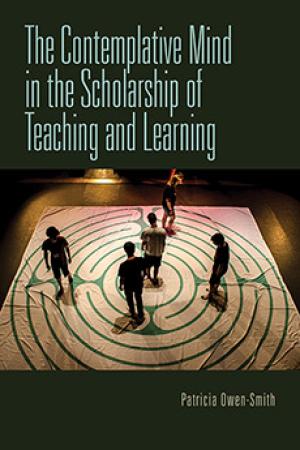
In The Contemplative Mind in the Scholarship of Teaching and Learning, Patricia Owen-Smith considers how contemplative practices may find a place in higher education. By creating a bridge between contemplative practices and the Scholarship of Teaching and Learning (SoTL), Owen-Smith brings awareness of contemplative pedagogy to a larger audience of college instructors, while also offering classroom models and outlining the ongoing challenges of both defining these practices and assessing their impact in education. Ultimately, Owen-Smith asserts that such practices have the potential to deepen a student’s development and understanding of the self as a learner, knower, and citizen of the world.
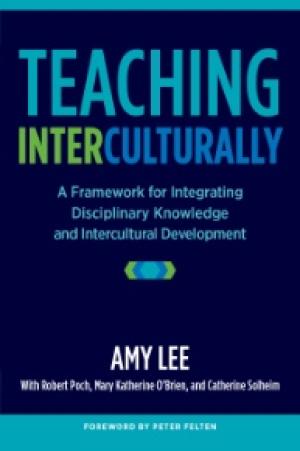
Click Here for Book Review How can I simultaneously support students' critical engagement with course content and develop their intercultural awareness? Most faculty have multiple diversities present in any given classroom or academic program— whether from an influx of international students or an increase of students from low-income, first generation, and/or racial/ethnic minority populations— and are concerned about how to maintain a rigorous curriculum and ensure that all their students succeed, given disparate backgrounds and varying degrees of prior knowledge. This book provides faculty and instructors with a theoretical foundation, practical tools, and an iterative and reflective process for designing and implementing an intercultural pedagogy. The authors bring to bear the expertise of their various disciplinary backgrounds to offer a responsive, integrative framework to develop and continually refine a pedagogy that both promotes deep disciplinary learning and supports intercultural outcomes for all students. The authors offer a framework that is flexible enough to be responsive to the experience, environment, and particulars of a given teaching and learning situation. The text incorporates narrative text by the authors, as well as first-person reflections, classroom activities, and annotated assignments that illustrate the dynamic process of intention, experiment/implement, critique, and refinement that characterize pedagogy and intercultural interaction. The authors bring to bear the expertise of their various disciplinary backgrounds, a deep knowledge of effective pedagogical practice, and their experience and grounding in intercultural practice: Amy in composition/writing studies, Mary Katherine in international education with rich experience as a faculty development trainer, and Bob and Catherine, respectively, an historian and a family scientist. This book is intended both for individual reading as well as for collective study in learning communities.
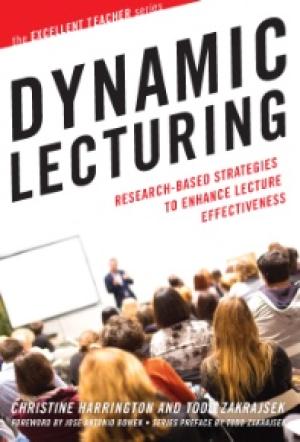
Click Here for Book Review Is the lecture an outmoded teaching method that inhibits active learning or is it a potentially powerful tool that is an essential part of every teacher’s repertoire? This book presents up-to-date research on the different types of lecture, on what constitutes effective lecturing, and on the impact of lecturing when done appropriately and well. It fills the void in professional development resources on how to lecture, validating the practice when it’s aligned with the educational mission of creating engaged learning environments. Christine Harrington and Todd Zakrajsek demonstrate that, rather than lecture and active learning being mutually exclusive or either-or propositions, the effectiveness of the former can be greatly enhanced when combined with active learning techniques through what they define as dynamic lecturing; and provide context about the need to balance these approaches to meet the needs of students as they progress from novice to advanced learners. They present a range of strategies that enhance student learning during lectures. They open each chapter with the evidence behind each lecturing strategy they describe, and conclude with practical suggestions for quick application in the classroom. They offer readers the lecture planning and evaluation tools for reworking their lectures in ways that provide high-level engagement and achievement for their students. The opening section of the book explores the benefits of lecturing and describes the different modalities of lecture, with an assessment of the advantages and disadvantages of each. The second section focuses on educational strategies to enhance the lecture, including, among others, activating prior knowledge, emphasizing important points, effectively using multi-media, making concepts meaningful via examples, and the importance of retrieval practice. Each covers the underlying theory and research, and advice on how to align the engagement techniques with instructional goals. The book concludes with guidance on effective planning for lecturing and helping chairs, administrators, or peers engage in effective evaluation of the lecture. This is a dynamic resource for all faculty interested in revitalizing their teaching. The strategies are succinct, easy to incorporate into lectures and, done well, will have immediate impact and increase student mastery of course content. (From the Publisher)
In "Arts of the Contact Zone, Pratt describes a manuscript from 1613 penned by Andean man named Felipe Guaman Poma de Ayala. The manuscript was a letter written to King Phillip III of Spain and was titled The First New Chronicle and Good Government. The manuscript details Spanish conquest in South America. Pratt cites the manuscript as an example of autoethnography. She writes, “Guaman Poma’s New Chronicle is an instance of what I have proposed to call an authethnographic text, by which I mean a text in which people undertake to describe themselves in ways that engage with representations others have made of them”. The New Chronicle ends with a revisionist account of the Spanish conquest. Pratt uses the manuscript as an example of an oppressed person or group resisting hegemony, and she connects the practice of authoethnography, critique and resistance to the creation of contact zones.
This essay explores challenges that arise for professors who teach critical theory in our current climate of conservatism. Specifically, it is argued that the conservative commitments to non-revolutionary change and reverence for tradition are corrupted in our current political and intellectual climate. This corruption, called "ideological imperviousness," undermines the institutional structures put in place to produce a functional educational environment that imposes an unjust vulnerability on professors and risks depriving students of the opportunity to acquire the critical skills necessary to combat their own vulnerabilities.
In its first century the American higher-education system was a messy, disorganised joke. How did it rise to world dominance?
Written assessment feedback has not been widely researched despite higher education students continually expressing the need for meaningful and constructive feedback. This qualitative study employing focus groups captures and interprets the student perspective of written assessment feedback. Participants were Registered Nurses and non-traditional entrants to higher education. The findings generated a framework of themes and categories representing the feedback process experienced by the students. The themes were ‘learning from’,‘the process of receiving’ and ‘making sense of’ feedback.When this framework incorporates strategies such as ‘feed-forward’, selfmanaged learning and personalized guidance it then represents a heuristic model of effective written assessment feedback. The model, created as a result of the research, should enhance the student experience and aid understanding of the complex processes associated with providing written assessment feedback.
In classes that examine entrenched injustices like sexism or racism, studentssometimes use ‘‘distancing strategies’’ to dissociate themselves from the injustice being studied. Education researchers argue that distancing is a mechanism through which students, especially students of apparent privilege, deny their complicity in systemic injustice. While I am sympathetic to this analysis, I argue that there is much at stake in student distancing that the current literature fails to recognize. On my view, distancing perpetuates socially sanctioned forms of ignorance and unknowing, through which students misrecognize not only their complicity in injustice, but also the ways that injustice shapes the world, their lives, and their knowledge. Thus, distancing is pedagogically problematic because it prevents students from understanding important social facts, and because it prevents them from engaging with perspectives, analyses, and testimonies that might beneficially challenge their settled views and epistemic habits. To substantiate this new analysis, I draw on recent work on epistemologies of ignorance, especially Jose´ Medina’s account of ‘‘active ignorance.’’ In order to respond to student distancing, I argue, it is not sufficient for teachers to make students aware of injustice, or of their potential complicity in it. Beyond this, teachers should cultivate epistemic virtue in the classroom and encourage students to take responsibility for better ways of knowing. The article ends by outlining several classroom practices for beginning this work. Keywords Pedagogy Distancing Epistemology of ignorance Active ignorance
Kennesaw’s Center for Excellence in Teaching and Learning maintains one of the most extensive directories of conferences focused on college/university teaching and their sponsoring organizations.  
Kennesaw’s Center for Excellence in Teaching and Learning provides an extensive list of disciplinary and interdisciplinary journals in the scholarship of teaching and Learning (SoTL) focused on undergraduate and graduate education for teachers at colleges and universities, organized alphabetically. Last updated in July 2017.