Resources

This volume of New Directions for Adult and Continuing Education explores emerging theory and practice in adult development, adult learning, and feminist pedagogy for learning environments designed to meet women's needs. Adult women learners face special challenges as they enter or reenter higher education. Research and experience suggest that historical and current education approaches may not serve men and women equally. The central aim of this book is to help make learning environments more supportive of reentry women in their ongoing development. Many of the practices showcased in this sourcebook emerged from programs of alternative higher education as they endeavored to meet the needs of an increasingly diverse population of learners. The different pedagogical approaches described herein help a woman learner shape the narrative of her evolving self in multiple life contexts. Ultimately, the kinds of educational practices described in this volume will prove effective in promoting lifelong learning and development for both women and men. This is the 65th issue in the journal series New Directions for Adult and Continuing Education. (From the Publisher)

What happens when teachers share power with students? In this profound book, Ira Shor--the inventor of critical pedagogy in the United States-- relates the story of an experiment that nearly went out of control. Shor provides the reader with a reenactment of one semester that shows what really can happen when one applies the theory and democratizes the classroom. This is the story of one class in which Shor tried to fully share with his students control of the curriculum and of the classroom. After twenty years of practicing critical teaching, he unexpectedly found himself faced with a student uprising that threatened the very possibility of learning. How Shor resolves these problems, while remaining true to his commitment to power-sharing and radical pedagogy, is the crux of the book. Unconventional in both form and substance, this deeply personal work weaves together student voices and thick descriptions of classroom experience with pedagogical theory to illuminate the power relations that must be negotiated if true learning is to take place. (From the Publisher)

Presents five different perspectives on teaching adults, based on interviews with 253 teachers of adults in Asia and North America. After an overview of a general model of teaching and an introduction to the perspectives, Section II details the transmission, apprenticeship, developmental, nurturing, and social reform perspectives, presenting each as a legitimate way of teaching. Each perspective is described as an interrelated set of actions, intentions, and beliefs, and then illustrated within contexts of adult education practices. Section III comments on analytical tools and evaluation of teaching methods. (From the Publisher)
This book presents successful programs, techniques, and strategies for helping adult learners tap into their rich and diverse life experiences as a basis for growth and lifelong learning. (From the Publisher)
Transformative Dimensions of Adult Learning describes the dynamics of how adults learn--and how their perceptions are transformed by learning--as a framework for formulating educational theory and practice. It presents an in-depth analysis of the ways in which adults learn, how they make meaning of the learning experience, and how their lives can be transformed by it. (From the Publisher)

The second edition of Learning in Adulthood integrates the most important contributions to adult learning in the last decade. The result is an updated, comprehensive synthesis of what we now know about adult learning--including the context in which it takes place, who the participants are, what they learn and why, the nature of the learning process itself, major theoretical developments, and much more. Sharan Merriam and Rosemary Caffarella reveal how sociocultural influences can create specific developmental needs and interests, and how such social factors as race, class, and gender can shape learning. From this background, they construct a more inclusive perspective on adult learning, guiding readers toward new ways of thinking about teaching, learning, and the broader social implications of adult education. (From the Publisher)

From one student's off hand remark, the idea of a casebook for use in adult education grew into a reality. Regina Lopata Logan and Robert M. Fromberg have collected twenty cases representing various experiences of faculty, students, and administrators which, while not necessarily representing historical facts, are all true. These cases convey a sense of the dynamism and complexity that educators of adults and adult students experience when they return to school in the midst of busy adult roles and responsibilities. This is an ideal workbook for those involved in higher education, especially faculty developers, deans, department chairs, or anyone else who teaches about adults in the classroom. (From the Publisher)
"Developing Critical Thinkers" is a book practitioners and others interested in applying critical thinking principles will find extremely useful. The writing is clear, the examples are many, and the ideas are well grounded in theory and research. (From the Publisher)
This slender volume presents a collection of essays examining concerns for adult education. The first chapter frames the problem with the concept of “liquid modernity,” which is the idea that structures such as family, occupation and career, and social life are fluid in an unprecedented way (12). Education and informal learning serve learners if they teach them how to navigate complex contexts and to recognize and adapt to changing circumstances. The metaphor of “tectonics” is used to describe forces which are sometimes convergent, divergent, and/or transformative in adult learner’s lives (93). This metaphor underscores the paradox that for adult learners, education needs to complement the structures of their lives while at the same time responding to the modern world’s shifting demands. Other chapters explore various contexts of adult learning. Chapter Two discusses the concerns of adults learning English as a second language. As immigrants, these learners are in transition, adjusting to new circumstances and a new culture. In order to make their education meaningful and engage them in learning, the authors describe strategies of using prompts to get students speaking and writing about their lives and their experiences to practice English, to engage students, and make their education meaningful (25). Chapter Three describes the growth of job clubs among communities of African-American women. These clubs are often attached to other institutional social networks in their lives, such as faith-based communities. These networks facilitate informal learning by providing tips and resources for members to update their skills. Chapter Four addresses education for the dissemination of health information, describing interrelated cultural, social, and economic factors that impinge on health education and which in turn impact health care outcomes. Chapter Five takes the digital native versus digital immigrant divide to examine intergenerational differences in approaching education. The challenge for educators is to design educational content which engages natives yet is also friendly and inviting for immigrants, and to shift the mode of adult education from thinking about teaching to thinking about learning. Chapter Six describes the significance of the ancient art of storytelling, not just to preserve culture, but to evoke and shape the meaning of life experiences for adult learners. Chapter Seven begins with the context of a post-recession economy in which low-skilled workers are increasingly vulnerable. This context provides the foundation for a discussion of the role of adult education: to build human capital, to make better citizens, and to enrich the course of learner lives. Chapter Eight outlines problems of delivery, credit, and accreditation that result from the tectonic shifts of the modern digital age. These shifts include such varied educational modes and attainments as badges, MOOCs, and "direct assessment competency-based programs" (87). The book’s strength rests in its ability to point to the concerns that frame contemporary adult education, although it does not describe pedagogical strategies in an equally consistent fashion. The book ends with the important reminder that in adult education, negotiation is key. Adaptability and flexibility complement the issue of fluidity. Good pedagogy meets learners where they are and recognizes their needs and concerns.
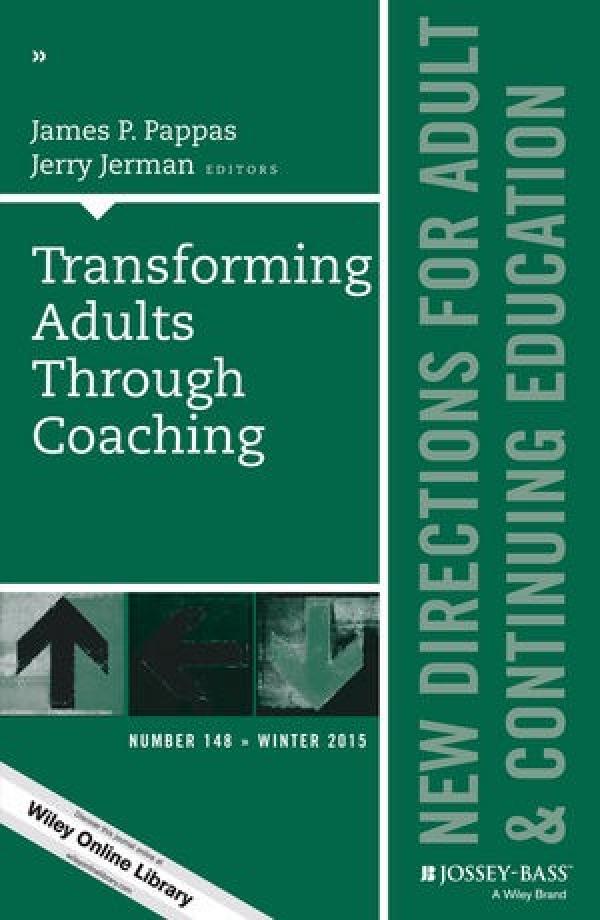
Transforming Adults Through Coaching (New Directions for Adult and Continuing Education, Number 148)
Coaching has grown exponentially as a professional practice and as a discipline in recent years. According to the International Coach Federation (ICF), the number of coaches worldwide increased from some 30,000 in 2008 to 47,000 in 2012. Coaches assist individuals with a variety of vocational and personal issues in both public and private sector organizations. As a result, many clients have become better prepared to reach their workplace and life goals. The field of adult coaching as a discipline has matured considerably alongside the practice itself. For example, studies of best coaching practices and analysis of coaching models abound. Professional organizations have formed and have begun to address such critical issues as training, certification, and ethical standards. Transforming Adults Through Coaching, edited by Pappas and Jerman, provides an introduction to the history, current practices, and possible future of coaching. Each chapter in this compact overview includes material that will benefit scholars, practitioners, and their clients. In particular, there is a solid review of adult development and learning theory with illustrative case studies and pertinent bibliographies. Pappas and Jerman acknowledge in their introduction that clarity is needed when considering what coaching is and is not. It is, they say, neither psychotherapy nor advice giving. Coaching is relational. It is ordinarily practiced with individuals and not groups. And, they underscore, the coaching relationship typically proceeds with a combination of questions and attentive listening. The results, they contend, can be transformative for clients. The first three chapters sketch the parameters for the field of adult coaching. The initial essay by Rachel Ciporen is “The Emerging Field of Executive and Organizational Coaching: An Overview.” Ciporen provides the reader with essential definitions and perspectives on coaching as well as a valuable list of resources for further study. She also notes some of the most common critiques of coaching, such as a frequent reliance on an “overly simplistic view of the learning and change process” (12). Carolyn Coughlin explores a major goal of adult coaching in “Development Coaching to Support the Transition to Self-Authorship.” Her essay describes how coaches, using their knowledge of adult development – especially body and mind theory and practice – can facilitate their client’s movement toward self-authorship. Adult learning theory provides a vital foundation for coaching. Elaine Cox’s contribution, “Coaching and Adult Learning: Theory and Practice,” identifies links between andragogy and transformative learning and how each connects with the practice of coaching. In addition, Cox addresses practical applications of these theories. Brief illustrative dialogues are included to show how the theories can impact actual adult coaching. “Coaching as a Strategy for Helping Adults” by Dorothy M. Wax and Judith Westheim focuses on the kind of issues adult learners bring to the learning environment and how coaching strategies can help them deal with professional and personal obstacles to success. Pappas and Jerman’s closing essay, “The Future of Coaching among Adult Populations,” outlines major directions and critical issues that lie ahead for the field. They underscore not only continued growth for coaching, but also the need for further refinements, including more specialization. These are some of the essays that make this brief collection valuable, not only for coaches and their clients, but for a range of helping professionals and researchers.