Resources
This web page from Drexel University contains suggestions to help you development a learning-centered syllabus, as well as links to sample syllabi and additional readings.
An online “workshop” from Iowa State University that offers tips and suggestions on creating a learner-centered syllabus.
This web page from the University of Michigan offers suggestions on creating a syllabus “students will appreciate and respond positively to.” Included are ideas on setting learning goals, what to include in your syllabus, course policies and schedule/weekly calendar/assignments.
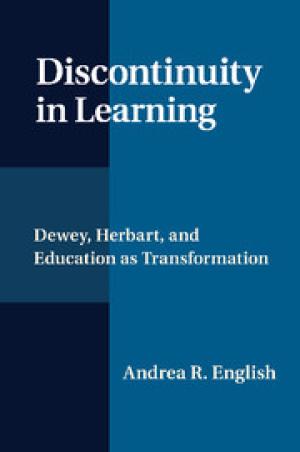
Click Here for Book Review Abstract: In this groundbreaking book, Andrea English challenges common assumptions by arguing that discontinuous experiences, such as uncertainty and struggle, are essential to the learning process. To make this argument, Dr English draws from the works of two seminal thinkers in philosophy of education - nineteenth-century German philosopher J. F. Herbart and American pragmatist John Dewey. English's analysis considers Herbart's influence on Dewey, inverting the accepted interpretation of Dewey's thought as a dramatic break from modern European understandings of education. Three key concepts - transformational learning, tact in teaching, and perfectibility - emerge from this analysis to revitalize our understanding of education as a transformational process. Dr English's comparative approach interweaves European and Anglo-American traditions of educational thought with a contemporary scholarly perspective, contributing to a work that is both intellectually rewarding and applicable to a classroom setting. The result is a book that is essential reading for philosophers and scholars of education, as well as educators. (From the Publisher)

Explores the challenges faculty fathers face in navigating the demands of work and family. For the past two decades, colleges and universities have focused significant attention on helping female faculty balance work and family by implementing a series of family-friendly policies. Although most policies were targeted at men and women alike, women were intended as the primary targets and recipients. This groundbreaking book makes clear that including faculty fathers in institutional efforts is necessary for campuses to attain gender equity. Based on interviews with seventy faculty fathers at four research universities around the United States, this book explores the challenges faculty fathers—from assistant professors to endowed chairs—face in finding a work/life balance. Margaret W. Sallee shows how universities frequently punish men who want to be involved fathers and suggests that cultural change is necessary—not only to help men who wish to take a greater role with their children, but also to help women and spouses who are expected to do the same. (From the Publisher)

Click Here for Book Review Abstract: This book details the legal and historical development of institutional and professorial academic freedoms to better understand the relationship between these concepts. While some judges and scholars have focused on the divergence of these protections, this book articulates an aligned theory that brings both the professorial and institutional theories together. It argues that while constitutionally based academic freedom does its job in protecting both public and private universities from excessive state interference, or at the very least it asks the right questions, it is inadequate because it fails to protect many individual professors in the same way. This solution entails using contract law to fill in the gaps that constitutional law leaves open in regard to protecting individual professors. Contract law is an effective alternative to constitutional law for three reasons. First, unlike constitutional law, it covers professors at both public and private universities. Second, it allows for the consideration of the custom and usage of the academic community as either express or implied contract terms in resolving disputes between universities and professors. Third, contract law enables courts to structure remedies that take into account the specific campus contexts that give rise to various disputes instead of crafting broad remedies that may ill fit certain campus environments. The proposed reconceptualization of academic freedom merges constitutional protection for institutions and contractual protection for individual professors. This combined approach would provide a more comprehensive framework than is currently available under the predominantly constitutional paradigm of academic freedom. (From the Publisher)

Click Here for Book Review Abstract: This practical guide prepares graduate students of color for their first job in academia and offers strategies for succeeding in the early years of a tenure-track position. Through the voices of faculty who have experienced the rigors of the job search and a career in academia, Beginning a Career in Academia offers advice for graduate students of color on how to transition from graduate school to an academic position. This inclusive volume shares perspectives that vary based on gender, racial, ethnic, generational, and disciplinary backgrounds, giving readers an opportunity to reflect on successful strategies for career readiness and for dealing with marginalization. The authors provide recommendations and tips to enhance the job search, identify campus fit, prepare for the interview and negotiation process, address dynamics of of racial and gender politics, find work-life balance, and demystify the promotion and tenure process. This must-read provides candid advice and mentorship for any graduate students of color embarking on a carreer in academe. (From the Publisher)
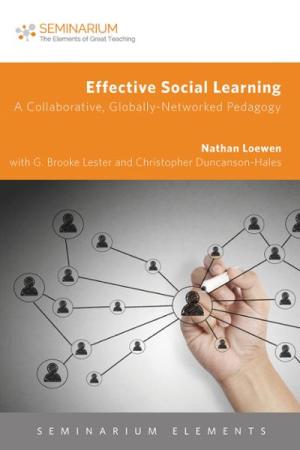
The ground of higher education is shifting, but learning ecosystems around the world have much more space than MOOCs and trendy online platforms can fill, and Loewen shows how professors have an indisputable pedagogical edge that gives them a crucial role to play in higher education. By adopting the collaborative pedagogical process in this book, professors can create effective social learning experiences that connect students to peers and professional colleagues in real time.   Loewen moves beyond surface questions about technology in the classroom to a problem best addressed by educators in bricks-and-mortar institutions: if students are social learners, how do we teach in a way that promotes actual dialogue for learning? Designing learning experiences that develop intercultural competencies puts the test to students’ social inclinations, and engagement with course material increases when it’s used to dig deeper into the specificities of their identity and social location. Loewen’s approach to interinstitutional collaborative teaching will be explored with examples and working templates for collaborative design of effective social learning experiences. This is done by collaborative dialogue with G. Brooke Lester and Christopher Duncanson-Hales. As a group, Loewen, Lester, and Duncanson-Hales create a text that extends pedagogical innovation in inspiring but practical ways. (From the Publisher)
An early demonstration of the value to teachers (and students) of writing the scholarship of teaching (SoTL) by defining a challenge to classroom learning, a “problem” to be investigated (much as we define a problem for our guild research to address) – in this case: learning goals and student pre-knowledge.
Journal Issue. Full text is available online.