Home » Resources » Scholarship on Teaching » Building a Pathway for Student Learning: A How To Guide to Course Design
Scholarship
March 29, 2017
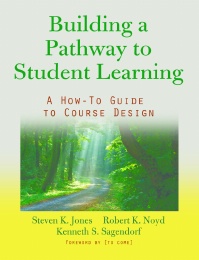
Building a Pathway for Student Learning: A How To Guide to Course Design
- Author
- Jones, Steven K.; Noyd, Robert K.; and Sagendorf, Kenneth S.
- Publisher
- Stylus, Sterling, VA
- ISBN
- 9781579228927
- Table of Contents
-
Foreword (Peter Felten)
Acknowledgments
Part I – Introduction
ch. 1 Our Course Design System and Effective Ways to Use This Book
ch. 2 Principles of Learning-Centered Course Design
Part II – Elements of the Learning Pathway
ch. 3 The Starting Point: Student Learning Factors
ch. 4 Defining the Destination: Learning Goals
ch. 5 Students’ Successful Arrival: Summative Assessment
ch. 6 What Your Students Need to Be Successful: Learning Proficiencies
ch. 7 Travelling the Pathway: Learning Experiences
ch. 8 Staying on Track: Formative Assessment
Part III – Pulling the Elements Together
ch. 9 Visualizing the Learning Pathway: The Course Poster
ch. 10 Students’ Pathway to Success: The Course Syllabus
ch. 11 Anticipating the Challenges Ahead
Appendix A: Rubric for Evaluating Course Posters
Appendix B: Taxonomy of the Psychomotor and Affective domains
Appendix C: Sample Syllabus
References
About the Authors
Index
Click Here for Book Review
Abstract: This book leads you through the process of designing a learning-centered course. It is written as a “how-to” handbook, providing step-by-step guidance on creating a pathway to student learning, including 26 workboxes (also available free online) that lead you through each element of the course design process and promote a rich reflection process akin to being in a workshop setting. The authors prompt you to (1) consider the distinctive characteristics of your students; (2) clearly articulate your course learning goals; (3) create aligned summative assessments; (4) identify the specific knowledge, skills, and attitudes students will need in order to be successful; (5) craft effective learning experiences, informed by the well-documented research on how people learn; and (6) incorporate formative assessment to ensure you and your students are staying on track.
Completion of the sequence of worksheets leads to a poster as a visual display of your course design. This graphic depiction of your course ties the components together, provides a clear map of action for teaching your course, for modifying as you evaluate the success of particular strategies or want to introduce new concepts, and for developing your syllabus. A rubric for evaluating course posters is included.
For faculty developers, this book provides a proven and ready-made resource and text around which to design or redesign learner-centered course design workshops or multi-day course design retreats, replicating or modifying the renowned workshop that the authors have developed at the Air Force Academy for both faculty new to teaching and those with many years of teaching experience under their belt. (From the Publisher)
Abstract: This book leads you through the process of designing a learning-centered course. It is written as a “how-to” handbook, providing step-by-step guidance on creating a pathway to student learning, including 26 workboxes (also available free online) that lead you through each element of the course design process and promote a rich reflection process akin to being in a workshop setting. The authors prompt you to (1) consider the distinctive characteristics of your students; (2) clearly articulate your course learning goals; (3) create aligned summative assessments; (4) identify the specific knowledge, skills, and attitudes students will need in order to be successful; (5) craft effective learning experiences, informed by the well-documented research on how people learn; and (6) incorporate formative assessment to ensure you and your students are staying on track.
Completion of the sequence of worksheets leads to a poster as a visual display of your course design. This graphic depiction of your course ties the components together, provides a clear map of action for teaching your course, for modifying as you evaluate the success of particular strategies or want to introduce new concepts, and for developing your syllabus. A rubric for evaluating course posters is included.
For faculty developers, this book provides a proven and ready-made resource and text around which to design or redesign learner-centered course design workshops or multi-day course design retreats, replicating or modifying the renowned workshop that the authors have developed at the Air Force Academy for both faculty new to teaching and those with many years of teaching experience under their belt. (From the Publisher)