Resources
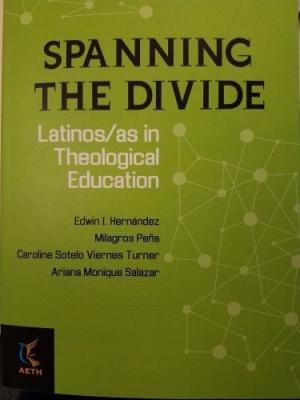
Not a pedagogical tool, “This book provides a detailed look at the current state of Latino/a theological education in the United States” (26). A compilation of research, it begins and ends using data to logically demonstrate the importance of theological education beyond denominations: (1) churches are anchor institutions in areas of poverty that provide critical services which are cost effective; (2) these churches partner to build social capital and personal relationships; (3) seminary educated religious leaders are better prepared to lead such vital churches. However, this is also an issue vital to denominations because demographic and religious adherence data suggest “Hispanic peoples are the future of Christianity” (469). Finally, it is an important issue for seminaries which not only wish to participate in that greater good beyond denomination by addressing diversity, but also wish to attract and retain faculty who are: comparatively young yet experienced, likely to hold more graduate degrees than required and speak more than one language, love teaching and excel as educators, are hard-working and open-minded, view their academic work as a vocation and persevere in their denominational affiliation, and who have a natural proclivity to span divides among races, partisan politics, languages, ethnicities as well as between seminaries and local churches. These are all descriptors of Latina/o faculty. Though lengthy, the book is an easy read due to its helpful introduction and chapters that both provide both an opening summary and concluding recommendations. Chapter ten is the most challenging because it moves the discussion beyond inclusion to justice: “push against tokenism, stereotyping, monocultural curricula….recognizing scholarship and teaching….[push for] greater transparency…” (326). Two chapters provide case studies on seminaries that are models of this inclusive justice. Another chapter describes the worthy efforts of the Hispanic Summer Program and the Hispanic Theological Initiative, both important partners for schools serious about increasing the number of their Latino/a faculty, which is a key take-away because “Latino/as beget more Latino/as” (445). Every positive outcome documented appears predicated on the presence of Latina/o faculty. Chapter thirteen is a groundbreaking study of Bible Institutes. Among the most important recommendations is a kind of mutual mentoring. Latina/o faculty need and want to be mentored; non-Latino/a deans and presidents with good will but poor skills concerning diversity would profit by listening to those faculty. If they do, everyone benefits. Another urgent need is continual training on diversity for faculty, students, staff, administrators, and board members. “Through Hispanic Eyes” (chapter fourteen) serves as an example. Although not exhaustive, the bibliography is comprehensive. An index would have been helpful, and given the repeated assertion that Catholic seminaries compare well to their Protestant counterparts, a case study of a Catholic seminary seems missing. Nonetheless, this is not a book to be shelved or filed, but rather one to spark necessary debate and urgent action.
Brazilian writer Eliane Brum tells this story: Vanderley was a man who used to go to an agriculture fair in the south of Brazil with a broomstick saying that this broomstick was a pure breed horse. He was known around as the “little cuckoo guy.” One day I asked him, "Are you really Cuckoo Vanderley?" And he said, "Don’t you think I know this isn’t a pureblood horse? That this is just a stick? But this is my way of thinking about that which I will never have.” Perhaps we teachers could be more like Vanderley, a little cuckoo, imagining that which we cannot think, have, or teach, and make it our own. Perhaps we can engage a double pedagogical movement: to listen to those students who actually have a broomstick and see what meanings they give to it, and help those students who don’t have one to invent a broomstick as a pure breed horse, or whatever else, and make it their own. Our classrooms need an inventory of broomsticks! Broomsticks that can give us a sense of our reality. In order to do that we need more art! Art helps us access the madness of our realities. Art helps us think and feel differently. Art gives us access to different forms of reasoning of our bodies and our relations in our world. Art wires our brain differently. Art gives us a space beyond objectivity so we can venture into the unknown in order to reshape our realities. Unfortunately, our pedagogies are often centered in objective knowledge, positivistic thinking based on progress, and detached forms of thinking that celebrate a necessary distance between the seeing and the thing seen. Sadly enough, this form of knowledge can’t catch our realities from the point of view of Vanderley. We need something else. We need other venues and forms of thinking that can help us invent and imagine something that can actually affect our reality. We feel that our objective words can grasp our reality in some forms and yet, it feels also that what we say is like unopened letters that end up returning to us.[1] We can’t be transformed only by precise objective readings of our reality. We need the enchantment of the unknown, gray areas of thoughts and beliefs, the uncontrolled parts of our lives, the broomsticks of Vanderley. The Brazilian theologian, poet, philosopher, and sociologist Rubem Alves lived in the academy for many years and produced many books. One day he realized that his kind of work wouldn’t change people. He then started to write short essays and children stories. With the theoretical knowledge he gained, he delved into the abyss of the quotidian life of people by way of children stories. He would mix Escher, Camus, Bachelard, Bach, Celan and many others with daily events in life. I was introduced to art by his theo-poetics writings. In my classrooms, I am growing more skeptical of only objective readings of realities. We are lost trying to grasp the ever-expansive disasters of our lives. We need rituals! We need art to tap into that aspect where objective knowledge can’t go. Words alone can’t do it. We need other mediums to express the absurd of our present, to retell stories of pain and trauma of our past and imagine our future. Without addressing the present, reshaping the past, and gaining a good sense of future we will be lead to a future that will continue not to be ours. However, life will be given to those who can invent life in its multiple, timely possibilities. And for that, we need new partners! When we bring Doris Salcedo to our classrooms we have a much-expanded way of addressing violence, trauma, and loss. When we invite Tania Bruguera and Weiwei to present their works to us, we can have a better sense of repressive governments and societal systems. It is when we wrestle with Favianna Rodriguez, Justin Favela, Guillermo Gómez-Pena, Jacob Lawrence, Kerry James Marshall, and Alvin Ailey Dance that we can wrestle with a flow of white supremacy, race and identity politics. When we deal with the artist Banksy, we can learn about social contestation. When we engage Giuseppe Campuzano and Miguel A. López, we see new figurings of sexualities and gender nuances and immensities. When we open up to know Raven Chacon, Cristóbal Martínez, and Kade L. Twist, we can see the complex collective interdisciplinary environmental colonial/postcolonial gaze of native people. It is when we listen and watch Mona Haydar, Beyoncé, and Kendrick Lamar, we can deal with the cultural racial pop culture. We indeed need more art in our classroom! But we have many challenges to do that. First, we don’t feel we have enough expertise to do it. We would need to learn how to teach it. Second, we don’t know what to do to assess it. Once in a faculty meeting, I heard from friends that they wish they could use more art but they don’t have criteria to evaluate any work of art. Third, art doesn’t seem to have the same academic weight. We all know the fight Cornel West had to undergo at Harvard when he was accused by the president Lawrence Summers for not doing proper scholarship when he ventured into recording a rap CD. Yes, to use art we need to cross these boundaries. We have to venture into that weary space in order to know a little more. But we can start by looking and imagining. And helping our students to look and invent as well. The best “final projects” in my classes are the ones students can imagine and invent. Perhaps we can give up a little of our sense that we have to control every corner of what is to be taught, both for proper reasoning and meaning, but also for coherence. Not to dismiss intellectualism and proper theoretical work, but to actually expand it for better ways to grasp life. Perhaps we can start by trying some new things out. GO visit a museum, a street artist, a mural. Perhaps we can start by listening to a song, watching a performance in a video, looking at a picture. And let the artists help us expand ourselves and our imagery/imagining. They might help us dream, invent, figure out something else! They might help us see that Vanderley’s broomstick is indeed a pure breed horse! And that we desperately need one too! [1]Eliane Brum, O Brasil desassombrado pelas palavras-fantasmas. Como o sonho e a arte podem nos ajudar a acessar a realidade e a romper a paralisia, https://brasil.elpais.com/brasil/2017/07/10/opinion/1499694080_981744.html Resources: http://www.stedelijkstudies.com/journal/transvestite-museum-of-peru/ https://www.youtube.com/watch?v=idMJIEFH_ns http://postcommodity.com/About.html http://favianna.tumblr.com
In a previous blog post, I sounded an optimistic note about the believing educational community that engages profoundly with various streams of the religious tradition – in my case, the Muslim tradition. As I contemplate a valuable piece by SherAli Tareen on the potential issues with which we regard as critical secular pedagogy, I anticipate some of the pedagogical decisions I will make this semester. I teach at the American Islamic College, one of only two Islamic liberal arts colleges in the United States. This generates a unique and continuing set of pedagogical and disciplinary questions for me - questions that I do not usually find reflected in my colleagues’ pedagogical concerns regarding the teaching of Islam in the academy. My feelings of - shall we say, comfort – in teaching Islam to mostly Muslim students are tempered by practical pedagogical concerns as I am a Muslim, female professor who teaches gender at a Muslim college in the United States. Apart from the study of religion, classroom spaces in general can be battlegrounds for identities. A dash of critical distance can be a useful addition to the red-hot dynamics in classroom discussions. I nervously anticipate certain pedagogical situations in Muslim-majority learning settings as my own, as well as in mainstream academia, where critical distance is my go-to approach. Most of my Muslim students are eager to understand diverse perspectives on religious issues, and have been astoundingly eager to broaden their horizons, even to the point of intellectual discomfort. Still, I have learned to expect the Guerilla Student. He (usually) does not form a majority in my classes. But when he makes an appearance, he steps into the academic fray, brandishing a Qur'anic verse, intent upon shutting down any "wayward" discourse. As the class community contemplates various religious perspectives on Muslim politics, this student brings in And be not disunited (Qur’an 3:103). The discussion quickly falls flat, everyone hangs their heads piously, as if to contemplate the frivolity of human words before the Word, and that is that. Or the Guerilla Student lobs a Prophet tradition into the controversy, and the hadith instantly establishes a literalistic, atomistic framework over the intellectual community - a framework that allows for a singular one-dimensional view of religion, and therefore, shuts down discussion as unnecessary or even reprehensible. A young fervent woman might react negatively to the complexification of a religious problem, demanding a simple response to her “Well, should I do it or not?” The impact of such guerrilla warfare is to silence, at least temporarily, the majority of students who are interested in investigating the sociological implications of religious norms, who wish to explore the contextual deployment of religious sources, and who are interested in a religious world where people disagree. In other words, says the Guerilla Student, let's just shut our books and our mouths, and retire to our corners and recite Qur'an. Not that I haven't frequently been tempted to do the same, because ambiguity isn't exactly soothing. In anticipation of the Guerrilla Student, I set up a classroom community where, most importantly, students must engage with the required readings in all discussions. No one can simply show up without doing any of the work and, swaggering, simply toss the grenades of Scriptural texts amidst the group. Anyone who hasn’t done the reading will be reminded that entrance to discussion is guarded by the test of academic work. I explicitly state in my syllabus: "You must develop the analytic habit of considering various perspectives, including opposing ones." This is troubling to the student who regards feminist interrogations of the Qur’an as disrespectful and impious. To some, these readings are not worshipful. For students who study Islam to seek piety rather than profound understanding, this is a distraction. For some Muslim students, a Gender course would be better served by Maudoodi’s Purdah and the Status of Women in Islam rather than Kecia Ali’s Sexual Ethics in Islam. I add, in my syllabus, "In this academic setting, all claims and opinions must be supported by scholarly evidence and reasoning." In these words, I establish that the setting was an academic one, and not a religious one. To some students, this is disappointing. To me, as a religious Muslim academic, it’s not entirely truthful. I do regard academic Islam as worship. Moreover, the evidence expected is human scholarship. This establishes the importance of interpretation. To the believer who sees his or her interpretations as self-evidently true, this is blasphemous. When I classify my classroom as an academic one, I clarify that no one may come in with their credentials as local imam and become the lecturer here. In terms of my role as facilitator and my authority as course instructor, a religious educational setting is dangerously democratic. A religious classroom demands clerical or seminary/madrasa credentials; with my Ph.D., I am not appropriately appareled. Any public preachers, study-circle leaders or madrasa-trained males could always turn up their noses at my Western academic credentials. And then there is patriarchy. As a woman - of color (and of short stature) - my pedagogic authority is always at risk in all classrooms. Most of my Muslim students bring a deeply Islamic affectionate respect to my teaching. In fact, my Muslim students at AIC humanize and respect me in a way that, in my previous teaching experience, many of my White students never did. I cannot express how deeply refreshing this teacher-student relationship is, in contrast to the experiences I had before. But there has been the occasional male student - especially when I taught Islam & Gender - who finds the dynamic in my class intolerable. At times, such a student drops the class, but not before lobbing the Scriptural grenades and disrupting the analytic discussion. If he simply evades the readings, he succeeds in getting by in a disturbingly water-off-a-duck’s-back manner. A student committed to patriarchy could not stomach the idea of a female professor who taught Amina Wadud and Leila Ahmed - or a female professor who gave out C's. When Islam is used as a patriarchal stick to establish the authority of literalism, or Islamism, or Traditionalism, or sexism, critical distance in pedagogy can be a handy shield. When the literalistic, patriarchal, hegemonic interpretations are brandished in my classroom, I do sometimes brandish certain critical secular tools. "We cannot throw out ayaat or ahadith as responses to a question. You can bring your readings of those sources to the discussion, but they are readings. You cannot use the Qur'an to shut everyone up.” "But," sputters a certain kind of student, “It should shut everyone up.” This critical distance and interpretive freedom is widely regarded as critical secular pedagogy. But it is not just that. To me, as a Muslim professor, it is also an internal Muslim tool to safeguard the right to ikhtilaf (difference of opinion). But when I embrace this tool of critical distance as an Islamic one, there is always the danger that we commence the battle of my-source-trumps-yours. Appeals to religious authority in religious settings can close debate. I respect and value the sources, but there is a danger in how they are deployed by my interlocutors. The problem isn’t the Qur’anic verse being lobbed by the student. In such pedagogical encounters, I’m at the mercy of the Guerilla Students. I’m hostage to the personality of the discussant at risk, to his conception of adab (etiquette) in Islamic education. Any pedagogical approach must necessarily be multi-faceted and respectful of its context. As a Muslim professor of Islamic Studies, I combine a believer's loving commitment with an explorer's dedication to the journey. I ask my students to bring the same intrepid commitment to this path. No woman or man will be allowed to blow up the trail. I'll deploy any tools necessary to protect the trail. Critical distance is one of those tools. Critical distance is frequently used in secular settings to shut down Muslim critiques of dogmatic secularity. But my critical distance is different. It is a protective distance of love.

The creation of a successful learning environment involves the examination and improvement upon current teaching practices. As new strategies emerge, it becomes imperative to incorporate them into the classroom. Student-Driven Learning Strategies for the 21st Century Classroom provides a thorough examination of the benefits and challenges experienced in learner-driven educational settings and how to effectively engage students in these environments. Focusing on technological perspectives, emerging pedagogies, and curriculum development, this book is ideally designed for educators, learning designers, upper-level students, professionals, and researchers interested in innovative approaches to student-driven education. Topics Covered The many academic areas covered in this publication include, but are not limited to: Literacy Development Non-Traditional Students Reflective Learning Self-Management Strategies Service Learning Student Creativity Virtual Learning (From the Publisher)

I owe a great deal of my pedagogical approach to Vincent and Rosemarie Harding. The way I teach has been profoundly impacted by watching and learning from these activist teaching elders in the Black-led freedom struggle. Have you ever had a teacher who was a good story teller? A teacher who was so good that he or she pulled you into the teaching moment and it made you feel as though you were living history? Have you had a teacher who was so authentic, so responsive, so tuned in that you felt like you could make change? The Hardings, and teachers like them, keep this at the center of their teaching relationships and community. Some other characteristics these kinds of master teachers have in common are: 1) Personal lives that are consistent with what they teach about social change and justice, 2) A belief that every person has someone in their ancestry that has been a social change agent, 3) The conviction that the stories of ordinary people can be used to inspire others, and 4) A belief that religion is a force for justice. Let me give an example of such a model. A small crowd gathered at Pendill Hill retreat center to listen to Black-led freedom struggle elder Vincent Harding. Harding made his way to the front of the room. He sat down and looked over the crowd. He began to speak. In that moment the room grew quiet and even my restless three-year-old crawled off my lap, stood, and waited in anticipation. After a few warm smiles and opening remarks, in his own Harding way, he led us in a conversation. It was a truly dialogical experience. Harding invited the body of people gathered to share their own stories as he shared his own. During the remainder of the program, one could sense the ancestors among us. As the evening drew to a close, Harding shared a deeply moving piece on the last time he saw Martin Luther King Jr. He told us how he and three other men had been asked by Corretta King to stand nonviolent watch over King’s body as it lay in state in Atlanta. Harding drew the midnight to morning shift. He reminded us that the only people coming to pay their respects at that time of the night were either coming from work or going to work. “Martin’s people.” These were not celebrities or dignitaries, but the people of the movement. He tearfully talked about a nurse and man who had been to the bar before coming. As the evening closed, Harding asked sister Sonia Sanchez to do a piece of spoken word. Sanchez moved the community with a 15-minute piece she created from hearing the stories of the people present. Sadly, this would be the last time I would hear Vincent Harding talk in public. However, the evening reflected the pedagogy created by Rosemarie and Vincent Harding, that is, circles of people listening and learning from one another. Both Vincent and Rosemarie Harding were awe-inspiring master teachers who made their students/participants understand they too were a part of movement-making and the Beloved Community. They were the kind of teachers that many of us seek to be to our students. It is these models that guide me in helping students to learn about their own justice roots. Creating the space for students to listen and to reflect is important if we want to connect them to social justice movements. In religious studies, as well as in peace studies, one of the goals is to make students feel connected to what is taking place socially and politically. Students often come into religious studies classes looking for a place to explore the big questions about life and to learn what others think. Combining the idea of connecting students socially and politically with an opportunity to explore the big questions opens a space for students to find their religious justice roots. Here are some exercises I use in my religious studies and peace studies classes to foster student’s investment in social change while providing an opportunity to think about their religious justice roots: Students read Vincent Harding’s “Do Not Grow Weary or Lose Heart” and Grace Lee Boggs’ “In Person.”[i] Afterwards I give this prompt: Each of us finds inspiration for how we want to live our lives. Many of us have an understanding of what it means to stand up for what is right or just. Places of inspiration can be family (or family-like) legacies. Students may choose to write a paper about someone in their family that inspires them to be a just person. The student should clearly identify the person in their family (or someone they would consider like family) that inspires his or her life. What did they do? How did you learn about this person? How does the person relate to your sense of social justice and what is right? How does this relate to what the authors had to say in their articles? Students read Rosemarie Freeney Harding and Rachel E. Harding’s book Remnants A Memoir of Spirit, Activism, and Mothering over the course of the semester.[ii] About every two weeks there are small group discussions about the readings in class. Students are prompted to discuss their understanding of the readings, but they are also asked how the readings relate to religion, politics, community, family, and justice. The book is written in such a way that students quickly find things to which they can relate. The end of the semester assignment is a reflection on the connection between religion, family, community, and justice. At the end of the semester, it is always my hope that students find their roots in social justice. For many, their roots are in religious communities and family. Once students have established their roots, they begin to grow into the movement for justice. [i] Vincent Harding, “Do Not Grow Weary or Lose Heart,” Veterans of Hope Project. http://www.veteransofhope.org/do-not-grow-weary-or-lose-heart/. Accessed 25 July 2017. Grace Lee Boggs, “In Person.” In These Times. http://inthesetimes.com/inperson/4060/grace_lee_boggs. Accessed 25 July 2017. [ii] Rosemarie Freeney Harding and Rachel E. Harding, Remnants A Memoir of Spirit, Activism, and Mothering (Durham: Duke University Press, 2015).
Wabash Center Activities at the Annual AAR-SBL Conference How Learning Works: Research on Learning as a Resource for Teaching AAR-P17-109/SBL-P17-201a Friday - 12:00 PM–5:30 PM Hynes Convention Center-107 (Plaza Level) Space is limited. Pre-registration is required. Send an email to Beth Reffett, reffettb@wabash.edu Faculty of Color Luncheon AAR-P18-127/SBL-P18-201b Saturday - 11:30 AM–1:00 PM Hynes Convention Center-107 (Plaza Level) This mealtime gathering is a space for fellowship, mutual support, and empowerment for our teaching lives. Pre-registration is required. Send an email to Beth Reffett,reffettb@wabash.edu. Registration deadline is November 1. Walk-ins may also be accepted if space is available. Pedagogical Uses of Social Media: Twitter, Facebook, and Beyond AAR A18-144/SBL-S18-201a Saturday ‐ 11:30 AM‐1:00 PM Hynes Convention Center‐303 (Third Level) Co‐sponsored by the Wabash Center and the AAR & SBL Student Advisory Board Please join us for lunch and conversation. Pre-registration is strongly encouraged; please email Bhakti Mamora (bhaktim@ufl.edu) to reserve your spot. Registration deadline isNovember 1. Walk-ins will be accommodated if space permits. Introduction as Subversion: On Liberal Arts Religious Studies Pedagogy for Non‐majors AAR-A18‐233 Saturday‐ 1:00 PM‐3:30 PM HynesConvention Center‐107 (Plaza Level) Online Teaching and Biblical Studies SBL-S18-234 Saturday 1:00 PM to 3:30 PM Vineyard (Fourth Level) - Boston Marriott Copley Place (MCP) Hosted by the SBL Professional Development Committee and Wabash Center. As online and hybrid courses proliferate in higher education this panel will consider the special opportunities and challenges for teaching various aspects of biblical studies in an online or hybrid format. Wabash Center Reception AAR-P18-403/SBL-P18-402 Saturday – 8:00 PM-10:00 PM Marriott Copley Place-Gloucester (Third Level) All are invited to come celebrate our 20 years of publishing the scholarship of teaching in Teaching Theology and Religion. Grant Design Conversations AAR-P19-118/SBL-P19-154a Sunday - 9:00 AM–11:30 AM Hynes Convention Center – 107 (Plaza Level) Do you have a grant idea for a project on teaching and learning?Come see us in the Convention Center Room 107 to meet with one of the Wabash Center Staff. We are scheduling appointments ahead of time. ContactBeth Reffett,reffettb@wabash.eduto schedule a time to meet with us. Teach with Confidence: “Difficult Conversations” in the Classroom(Graduate Student Lunch and Session) AAR-P19-119/SBL-P19-159 Sunday – 11:30 AM-1:30 PM Hynes Convention Center-107 (Plaza Level) Graduate students please join us for lunch and interactive presentation about teaching in higher education.Pre-registration is required. Please email Beth Reffett,reffettb@wabash.eduto reserve your spot. Registration deadline is November 1. Walk-ins may also be accepted if space is available. Seminary Teaching & Formation Online AAR-P19-204/SBL-P19-250a Sunday - 2:30 PM-4:00 PM Hynes Convention Center-107 (Plaza Level) Dinner for New Teachers (Invitation Only Event) AAR-P19-402/SBL-P19-348 Sunday - 6:30 PM-8:30 PM Marriott Copley Place-Simmons (Third Level) Grant Design Conversations AAR-P20-101/SBL-S20-149a Monday - 9:00 AM–11:30 AM Hynes Convention Center – 107 (Plaza Level) Do you have a grant idea for a project on teaching and learning?Come see us in the Convention Center Room 107 to meet with one of the Wabash Center Staff. We are scheduling appointments ahead of time. ContactBeth Reffett,reffettb@wabash.eduto schedule a time to meet with us. "Wabash Center Lounge" Come by and visit us when we’re not in session. Room 107 Hynes Convention Center :-D Other sessions on teaching
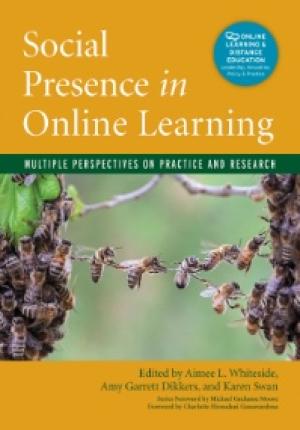
Click Here for Book Review Social presence continues to emerge as a key factor for successful online and blended learning experiences. It is commonly described as the degree to which online participants feel connected to one another. Understanding social presence with its critical connections to community-building, retention, and learning outcomes allows faculty and instructional designers to better support and engage students. This volume, Social Presence in Online Learning, addresses the evolution of social presence with three distinct perspectives, outlines the relevant research, and focuses on practical strategies that can immediately impact the teaching and learning experience. These strategies include creating connections to build community, applying content to authentic situations, integrating a careful mix of tools and media, leveraging reflective and interactive opportunities, providing early and continuous feedback, designing with assessment in mind, and encouraging change in small increments. Because student satisfaction and motivation plays a key role in retention rates and because increased social presence often leads to enriched learning experiences, it is advantageous to mindfully integrate social presence into learning environments. Social Presence in Online Learning brings together eminent scholars in the field to distinguish among three different perspectives of social presence and to address how these viewpoints immediately inform practice. This important volume: • Provides an overview of the evolution of social presence, key findings from social presence research, and practical strategies that can improve the online and blended learning experience • Differentiates three distinct perspectives on social presence and explains the ideas and models that inform these perspectives • Explores specific ways in which social presence relates to course satisfaction, retention, and outcomes • Offers practical implications and ready-to-use techniques that are applicable to multiple disciplines • Introduces current research on social presence by prominent researchers in the field with direct inferences to the practice of online and blended learning • Looks at future directions for social presence Social Presence in Online Learning is appropriate for practitioners, researchers and academics involved in any level of online learning program design, course design, instruction, support, and leadership as well as for graduate students studying educational technology, technology-enhanced learning, and online and blended learning. It brings together multiple perspectives on social presence from the most influential scholars in the field to help shape the future of online and blended learning. (From the Publisher)
Click Here for Book Review Teaching the Whole Student is a compendium of engaged teaching approaches by faculty across disciplines. These inspiring authors offer models for instructors who care deeply about their students, respect and recognize students’ social identities and lived experiences, and are interested in creating community and environments of openness and trust to foster deep-learning, academic success, and meaning-making. The authors in this volume stretch the boundaries of academic learning and the classroom experience by seeking to identify the space between subject matter and a student's core values and prior knowledge. They work to find the interconnectedness of knowledge, understanding, meaning, inquiry and truth. They appreciate that students bring their full lives and experiences—their heart and spirit—into the classroom just as they bring their minds and intellectual inquiry. These approaches contribute to student learning and the core academic purposes of higher education, help students find meaning and purpose in their lives, and help strengthen our diverse democracy through students’ active participation and leadership in civic life. They also have a demonstrated impact on critical and analytical thinking, student retention and academic success, personal well-being, commitments to civic engagement, diversity, and social justice. Topics discussed: • Teacher-student relationships and community building • How teaching the whole student increases persistence and completion rates • How an open learning environment fosters critical understanding • Strategies for developing deep social and personal reflection in experiential education and service learning The authors of this book remind us in poignant and empirical ways of the importance of teaching the whole student, as the book's title reflects. (From the Publisher)
Click Here for Book Review This powerful book explores how institutions of higher education can successfully serve “breakaway” students—first-generation, low-income students who are trying to break away from the past in order to create a more secure future. The gap between low-SES and high-SES students persists as efforts to close it have not met with great success. In this provocative book, Gross offers a new approach to addressing inequities by focusing on students who have succeeded despite struggling with the impacts of poverty and trauma. Gross draws on her experience as a college president to outline practical steps that postsecondary institutions can take to create structures of support and opportunity that build reciprocal trust. Students must trust their institutions and professors, professors must trust their students, and eventually students must learn to trust themselves. Visit the book’s website at breakawaylearners.com.(From the Publisher)
Click Here for Book Review Flipped learning is an approach to the design and instruction of classes through which, with appropriate guidance, students gain their first exposure to new concepts and material prior to class, thus freeing up time during class for the activities where students typically need the most help, such as applications of the basic material and engaging in deeper discussions and creative work with it. While flipped learning has generated a great deal of excitement, given the evidence demonstrating its potential to transform students’ learning, engagement and metacognitive skills, there has up to now been no comprehensive guide to using this teaching approach in higher education. Robert Talbert, who has close to a decade’s experience using flipped learning for majors in his discipline, in general education courses, in large and small sections, as well as online courses – and is a frequent workshop presenter and speaker on the topic – offers faculty a practical, step-by-step, “how-to” to this powerful teaching method. He addresses readers who want to explore this approach to teaching, those who have recently embarked on it, as well as experienced practitioners, balancing an account of research on flipped learning and its theoretical bases, with course design concepts to guide them set up courses to use flipped learning effectively, tips and case studies of actual classes across various disciplines, and practical considerations such as obtaining buy-in from students, and getting students to do the pre-class activities. This book is for anyone seeking ways to get students to better learn the content of their course, take more responsibility for their work, become more self-regulated as learners, work harder and smarter during class time, and engage positively with course material. As a teaching method, flipped learning becomes demonstrably more powerful when adopted across departments. It is an idea that offers the promise of transforming teaching in higher education. (From the Publisher)