Book Reviews
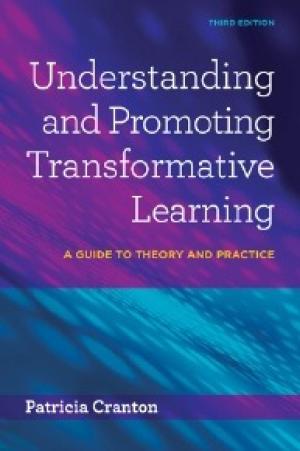
In the third edition of Understanding and Promoting Transformative Learning, Patricia Cranton provides new insights into the field of transformative learning. Cranton promotes transformative learning, addresses transformative learning theory, and offers strategies for the concept itself. The author examines and promotes transformative learning in multiple contexts: higher education, business industry, government, health professions, nonprofit organizations, and community development. Cranton traces the origin of the concept of transformative learning and then gives a full description of the theory from an integrative perspective. In doing so, she shows the reader that transformative learning takes place both individually and communally. A minor weakness of the book is its use of specialized psychological terminology; the reader unfamiliar with it may lose focus on the overall purpose of the book as they strive to understand the meaning of particular words and phrases. That said, the book is helpful for understanding transformative learning theory, practice, and strategy. These insights alone aid faculty in developing effective teaching strategies to advance student learning. In addition, the author shows not only the importance of the subject, but how it can be used in real life applications. This book is valuable because it focuses on the core of what it means to learn. At the forefront of this learning is an acknowledgement of various ways of knowing and the author provides examples of these. I was particularly drawn to the section that discusses dialogue, discourse, and support. This section of the book resonates with me because it fits into my own theory of critical pedagogy. The student should be impacted by learning in such a way that it transforms not only the learner, but the learner’s society as well. Understanding and Promoting Transformative Learning is particularly valuable for helping educators see their role in the learning process. The methodology described throughout the book leads to self-reflection, critical reflection, and thinking about how one’s teaching may fit into contemporary contexts. Furthermore, it converts the process of reflection into active participation in society. Additionally, the book discusses empowerment and the importance of dialogue to this process. This book is valuable in its demonstration of how dialogue is critical to transformative learning and can help the reader see how this affects student self-awareness and consciousness. Overall, I found this book to be a valuable asset for those interested in social justice and especially for teachers interested in transformative learning.
Editors Cano and Ion offer a group of international voices in their contribution to the Advances in Higher Education and Professional Development Book Series (series editor, Jared Keengwe), with this volume focusing on innovative practices in assessment. The book’s organization structure involves general contents followed by a detailed table of contents with full abstracts for each chapter, then a thorough summary of each of the twenty authors’ works in the preface before turning to relevant chapters. Such a format facilitates pinpointing the reader’s interest in particular methodologies for assessment, measurement, and data-gathering. The volume itself is divided into three main sections: (I) Theoretical Approaches on Students’ Assessment, (II) Research-Based Evidences on Assessment, and (III) Innovative Practices in Students’ Assessment. The editors claim that the purpose of their book is to attend to an international level of assessment innovation with a triple perspective (theoretical, practical, and research-based), that integrates theory and practice to enrich the field of assessment (xvii). Authors have created scenario-specific assessment innovations and practices in each of their chapters so readers have a variety of choices from which to draw ideas. Section I focuses on engaging students in self-, peer-, and professor-based assessment loops. Self-regulated learning that is based on assessment, both in face-to-face and online environments, is addressed in the chapters one through three, and six. Competency-based assessment, where student competencies are measured against standards of performance, is illustrated in chapter four. “Brain-Based Learning” discusses the neuroscience of feedback and application to contexts in chapter five. “Comparative Judgement” is introduced in chapter seven as an alternative assessment domain to counter standardized tasks and test scoring. Section II moves to research about assessment versus testing cultures, beginning in chapter eight with meaning-oriented learning rather than recall and recognition learning. Research in this chapter shows that students will make the effort to succeed when asked to do more complex thinking than is required for standardized testing. Feeding back and feeding forward are discussed as case studies and analyses in chapters nine and ten. Self-direction and student participation are also analyzed in case studies in chapters eleven and twelve, followed by online assessment projects conducted in Portugal and Spain in the remaining two chapters of this section. Section III names innovative practices in student assessment. The remaining chapters in the book (fifteen through twenty) attend to pedagogical approaches to incorporate assessment into the learning endeavor. The chapters include case studies and strategies. Practical applications including project-based learning and formative assessment are outlined by each set of authors. The book is a reference resource, best used by browsing topics and making choices about which innovative approaches to assessment best fit one’s own context. There is some overlap in authors’ experiences, reinforcing the validity of the international research and pedagogical approaches. This resource, filled with illustrations, should be available in libraries for institutions of higher education that are working on self-study and self-assessment. There is much here to aid teachers in honing their attention to assessment excellence as part of the pedagogical task.
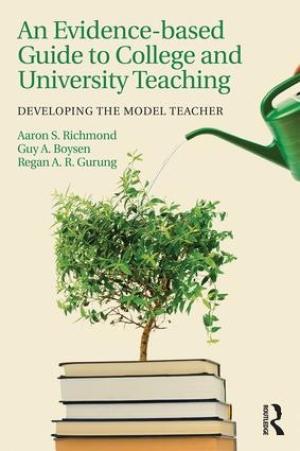
Richmond, Boysen, and Gurung’s work provides a much-needed resource for new teachers and is valuable to experienced teachers as well. The text is both concise and comprehensive concerning the current state of the Scholarship of Teaching and Learning (SoTL). The authors are psychologists who include their disciplinary insights, as well as provide important examples and resources from disciplines in the sciences, social sciences, and humanities. Chapters one and two set up the context of the “model teacher.” Rather than providing an essentialist answer to the definition of the model teacher, the authors focus on behaviors that produce consistent ideal results in the classroom. Chapters three through five – focused on teacher training, instructional methods, and student learning respectively – are useful to new teachers. As a text for initiating teachers, these chapters provide a reliable systematic introduction to key ways in which teachers interact with students in the classroom. These chapters should be complemented with discipline-specific examples or readings in graduate school teaching programs. Chapters six and seven on assessment of student learning and syllabus construction are the most valuable to teachers at any stage in their career. The insights into the scholarship on assessment is invaluable for the development of class, departmental, and university-wide curriculum. These two chapters are the most practical chapters for reconsidering the significance and purpose of teaching strategies and assignments. Finally, chapter eight examines student evaluations. There are many important insights in this chapter for new teachers on how to engage meaningfully with student summative evaluations. One point of interest was the authors’ statement on the significance of student satisfaction with a course. The authors could have included a lengthier conversation on how to meaningfully address the question of student satisfaction. In the end, “evidence-based” means that one organizes the multiple resources we employ in higher education in a way that substantiates the claims we wish to make. This text provides concrete advice that is useful for the novice; it is also a helpful aid for anyone wishing to mentor others in the art of teaching. An Evidence-based Guide to College and University Teaching employs an engaging hypothetical dialogue with the reader and an interactive approach. There are self-assessments at the beginning and end of each chapter along with hypothetical case studies for each chapter. An appendix at the end presents the uninterrupted self-assessment scale on sixty-four criteria for model teachers. These elements are excellent resources for group discussion in graduate seminars or faculty retreats. This book presents an accessible synthesis of the SoTL literature. It is successful as a gateway resource to the dialogue from the last forty years on pedagogical best practices. The text is limited in terms of the depth that it covers given the myriad topics it addresses, but it provides a solid beginning to engage the conversation.
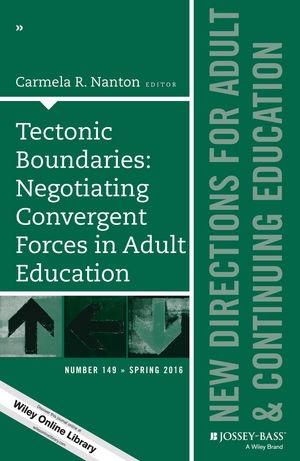
This slender volume presents a collection of essays examining concerns for adult education. The first chapter frames the problem with the concept of “liquid modernity,” which is the idea that structures such as family, occupation and career, and social life are fluid in an unprecedented way (12). Education and informal learning serve learners if they teach them how to navigate complex contexts and to recognize and adapt to changing circumstances. The metaphor of “tectonics” is used to describe forces which are sometimes convergent, divergent, and/or transformative in adult learner’s lives (93). This metaphor underscores the paradox that for adult learners, education needs to complement the structures of their lives while at the same time responding to the modern world’s shifting demands. Other chapters explore various contexts of adult learning. Chapter Two discusses the concerns of adults learning English as a second language. As immigrants, these learners are in transition, adjusting to new circumstances and a new culture. In order to make their education meaningful and engage them in learning, the authors describe strategies of using prompts to get students speaking and writing about their lives and their experiences to practice English, to engage students, and make their education meaningful (25). Chapter Three describes the growth of job clubs among communities of African-American women. These clubs are often attached to other institutional social networks in their lives, such as faith-based communities. These networks facilitate informal learning by providing tips and resources for members to update their skills. Chapter Four addresses education for the dissemination of health information, describing interrelated cultural, social, and economic factors that impinge on health education and which in turn impact health care outcomes. Chapter Five takes the digital native versus digital immigrant divide to examine intergenerational differences in approaching education. The challenge for educators is to design educational content which engages natives yet is also friendly and inviting for immigrants, and to shift the mode of adult education from thinking about teaching to thinking about learning. Chapter Six describes the significance of the ancient art of storytelling, not just to preserve culture, but to evoke and shape the meaning of life experiences for adult learners. Chapter Seven begins with the context of a post-recession economy in which low-skilled workers are increasingly vulnerable. This context provides the foundation for a discussion of the role of adult education: to build human capital, to make better citizens, and to enrich the course of learner lives. Chapter Eight outlines problems of delivery, credit, and accreditation that result from the tectonic shifts of the modern digital age. These shifts include such varied educational modes and attainments as badges, MOOCs, and "direct assessment competency-based programs" (87). The book’s strength rests in its ability to point to the concerns that frame contemporary adult education, although it does not describe pedagogical strategies in an equally consistent fashion. The book ends with the important reminder that in adult education, negotiation is key. Adaptability and flexibility complement the issue of fluidity. Good pedagogy meets learners where they are and recognizes their needs and concerns.
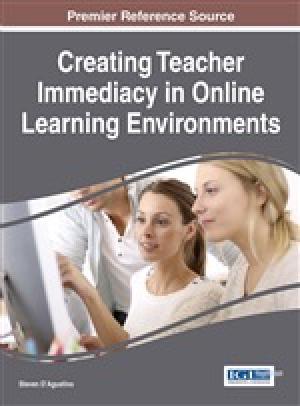
A key issue in distance education is how to establish a vital two-way, personal communication between learner and instructor. Borje Holmberg, among other theorists, argues that the primary role of an instructor is to empathize with the learner; imparting information is a secondary matter. What, then, are the most effective ways to form a dyadic alliance between a learner and instructor? This is the major question that D’Agustino’s Creating Teacher Intimacy in Online Learning Environments seeks to answer. This is a reference work, so it can be read profitably article by article or completely. The volume begins with a helpful detailed table of contents that provides a brief synopsis of each chapter. There is also a useful foreword by Karen P. Kaun which underscores the importance of the human component in teaching and learning regardless of the instructional format. The preface speaks to the impact of the “interactive turn,” the “undesigned remainder,” and the “modelling function” in asynchronous learning. In addition, there is a brief description of each chapter that complements the summaries in the table of contents. Every chapter also starts with an abstract and an introduction. Pedagogy, not technology, is the focus of each chapter. Therefore, this reference is valuable for course designers, media specialists, instructors, and researchers across a range of academic disciplines. That said, there are a few chapters that all will want to read and ponder. Oliver Dreon’s “Building Teaching Presence in Online Classes,” for example, provides an overview of the main issues along with strategies that support learning and interaction. A list of design principles is included, suggestions for future research are indicated, and there is a concise paragraph of conclusions plus an extensive list of references. A central contention made by Dreon is that practices that contribute to high quality, traditional undergraduate instruction also apply to establishing meaningful instructor presence in online classes. Many readers will also want to look closely at Caroline M. Crawford’s “Instructor Immediacy and Authenticity: Engaging in Cognitive Vulnerability within the Instructional Environment.” Often, learner success in an online course – synchronous or asynchronous – will largely depend on the instructor’s efforts to generate worthwhile interactive opportunities. These activities require that the instructor have a clear philosophical belief system united with an understanding of the learner’s cognitive vulnerability in an online environment. Crawford explores these core issues while calling for the development of a “talent propelled” instructional environment. Neal Shambaugh’s “Interactivity and Immediacy in Online Academic Programs” addresses quality issues in higher education distance classes. This is an important theme because, as D’Agustino notes in the preface, “online learning still has a perceived lack of legitimacy” (xxiv). Shambaugh advocates interactivity as a method to counter this concern. He offers a list of best practices for creating and sustaining online immediacy. Then he sketches a series of recommendations for undergraduate, master’s, doctoral, and specialized programs, such as teacher education, certificates, and professional development. There is an extensive compilation of references and notes about the contributors that conclude this collection. The references alone are an excellent guide for further research and course syllabi.

There can be no question that understanding (implicit or explicit) learning theory undergirds effective teaching. This is especially true when instructional topics become confusing or diverge from the common experience of students. Many of the topics students encounter as they study theology and religion fall into this category, and it is for this reason that the collection of Knud Illeris’s works, Learning, Development and Education, has value for teachers of theology and religion. Illeris has spent his career figuring out how learning works and determining how to create authentic, transformative learning experiences. This collection of essays demonstrates the way in which Illeris’s theories developed over time, and shows the breadth of topics that come to bear on the understanding of student learning. Illeris categorizes his selected works into five parts, containing essays that were originally published between the late 1990s and 2015. Some of the essays have not previously appeared in English. The first two sections have the most bearing on the teaching of theology and religion, so they will be the focus of this review. The three essays in Part One succinctly describe Illeris’s comprehensive theory of learning, articulated more fully in his 2007 monograph How We Learn (New York: Routledge). In brief, Illeris argues that learning has two fundamental processes and three dimensions. The processes are “an external interaction process between the learner and his or her social, cultural, or material environment, and an internal psychological process of elaboration and acquisition” (10). Illeris also identifies three dimensions of learning: the content dimension deals with the material being learned, the incentive dimension considers the motivation and energy necessary for learning, and the interaction dimension categorizes dispositions that provide the genesis of learning. Illeris further identifies several barriers to learning (15-17) after recognizing that education is rife with “non-learning and mislearning” (15). According to Illeris, there are four types of learning: cumulative, assimilative, accommodative, and significant/transformational learning. Each of these types of learning is connected to a phase in psycho-social development in Part Two, where Illeris lays out his understanding of lifelong learning (48-55) and gives extended treatment to the function of learning at the youth and adult stages. He argues that education during the phase of youth is typified by a quest for what he calls “self-orientation,” which means the “process where one orients oneself with a view to finding oneself, one’s options, ways of functioning, and preferences” (69). In his view, all educational experiences (inside and outside of the classroom) contribute to and are undergirded by the youth’s quest for self-orientation. The situation is different with adult learners, who have already found their orientation, and so accept responsibility for their actions and their learning. In Illeris’ estimation, this different approach to learning requires different foundations for adult education. Part Three, “Special Learning Issues,” is a compilation of chapters that do not fit in the other sections but provide a theoretical grounding for the arguments Illeris makes in parts one and two. Part Four, “Various Approaches to Education,” includes the oldest of the selected articles, and describes how some of Illeris’s theories were put into practice at Danish universities in the 1970s. The final part concerns learning in working life. Here Illeris applies his comprehensive theory of learning (articulated in Part One) to the workplace. While there is certainly room for criticism of Illeris’s understanding of learning, and in particular, his connections of types of learning with phases of psycho-social development, Illeris’s comprehensive theory of learning is helpful as a foundation for effective theological education. Three observations, in particular, deserve mention. First, his contention that learning is not merely knowledge transfer, or skills acquisition, but includes a variety of psychological, biological, and social factors is worth keeping in mind as we construct learning experiences for our students. Second, Illeris’s observation that youth and adults have a different foundation for learning is significant, especially as there are now more adults students enrolling in college than ever. Finally, it is incredibly important to consider the various barriers students face as they try to learn. While it is certainly the case that students are responsible for their education, Illeris is right to argue that teachers both create and tear down barriers.
Preparing citizens through education is not a novel idea. Its origins lie in Greco-Roman approaches to the task, and in American history the goal of educating the citizenry can be traced back to Charles Sanders Peirce (1839-1914), William James (1842-1910), and John Dewey (1859-1952). Dewey, who was perhaps the most articulate about the implications of pragmatism for education, saw academic preparation for life in a democracy and the moral education of children as part of the same endeavor. The contributors to this volume acknowledge Dewey’s role in this enterprise, but do not explicitly explain why these essays represent the “next generation” of educators inspired by his vision. The best explanation, perhaps, is that they emphasize academic advocacy, as opposed to broader social wellbeing; engagement with society over preparation for engagement with society; and social location over citizenship as a point of departure for academic work. With that set of assumptions in mind, it is easier to discern the larger purpose of the sixteen essays in this volume which include an introduction and afterward, along with chapters devoted to three subject areas: (1) “The Collaborative Engagement Paradigm”; (2) the work of “New Public Scholars”; and (3) thoughts on “The Future of Engagement.” The vast majority of the contributors to this volume are specialists in education and programs in community engagement, and there are individual writers from the disciplines of art and political science. For that reason, some seminarians and seminary faculty will find more immediate points of contact with their work than others. Both groups will also find themselves asking – if education driven by engagement is appealing or necessary – whether the more natural point of contact for seminaries is the community, the church, or both. A critical evaluation of the essays will also raise other questions to which there are no simple answers: What is the place of “social relevancy and public legitimacy” in shaping the curriculum of higher education (1)? Can engagement as a model for learning set aside more abstract, disciplinary concerns (17)? What role has commodification played in shaping higher education and is learning through engagement immune to commodification (24)? To what degree do faculty members remain accountable to the disciplines that they represent when using engagement as a model for teaching and, if so, how is that accountability achieved? The answers to those questions will all look potentially different in theological schools and seminaries where faculty regularly grapple with the relationship between the work that they do and the needs of the church. Indeed, that realization may point to the most important question that the subject matter, but not the book itself, raises for theological educators: What does it mean for seminaries to engage the church “as reciprocal partners and coeducators” (5)? Answering that question is one that everyone who cares about theological education would do well to answer.
Excellence is seldom achieved alone. These words express one of the major themes of Indigenous Leadership in Higher Education, edited by Robin Starr Minthorn and Alicia Fedelina Chávez. Consisting of autobiographical narratives, the editors and contributors weave a blanket of experiences and guiding principles which illustrate and encourage the involvement of Indigenous leaders throughout the academy. Many of the narratives begin in the traditional manner with the authors situating themselves within their maternal and paternal lines, recognizing the interconnectedness of the present to the past in order to lead future generations well. That sense of community permeates the various narratives, weaving a thread into the blanket of colors that blends the experiences and insights into what constitutes Indigenous leadership. This blend of narratives is most evident in the second and the final chapters, in which the editors succinctly gather individual contributors’ words and correlate them to particular themes that serve as a wheel of knowledge in chapter two and summarize potential methods for incorporation into higher education in the final chapter. In chapter two, “Collected Insights,” the editors provide a wheel of four major components of what constitutes Indigenous leadership. The last chapter highlights approaches and philosophies, strategies, academics, and means of working with students to promote and encourage leadership for Indigenous peoples. While it may be tempting to read just these two chapters because of the breadth contained therein, the narratives themselves expand on one or more of the dimensions discussed in these two chapters. One of the major themes is that Indigenous leadership is communal rather than a solo endeavor; Bryan McKinley Jones Brayboy writes that “Indigenous leadership requires individuals to see themselves as part of a unified whole” (53). In chapter two, the editors provide other examples that demonstrate the importance of connection to the community through its elders and the people for whom one serves. Even though most of the narratives are directed toward Indigenous leadership in higher education, many of the principles can be applied to all persons in the academy. The narratives help educators rethink how to provide opportunities for all students to grow in wholeness and wisdom, not just knowledge of facts. Among the qualities the editors describe as “what we strive to embody,” (17) qualities that may resonate with all Indigenous persons, for me, one is clearly lacking. As a Native Hawaiian, I would include gratefulness. While this quality may be imbedded in the concepts of generosity, humility with confidence, and spirituality, I found few expressions of gratitude within the narratives. This disconcerted me because it is inconsistent with what I learned from my kupuna, my Elders. I would hope that, while this embodiment is not expressly evident in the narratives, it is part of their respect for the Elders who have wrapped them in the blankets of experience and provided them with the warmth that enabled them to be Indigenous leaders.
Professors of religion and religious studies may find a familiar link between this edited volume and aspects of their personal academic journey, especially if they are on the tenure track. Both represent texts that involve self-reflection and can embody intellectual wrestling. Most significant for this review: the former also offers tools for rethinking the World Religions Paradigm (WRP) that can challenge pedagogical strategies considered the norm of today and tomorrow. After World Religions: Reconstructing Religious Studies represents a methodologically rigorous way to create a classroom that cements the study of religion as an integral component of both undergraduate and graduate study. The twelve chapters in the volume – spread across three sections – are individually and collectively thought-provoking and intriguing essays. While I acquired the text for potential course adoption in my liberal arts undergraduate methods course, my engagement with the international cast of scholars (from the UK, Australia, Canada, Finland, and the U.S.) confirmed the importance of this work for professors of what might still be considered “world religions” as we strive to help our students “make sense of our world” (186). One of the more teachable moments was delivered by Teemu Taira. In “Doing things with ‘religion,’” Taira sets out to “instigate an exploration of how something came to be understood and classified as ‘religion’ and why,” as it simultaneously questions the inclusion and exclusion of traditions such as Confucianism, Shintoism, and Scientology (84). For example, the formation of Confucianism as a religion is connected with Western scholarship. Yet it “was regarded as a religion in China in 1949,” until the Communists took power in China when they “established the current system in which only Buddhism, Daoism, Catholicism, Protestantism, and Islam are considered as religions” (86, 85). Michel Desjardins provides another significant moment of illumination with “The Desjardins Diet for World Religions Paradigm Loss.” In a post-presidential-election season during which many Americans are threatening to emigrate to Canada, it seemed apropos to gain new insight from a classroom on our shared northern borders. It was easy to be hooked by the chapter’s focus on food and religion as the sole doorway to an introduction to religion seminar. Not only does Desjardins employ his own qualitative research, but he also challenges readers to reimage food – and, thereby, create “more nuanced views of religion” – “as a rich site for examining human nature” (124, 123). Additionally, useful resources are either embedded within the chapters (such as difficult to locate work on Sikhism) or as part of the references with which each ends. The “Afterward” by Russell McCutcheon, a stalwart in the field, concludes the work with a compelling goal: “If what we’re teaching these diverse students in our World Religions courses is not just the names and dates that these students are probably focused on, but, instead, subtly demonstrating to them how scholarship happens,” then we are more likely to teach skills “that are useful in unanticipated settings.” Who among us doesn’t yearn to accomplish that!

What can teachers of theology and religion learn from a text on contemporary global education? Moreover, “If our world is constantly changing, particularly with globalization, how can educators support the nature of change through curriculum, teaching, and learning, particularly in international contexts” (30)? Mary Gene Saudelli, a Canadian educator with a rich background of teaching abroad, highlights the significance of contextual considerations in twenty-first century teaching and learning through this case study of nineteen international educators at Dubai Women’s College in the United Arab Emirates. Within the pluralistic context of many of our classrooms, as well as the increased emphasis on internationalization in many of our institutions, theological and religious educators will benefit from Saudelli’s insightful analysis of contemporary educational theory and curriculum through a global lens. Divided into three modules, the first describes the context of the study along with a discussion of contemporary theories of adult learning, including sociology of education and change theories. Module 2 presents the international educators, the Emirati learners, and the curriculum. And Module 3 explores issues within the learning context: religion, culture, society, and language. Finally, a brief conclusion captures salient lessons learned from this case study with application to twenty-first century curriculum design. Saudelli’s analysis of contemporary learning theories in light of the global educational context is of particular significance as it represents the integrative thinking that is essential for our thinking and practice in culturally-responsive theological education. For example, she examines Knowles’ work on andragogy and Mezirow’s transformative learning theory from an international and intercultural perspective, indicating the implicit Western individualistic bias that undergirds these approaches to learning. Moreover, values such as empowerment or emancipation, lauded in contemporary adult education scholarship, may look quite different through the lens of a more restrictive Arab context. Saudelli’s description of twenty-first century learning and its implications for curriculum design is another helpful discussion. In her words, twenty-first century teaching and learning refers to “an orientation that recognizes the incredible change that has been ushered in by virtue of a dramatic technological evolution and advancements, globalization and cross-national migration of both people and information, and intense shifting of educational needs” (63). Such curriculum is interdisciplinary, experiential, balanced, and interconnected with both local and global contexts (63ff). Moreover, its design supports the development of key skills that students require to be equipped to address the opportunities and challenges in our ever-changing world. It may be instructive to consider how these criteria could contribute to shaping theological and religious studies within our own educational institutions. The section on faith is somewhat brief, especially given the enormous impact that religion has in the context of this study, the Arab world. And while the author does reference epistemological differences in the conclusion (179), a more robust discussion as to their significance for global education would be a welcome addition to her otherwise helpful synopsis in the final chapter. Thus, while the particulars of this case study may be unique, the author suggests that the text can be useful, “as a way to think about how we approach internationalization in education” (12). Moreover, its fresh perspective on curriculum and educational theory through a global lens is one that is worthy of consideration for contemporary theological educators.