Book Reviews
The ten chapters in this volume first appeared as a special issue of Teaching in Higher Education (2013). Each author is situated in particular classroom and institutional contexts ranging from South Africa to Australia, from Denmark to China and Canada, from the United Kingdom to the United States. Their expertise is far reaching. Although none of the contributors are in the areas of theology or religious studies, the questions raised and addressed in this volume center on strategies for effective teaching and learning. Collectively, these chapters supply a snapshot of the challenges and promises facing instructors of higher education. As a result, there are several potentially relevant sites for reflection and application. Grouped thematically, student-centered chapters highlight raising awareness of White Privilege (chapter 1) and of global citizenship through on-campus threshold-crossing experiences (chapter 3), undergraduate research (chapter 4), and social justice (chapter 8). More instructor-centered chapters confront the role of self-reflective practices (chapter 2), and of online education (chapter 10). Curricular chapters focus on inter-disciplinarity in an engineering curriculum (chapter 5), on the impact of problem-based learning on Chinese students undertaking higher education outside of their homeland (chapter 6), and on assessment practices (chapter 9). Of all of the chapters in this volume, “Reframing teaching relationships: from student-centered to subject-centered teaching,” would be the most suitable starting point for the reader of the Wabash Center’s online reviews. Although this chapter is situated at the center of the volume (chapter 7), it serves as the organizing chapter because it tackles an issue raised more specifically in the other chapters. Employing frame theory, the authors respond to questions of self-identity and the teaching relationship by advocating subject-centered learning. The strength of the volume rests with the particular contribution of each individual chapter. Offering a specific perspective in a local context, each author works within cleanly defined theoretical boundaries and approaches, and presents an argument worthy of further consideration and discussion. Despite this strength, however, the overall coherence of the volume suffers from the lack of a formal, introductory chapter and a final, concluding chapter. An additional chapter at the fore could justify the order of presentation of the collection (thematically topically, or through some other means) and facilitate the act of reading by explaining criteria for selection and inclusion; a closing chapter might indicate possible applications of the issues in other contexts and introduce new approaches or questions moving forward. The lack of these critical organizing chapters at the opening and closing of the volume requires the reader to determine the contours of coherence across the chapters and to impose frameworks for interpretation.
Inclusive Teaching: Presence in the Classroom (New Directions for Teaching and Learning, Number 140)
In his opening essay in the collection, editor Cornell Thomas of Texas Christian University invites readers to envision a new type of pedagogy that sees each student as a “unique being with the potential for great growth” (2). The educational philosophies of John Dewey and bell hooks grace the pages of this volume, even when they are not cited directly. The strength of this small collection lies in its variety. Ranging from an existentialism-inspired clarion call for the importance of “presence” in the classroom (Don Hufford) to a challenge posed to teachers and other mentors (in and out of the classroom) to integrate “criticality” and identity development in order to better meet the needs of students from low socioeconomic backgrounds (Anthony Walker), the essays are unfortunately a bit uneven when it comes to offering specific strategies and details about best practices. Prophetic calls for practicing “intellectual hospitality” and the value of more robust “connectedness” with our students are preaching ideas to the already converted, I suspect. Most readers of this journal likely already practice such pedagogy and are committed to creating “environments that maximize learners’ academic and social growth” (back cover). Some of the essays rely upon the briefest of anecdotes. The shining counter-example to that trend is the longer piece by Freyca Calderon Berumen and Cecilia Silva (also from Texas Christian University), describing a creative example of civic engagement for preservice teachers in an ESL class: students were matched up with newly resettled refugee families from Nepal and Burma in order to help with initial visits to local schools. The unexpected successes of their “Refugee Family Project” offers a nice example of why it is important for us to be authentic and creative if we are truly committed to more inclusive teaching. The essays offering concrete advice or descriptions of successful projects are the most rewarding, and some of the bibliographies offer further resources for anyone interested in exploring how critical race theory might be applied to our pedagogies and practices in higher education. In this vein, Kimberly Diggles’ essay is particularly helpful, as she lays out specific suggestions for implementing cross-institutional efforts that are not just racially aware but actively anti-racist in their intent and in their transformative effects on campus culture and student learning. I also appreciated Anthony Walker’s call for involving students in curricular reform as an antidote to what is otherwise “a propensity for an ideological stasis” (78). Walker goes on to state that, “a curriculum built for the integration of students’ thoughts and experiences has the ability to create a learning environment in which students are connected and engaged” (79). To the degree that teachers in religious studies have worked to develop such learning environments in their classrooms in recent years, Walker’s insights suggest that we should take the lead in larger curricular change. Unfortunately, given its brevity and the uneven quality of the essays, the collection does not ultimately deliver what is promised by the summary on the book jacket.
David Mathew introduces Fragile Learning: The Influence of Anxiety as a “book about barriers to learning.” He adds: “as a selection of what grew to be an interrelated body of published papers, Fragile Learning asks the reader to consider a wide variety of factors that might test a learner’s resilience or make the process of learning precarious and problematic.” These obstacles include “technology, environment, culture, age, disease, and incarceration. . . The book examines anxiety – both learner anxiety and educator anxiety – as both an inevitable and important pedagogic tool” (xv). In the chapters of the book, Mathew offers case studies of “fragile learners”: learners for whom obstacles like those presented above threaten to derail the learning process entirely. However, the definition of learner and learning is extremely broad, encompassing incarcerated youth engaged in face-to-face learning, diverse learners in online courses, a colleague struggling with physical pain, and workers in a horse stable. The wide range of subjects reminds us that many human behaviors, including academic study, work, and navigation of the medical system, are all examples of learning. However, the diversity of subjects dilutes the degree to which Mathew’s insights are useful for educators engaged with learning in a more traditional sense. While the range of subjects is very broad, Mathew’s fundamental approach is consistent. In each case, he explores the psychological dimensions of the learners’ experiences and their affects on the learners’ behavior. For example, one case study centers on an adult student in an online course who was situated in a traditional cultural context in which age, maleness, and social status were privileged categories. Mathews describes how assuming the role of student, in a context in which these factors did not automatically convey status or demand respect, was challenging and anxiety-producing for the student. This anxiety was an obstacle to his learning. In another essay, Mathew and his colleague, Susan Sapsed, describe the psychological effects of Sapsed’s ongoing experience of physical pain and unsuccessful medical treatment and the ways in which both the physical and psychic pain impacted her professional and personal life. In his discussions of the cases, Mathew’s brings first-person accounts of the learners’ experiences or his observations of them into conversation with psychoanalytic theory, primarily, but not exclusively, about anxiety. In the short space of the essays, the introduction of psychoanalytic theory serves to reframe the individual cases as examples of more general psychological experiences. In some of the essays, Mathew describes or proposes pedagogical approaches that help learners tolerate and address the obstacles to their learning. In keeping with his psychoanalytic orientation, the approaches he advocates cast the educator in a therapeutic role – either as pastoral caregiver or as an object of transference for the fragile learner. Mathew’s fundamental argument is an important one. Educators and educational systems need to be attentive to the ways in which the life experiences of many learners catalyze a range of psychological conditions, including anxiety, low self-esteem, inability to trust, and depression, that are often significant obstacles to learning. A psychoanalytic perspective of these obstacles can be a useful element in designing systemic and individual pedagogical supports for these learners. However, the anthological format of the book, and Mathew’s tendency to focus more on the psychoanalytic theory in itself rather than on the cases he presents limit the utility of the book for practitioners dedicated to supporting fragile learners in educational settings.
In Learning Cities for Adult Learners, Leodis Scott compiles seven articles that explore how cities are uniquely positioned to provide new directions for adult and continuing education. “Adult education needs more space,” Scott writes, and scholars and practitioners must take the lead in building larger spaces for all learners (1). The larger spaces are cities themselves – “learning cities” that take education beyond the traditional walls of schools, colleges, and workplaces in order to connect and grow in all life experiences. Scott suggests cities can take on the characteristics of learning, and in doing so, adults of every social class and educational level can experience a new quality of life. Scott is cofounder and research scholar at LearnLong Institute for Education and Learning Research, and lecturer in adult learning philosophy and practice at DePaul University–School for New Learning and Columbia University–Teachers College. Contributors to the volume come from a variety of universities, research centers, and programs that are committed to connecting the scholarship of adult learning with concrete practices that encourage a more widespread approach to learning. Most articles are co-authored, further demonstrating how collaboration and cross-disciplinary thinking is a natural hallmark of building the necessary infrastructure for learning cities. After an Editor’s Note by Scott, Connie Watson and Aimee Tiu Wu introduce key themes of lifelong learning and lifelong education in Chapter 1, as they explore the evolution and reconstruction of learning cities for sustainable actions. In Chapter 2, Hiram E. Fitzgerald and Renee Zientek write about the connections between learning cities, systems change, and community engagement scholarship in the context of a learning city/region. Lyle Yorks and Jody Barto investigate in Chapter 3 the interconnections between workplace, organizational, and societal learning, showing how 21st-century cities must function to promote learning for a larger society. In Chapter 4, Alysia Peich and Cynthia Needles Fletcher provide research and a case study for how public libraries and cooperative extension can work as community partners for lifelong learning and learning cities. In Chapter 5, Joanne Howard, Diane Howard, and Ebbin Dotson provide a connected history of health and education and demonstrate the necessity of including both health and education endeavors in any strategic planning of learning cities. Dan K. Hibbler and Leodis Scott write in Chapter 6 about the role of leisure in humanizing learning cities. Finally, Scott provides a summary in Chapter 7 of the main themes from the book and suggests a way forward: scholars and practitioners in the field of adult and continuing education can become facilitators of learning cities so that citizens have the power and ability to construct their own cities appropriate to their needs. This book is written for scholars and practitioners in adult learning and provides both a compelling vision and practical strategies for how citizens can work across fields and disciplines for the betterment of society. It will take leadership, vision, and talent to connect civic institutions in the formation of learning cities. One strategic type of institution not mentioned in the book is local religious communities. It seems that religious groups could be uniquely situated to both model and help facilitate the essential elements of a learning city. As scholars and practitioners continue to work towards this new direction for adult and continuing education, they will certainly do well to collaborate with as many different types of civic institutions as possible – for building a learning city is certainly worth the pursuit.
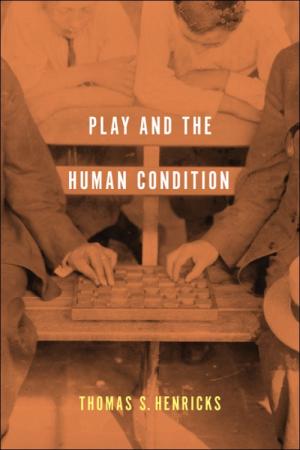
Thomas Henricks’ Play and the Human Condition provides a valuable guide to the academic study of human play. Henricks has been teaching at Elon University since 1977 as a sociologist. He has been studying human play since his PhD dissertation, which explored the relationship between sports and social stratification, and he has over thirty years of academic publications in play studies. In this volume, Henricks attempts to advance his thesis that “play is fundamentally a sense-making activity and that the broader goal of this process is to construct the subjectively inhabited sphere of operations and understandings called the self” (209). Henricks organizes this book into an introduction and nine chapters. He begins the introduction with three questions that guide his work: “How do we discover who we are? How do we determine the character of the world in which we live? And how do we decide what we can do in a world so configured?” (1). The introduction provides a rationale for studying play as well as an overview of the book. The first three chapters explore general models of play. In Chapter I, Henricks explores the difficulties around establishing a definition for play as he reviews several modern definitions. He presents six ways of understanding play: as action, as disposition, as experience, as context, as interaction, and as activity while he connects each model to their major theorists. The next chapter presents how play is different from other patterns of human behaviors including ritual, work, and communitas. The final chapter in this section develops a theory of play that centers upon self-realization. Henricks notes that “play best teaches people how to conceive self-directed lines of action and to mobilize varieties of resources to realize these ambitions” (89). In the middle of the book, Henricks devotes five chapters to various aspects of play including psychology, the human body, physical environment, social life, and culture. After focusing on the mind in his chapter on the psychology of play, Henricks turns to the human body and play in Chapter Five. While examining animal play, he concludes “play integrates symbolic and physically based meaning systems. . . play is a form of consultation between matters manifest and latent, known and unknown. In consequences, players extend and secure their understanding of themselves” (137). Next, he engages the physical environment and social aspects of play, because as he explains, “play is complicated by the presence of more than one player” (161). Chapter Eight builds upon the foundation of the earlier chapters to explore culture and play. This is an important chapter that engages the work of Geertz, Deerida, and Gadamer to list a few. Henricks’ final chapter weaves the various themes of the earlier chapters together to support his thesis. He examines the relationship between play and freedom. He concludes that “if play has a legacy, it is its continuing challenge to people of every age to express themselves openly and considerately in the widest human contexts” (227). Play and the Human Condition is a well-developed and scholarly text. Henricks engages a wide range of disciplines and carefully builds his arguments. The book offers a detailed road map to professional play literature that will be very useful to any scholar researching in this field. Except for a few terms, like communitas, this volume is accessible for the non-specialist. Theologians and graduate students should have no problem understanding and engaging this text in fruitful dialogue. This volume would be a good addition to major theological libraries. It is especially important for scholars and programs that explore ritual studies and hermeneutics. Chapter Four, on play as therapy, gives a foundation for this important approach to clergy who want to explore this avenue of pastoral care and counseling.

During his time on the editorial board of Teaching Theology and Religion Tim Jensen brought a distinctive, and often provocative, sensibility to that group’s discussions. Rooted in his own experience as a teacher in secondary schools and in universities, and based on his research into systems of “religion education” both in Denmark and throughout Europe, Jensen’s position vigorously argued for a strictly secular (and scientific) study of religions throughout the educational curriculum. Even when they did not carry the day, Jensen’s arguments were always “good to think with.” Although they do not focus as directly on Jensen’s teaching as they do on many of Jensen’s essays (the volume includes a bibliography of his writings), these essays honoring Jensen on the occasion of his sixty-fifth birthday address many of his persistent concerns. As an ensemble, the essays present a vision of the field of the study of religion that will challenge teachers in North America to articulate their own understandings of what the study of religion entails. More importantly for this context, several of the essays link their broad considerations of the study of religion directly to issues concerning teaching. Gustavo Benavides offers an essay that stands out in linking theoretical concerns to the classroom. He argues that whatever the subject matter may have been, at the end of the term students in any course in the study of religion “will have thought, however intermittently, about the various but nevertheless recurrent ways in which what we call ‘religion’ is generated and kept in place” (223). Beyond that broad learning goal he proposes – convincingly in my view – that “Ideally, anyone teaching a course that has to do with any of the aspects of what is generally known as ‘religion’ should be engaged in the elaboration of a theory that could accommodate – however provisionally, however tentatively – most of the topics being discussed in any given class” (225). Benavides shows clearly how conceptions of what is – and should be – involved in the study of religion is not simply the concern of a handful of scholars specializing in “theory and methods.” One’s conception of the nature and purpose of the field has a direct and pervasive impact in the classroom. Several other contributors propose interesting links between their scholarly concerns and their practice as teachers. Russell McCutcheon discusses his use of popular music videos “to illustrate the unexpected appearance of religion” (157) where it is least expected. Drawing on a thorough reading of Jensen’s own work, Wanda Alberts carefully maps out not only what “Religious Studies-based Religion Education” looks like in K-12 curricula but also how it contrasts to other, more confessional, understandings of “Religious Education” and what is at stake in the competing understandings. Satoko Fujiwara provides a persuasive account of why the “world religions” paradigm has persisted in Japanese education, linking it to a particularly Japanese understanding of Max Weber. Though this volume does not focus directly on teaching, it nonetheless provides the interested reader with both some very pointed suggestions about classroom practice and an array of essays about the state of the field that will provoke and perhaps even inspire careful rethinking about what we are teaching when we teach about religion.
Helen Cowrie and Carrie-Anne Myers’ Bullying Among University Students studies bullying in universities worldwide, with contributors from educational psychology, criminology, counseling, media, and other disciplines. One insight of the volume is that we tend to address bullying as a relationship between the bully and the victim without addressing bullying’s social and institutional contexts. The introduction reminds us that university students occupy an ambiguous position, neither protected children nor employees. In the university, therefore, bullied students feel lost, reporting “that they do not know of any policies, systems, or avenues to help them” (3). The essays begin with the student experience, move to the nature of bullying, look at social context, suggest interventions and policies, and end with reflections, suggesting that universities might address bullying by coordinating communications between the students, staff, administrators, and student services and by using research on workplace bullying as a resource. The corporatization of higher education, valuing individualism and competition, may unconsciously generate a context for bullying, meaning that systems must be put in place to address bullying, including strong counseling. The writers align bullying with what they call “laddish” behavior – indeed, boys bully more frequently than girls – which Toni Pearce defines as a “‘pack’ mentality evident in activities, such as sport and heavy alcohol consumption and ‘banter,’ which were often sexist, misogynist and homophobic” (17-18). It includes sexualizing behavior toward women and intolerance of gay and transgender students and racial ethnic students, all vulnerable, which leads to harassment and violence. The essays examine multiple forms of bullying, including stalking and cyber-aggression, which occurs as “invisible” bullying (113). Drawing lines in these cases is a key, but difficult, act: when, for example, is online activity conversation, teasing, or bullying? One finding is that bullies tend to bully throughout their lives (36). Osman Tolga Aricak’s essay explores genetic and environmental causes of bullying and the impact on the bullies themselves. Aggression is an outward sign of complex issues like poor self- and impulse-control and narcissism. The bully and the victim can experience ongoing mental health disorders, including anxiety, depression, and isolation. “The Research Student Experience” chapter is informative for those of us supervising graduate students, unveiling the sometimes unconscious bullying in the power-laden supervisor-student relationship. Graduate students also occupy an ambiguous position, being students and teachers or workers, making them vulnerable. Graduate supervisors must be mindful of power, avoiding actions like giving excessive or unauthorized work to teaching assistants and using their research as the supervisor’s own. This collection offers immense insight into an understudied subject. One article on “Cross-Cultural Comparisons” reminds American universities that we have “some of the highest rates [of bullying] among the developed world” (135). Our cultural and economic diversity, insistence on free speech, and desensitizing media violence confuse notions regarding appropriate behaviors (135). Since there is not clear data on what works against bullying, a system-wide response is necessary.
James Lang has written yet another immensely valuable book for post-secondary faculty. Using the analogy of “small ball” from baseball, the author provides classroom activities requiring only a few minutes that can easily be incorporated into a course sporadically or regularly to improve learning. Each strategy is based on the latest research about the human brain, and Lang has witnessed their “positive impact in real-educational environments” (7). The strengths of the book are numerous. First and foremost, it accomplishes the stated purpose. In each of the nine chapters, Lang explains the theory behind the learning principle, describes how the theory has been carried out in classroom models, and then summarizes the principles common in each model. Within the models, the reader finds activities that teachers can incorporate into any class and use randomly or repeatedly that enableing students to learn effectively. Second, each learning activity is transferable across academic disciplines. For example, while discussing “predicting,” the initial research example is from the field of language learning. Lang then applies the principles to his discipline of teaching literature, before concluding with a kinesthetic example of learning an athletic skill. Additionally, Lang recognizes the increasing frequency of teaching and learning online. He also notes students’ access to social media and suggests ways to use the principles and activities of online teaching and social media in a non-traditional classroom format. Finally, while the focus is on in-class actions that take minimal time, he does identify how specific teaching concepts can be incorporated into course planning and the syllabus. The book is well-organized, not only in its presentation but in the ordering of learning from knowledge acquisition to understanding to learning inspiration (motivation), with three strategies explained in each section. Each concept and activity is well-supported by research noted in a full bibliography. For example, in discussing retrieving, Lang gives examples of opening or closing questions an instructor can use in the first or last five minutes of class that will prove effective for short-term and long-term recall, in light of a variety of studies. Where there are questions about the validity of an idea or activity, Lang acknowledges the issues and interacts fairly with contrary opinion. In short, it is hard to find a negative with this book. Because each chapter is follows the pattern of theory, model, then principles, a theology or religious studies teacher can easily take the knowledge or concepts they desire to teach and adapt them to any of the teaching strategies. From a rookie faculty member experiencing challenges midway through a course to an experienced professor looking to improve student learning in a well-developed curriculum, there is something in Small Teaching for everyone. If your college cannot attend one of Lang’s professional development sessions, I would recommend academic deans purchase the book for faculty and together they could work through each chapter.
Graduate schools produce a good number of well-educated women who then go on to become successful professors, published authors, and administrators in institutions of higher learning. Women in academe are expected to do it all, do it well, and have well-balanced lives outside the work place. Graduate schools do not prepare women for the numerous challenges they encounter in the various facets of academic life. This book identifies challenges and issues related to women’s lives in academe and suggests practical and studied tactics to help women thrive in the academic world and in their own lives. Rena Seltzer has extensive experience as an academic coach and has gathered a compelling amount of data and first-hand experiences from women professors. She acknowledges that surviving in academia is not easy, especially for women and under-represented minorities. Oftentimes, women feel isolated and are not aware that some of the challenges they face are not uniquely their own. By identifying such challenges, Rena Seltzer achieves the goal of bringing awareness to these common experiences. In addition to identifying these challenges at the different stages of academic life, the book offers a deeper analysis of the issues and obstacles of academic life as well as provides practical advice on how to overcome them. In ten chapters, Seltzer addresses the following topics: How to have more time; Establishing a productive writing practice; Teaching; Work-life balance; Networking and social support; Tenure, promotion, and the academic job market; Authority, voice, and influence; Negotiation; Life after tenure; and Leadership. The book includes numerous practical tactics, from how to phrase effective emails to how to say no to attractive projects and roles that would overtax an already crowded schedule. This ability to say “no” when appropriate leads to a more productive and balanced life, thereby reducing stress. Each chapter offers a variety of further sources the reader may wish to investigate. The author’s style is engaging and friendly, and her voice comes through as wise and reassuring. Chapters can conveniently be read independently, as fits the reader’s interest. While the book addresses topics shared by most women across academic disciplines, it can be particularly useful for faculty who teach religious studies or theology since these fields rely heavily on self-reflection and self-giving. The balance between such theologically and pastorally motivated attitudes and the demands of academic and non-academic life is especially challenging. Anecdotally, all female academics I have shared this book with have expressed great interest in it and admitted they would like or need to read it. One said, “I wish this book was around when I started out!” The book is recommended to all women in academia but also to any faculty at any stage in her or his career who is experiencing some of the same challenges.
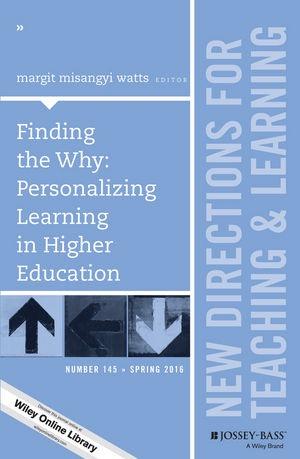
Whenever I’m asked, “How are your classes going?” my answer traditionally has been, “Ask the students.” As more faculty members shift their pedagogy to a student-centered learning, their focus must include not only delivering the content but also inviting students to explore the why of education. The articles in Finding the Why: Personalizing Learning in Higher Education edited by margit misangyi watts (sic), identify key ways to encourage students to discover the purpose of higher education as more than training for a career. While many of the articles describe institutional changes that have been developed to address the student success beyond the university, the principles behind such designs can be incorporated by individual faculty members in approaching how to present their courses’ content. One of the key principles is to encourage students to identify the applicability of a liberal-arts education to professional courses. One means by which this can be accomplished is described in “Integrative Learning: Making Liberal Education Purposeful, Personal, and Practical.” Ann Ferren and Chad Anderson describe several examples from various colleges that integrate learning across curricula and are adaptable even for larger institutions, such as designing opportunities for students to integrate curricula using collaborative projects, partnerships with the local community for service-learning, and making connections among disciplines. Furthermore, in “Project-Based Learning in Colleges of Business: Is It Enough to Develop Educated Graduates?” Penny Smith and Lindsey Gibbon note that business leaders are seeking qualities such as critical thinking skills, identifying and using creative problem solving, and communicating effectively. They note that “for business schools to graduate ‘well-educated’ students, they must forge and engage entire academic villages” (43) in preparing business students for their careers. Another important component of finding the why requires understanding the challenges in culture that affect the attitudes impacting student-centered education. Several of the chapters incorporate strategies to change the culture at institutions themselves to meet the ongoing challenges to student success. Among such recommendations are faculty “talking to students in a way that is supportive and encouraging” (29) or engaging in the six “P’s” of place, preparation, pathways, plan, purpose, and personal connection as explained by Sanford Shugart in “Why Higher Education: Lessons Learned in a Learner-Centered College.” While many of the articles describe specific activities involving changes within the entire institution, such as integrative classes or designing a community college’s plan from its inception, the authors do challenge individual faculty to incorporate helping students find the why within their particular courses. The key to student success in many of the articles involves engaging students individually, not just collectively. Therefore, some of the strategies discussed can be applied by individual faculty on a smaller scale. While my answer to “How are your classes going?” may be the same, my intentionality within my course itself should have students answering in the positive.