Resources
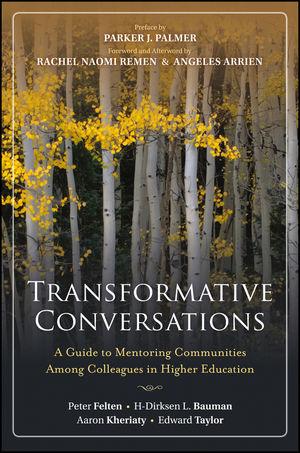
Click Here for Book Review Abstract: From the Inter-generational Mentoring Community project, which develops the next generation of academic leaders, comes formation mentoring, a process to enable faculty to recover, sustain, and further develop a sense of vocation, mission, and purpose. This book is a concise and practical guide to convening and sustaining these kinds of formation mentoring groups in higher education. It provides the necessary direction and structure to orient the process but is open-ended enough to apply across many settings and professional or educational disciplines. (From the Publisher)
By reclaiming the passions of our hearts and exploring insights and ideas, we begin a remembering of ourselves. As we begin to reclaim our wholeness, we also have the capacity to renew and revitalize our institutions from within. After a long career of writing and speaking about how living in congruence—without division between inner and outer life—allows for being present with ourselves and those who journey with us, Parker Palmer and colleagues at the Center for Courage & Renewal developed a process of shared exploration. This Circle of Trust approach encourages people to live and work more authentically within their families, workplaces, and communities. This issue explores the transformative power of engaging in a Circle of Trust. The authors examine its direct applications to teaching and learning, and they explore and discuss the research being done by the facilitators of this work. This is the 130th volume of this Jossey-Bass higher education series. New Directions for Teaching and Learning offers a comprehensive range of ideas and techniques for improving college teaching based on the experience of seasoned instructors and the latest findings of educational and psychological researchers. (From the Publisher)
Take an in depth look at discipline-centered learning communities. Using psychology as an example, this issue provides prescriptive advice for those interested in developing a learning community in any academic discipline or program. Learning communities are a powerful vehicle for creating and sustaining connections among students, faculty, and the curriculum, but creating one can be a challenge. By providing resources, practical case studies, and theoretical grounding, this volume can both inspire and guide faculty, staff, and administrators in meeting their pedagogical and curricular goals. Learn how the five types of learning communities—based curricularly, residentially, in the classroom, on the students themselves, and even virtually—can be used to enhance student engagement and learning. Illustrating the versatility of the practice across a wide range of settings, student populations, and institutional types, this issue also contains an extensive listing of resources that go beyond disciplinary boundaries and open possibilities for all in higher education.  This is the 132nd volume of this Jossey-Bass higher education series. New Directions for Teaching and Learning offers a comprehensive range of ideas and techniques for improving college teaching based on the experience of seasoned instructors and the latest findings of educational and psychological researchers. (From the Publisher)
With pedagogical philosophy and practice changing significantly, faculty development has become much more important. Each chapter in this volume identifies particular areas of opportunity, and although the authors recognize that not every initiative suggested can be implemented by all institutions—circumstances such as institutional mission, available resources, and governance issues will dictate that—it is their hope that every reader will be able to glean details that might provide a spark or fan a flame on campus. As educators themselves, McKee, Johnson, Ritchie, and Tew invite you to consider the challenges, explore the possibilities, and join them on the journey. This is the 133rd volume of this Jossey-Bass higher education series. New Directions for Teaching and Learning offers a comprehensive range of ideas and techniques for improving college teaching based on the experience of seasoned instructors and the latest findings of educational and psychological researchers. (From the Publisher)
Journal Issue.
Journal Issue.
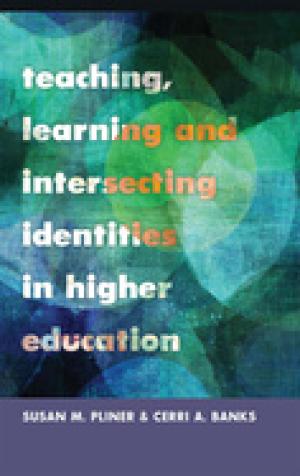
This book utilizes the theory of intersectionality to focus on the divergent identities and experiences of marginalized groups and to analyze the ways these experiences infiltrate the classroom. It examines teaching and learning as integrated and synergistic practices and highlights the personal and institutional power dynamics existing between scholars and students. Starting with the premise that institutions of higher education must pay attention to the ways intersecting identities and structures of privilege and disadvantage enter all educational settings, the contributors to this text represent a range of academic disciplines and they are both scholars and students. This approach demonstrates that ideas related to teaching and learning should not follow models that separate teachers, students, and disciplines, but rather that significant learning occurs in the areas where they overlap. Each chapter provides pedagogical strategies and methods for classroom practice that facilitate student learning, equitable classroom environments, and a social justice agenda. (From the Publisher)
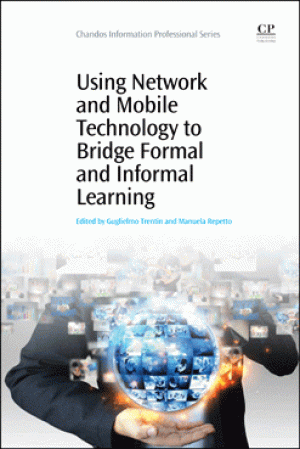
- includes a framework for the sustainability of new educational paradigms based on the combination of formal and informal learning processes supported by network and mobile technology (NMT)  - provides a series of recommendations on how to use attitudes towards NMT gained outside the school to integrate formal and informal learning  - gives a teacher training approach on how to use network and mobile technology-based informal learning to enhance formal learning pathways An ever-widening gap exists between how students and schools use communication technology. Using Network and Mobile Technology to Bridge Formal and Informal Learning introduces new methods (inspired by ‘pedagogy 2.0’) of harnessing the potential of communication technologies for teaching and learning. This book considers how attitudes towards network and mobile technology (NMT) gained outside the school can be shunted into new educational paradigms combining formal and informal learning processes. It begins with an overview of these paradigms, and their sustainability. It then considers the pedagogical dimension of formal/informal integration through NMT, moving on to teachers’ professional development. Next, the organizational development of schools in the context of formal and informal learning is detailed. Finally, the book covers the role of technologies supporting formal/informal integration into subject-oriented education. (From the Publisher)
From the Publlisher A Curriculum of Imagination in an Era of Standardization In A Curriculum of Imagination in an Era of Standardization: An Imaginative Dialogue with Maxine Greene and Paulo Freire, explores with the reader what is meant by imagination in the work of Maxine Greene and Paulo Freire and their relevance in an era of increasingly standardized and highly scripted practices in the field of education. The author explores how imagination permeates every aspect of life with the intent to develop capacity with the readers to look beyond the taken-for-granted, to question the normal, to develop various ways of knowing, seeing, feeling, and to imagine and act upon possibilities for positive social and educational change. The principal aspect of the work illustrated in this book that distinguishes it from other work is that an “imaginary” dialogue between Maxine Greene and Paulo Freire runs through the book using actual citations from their work. Each chapter starts with such a dialogue interspersed with the works of others and the author’s critical autobiographical reflections. With a brief overview of the socio-cultural evolution of imagination from pre-literate times to the present, the author explores some of the current iterations of imagination including the eugenics movement and “dark” imagination, sensing gaps and creative/critical imagination, metaphors as the language of imagination and empathy as social imagination. Reflecting upon emerging tensions, challenges, and possibilities curriculum workers face in such an era of standardization, the author calls for a curriculum of imagination. After providing a brief overview of the socio-cultural evolution of imagination from pre-literate times to the present, the author looks at some of the current iterations of imagination, including the eugenics movement and “dark” imagination, sensing gaps and creative/critical imagination, metaphors as the language of the imagination, and empathy as social imagination. All of these ideas are then incorporated in a curriculum of imagination that is envisioned through Joseph Schwab’s four commonplaces of curriculum followed by a discussion of emerging tensions, issues and possibilities for praxis and scholarship in present and future inquiry.
Click Here for Book Review Abstract: The coaching metaphor first entered the educational literature over twenty-five year ago when Ted Sizer urged classroom teachers to model the pedagogical relationship between coaches and athletes. Yet, since then, educators have rarely drawn direct lessons from the athletic arena for their practice... until now. DeMeulenaere, Cann, Malone and McDermott, in this groundbreaking analysis, explore the implications of athletic coaching for improved pedagogy. They offer concrete lessons and suggestions for best practices in the classroom. (From the Publisher)
Wabash Center Staff Contact
Sarah Farmer, Ph.D.
Associate Director
Wabash Center
farmers@wabash.edu