Resources

From the Publisher This book gives voice to the experiences of women of color - women of African, Native American, Latina, East Indian, Korean and Japanese descent - as students in pursuing terminal degrees and as faculty members navigating the Academy, grappling with the dilemmas encountered by others and themselves as they exist at the intersections of their work and identities. Women of color are frequently relegated - on account both of race and womanhood - into monolithic categories that perpetuate oppression, subdue and suppress conflict, and silence voices. This book uses critical race feminism (CRF) to place women of color in the center, rather than the margins, of the discussion, theorizing, research and praxis of their lives as they co-exist in the dominant culture. This book makes salient three characteristics of critical race feminism. Just as it is places emphasis on the application of theory to real life issues, the authors' narratives address concerns about the academic community, home, and family. Just as CRF supports a discourse of resistance, the book provides a forum for different voices as multi-representations of the counterstories against the acceptance of the dominant culture and the status quo. And, finally, the contributors' stories reflect CRF's emphasis on narrative to deepen the understanding of their lives as women of color. The first part of the book addresses the issues faced on the way to achieving a terminal degree: the struggles encountered and the lessons learned along the way. Part Two, Pride and Prejudice Finding Your Place After the Degree, describes the complexity of lives of women with multiple identities as scholars with family, friends,and lives at home and at work. The book concludes with the voices of senior faculty sharing their journeys and their paths to growth as scholars and individuals. This book is for all women of color growing up in the academy, learning to stand on their own, taking first steps, mastering the language, walking, running, falling and getting up to run again, and illuminates the process of self-definition that is essential to their growth as scholars and individuals.
Journal Issue.
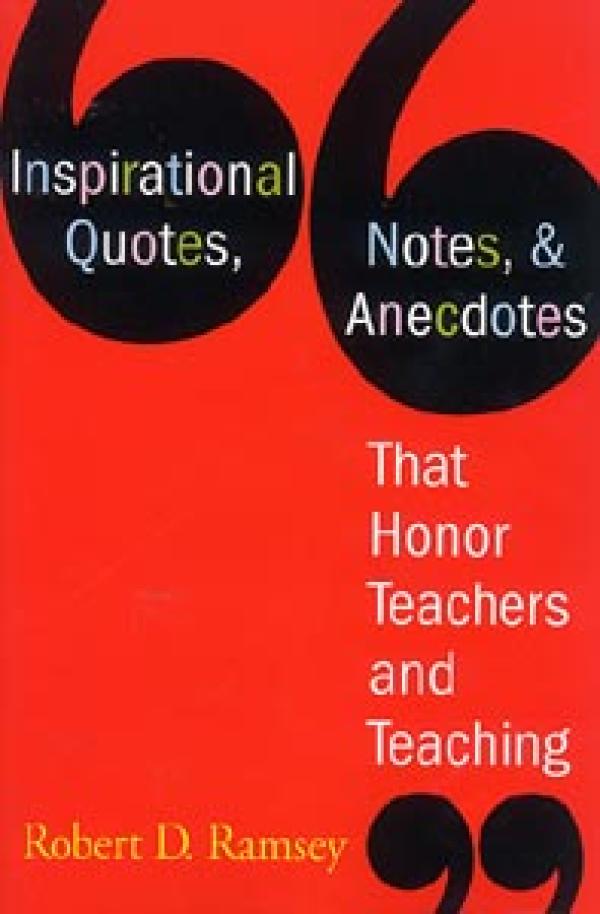
The complete uplifting guide for every teacher to enrich each day and a career in teaching! All teachers need encouragement, affirmation, support, and to be reminded that they are part of a noble profession. Best-selling author Robert D. Ramsey has been an avid collector of inspirational quotes, notes, anecdotes, reflections, testimonials, and tributes for educators, and his new collection provides potentially career-saving homework for the soul of every teacher. This easy-to-read, but hard-to-forget anthology is full of powerful reminders that there is no such thing as "only a teacher." The contents of this uplifting resource have been carefully harvested by an educator for educators and are designed to: * Help belabored and beleaguered educators jump start their careers * Reclaim their professional pride * Rekindle their passion for teaching * Get the grit to press on against all odds Inspirational Quotes, Notes, & Anecdotes That Honor Teachers and Teaching makes a strong unified statement all teachers need to hear! (From the Publisher)
Spirituality, Action, & Pedagogy: Teaching from the Heart invites the reader to participate in a personal exploration of what it means to consciously seek the heart of education. The authors in this collection - practitioners in higher education and teaching in such diverse areas as educational foundations, communication, theater, sociology, reading and literacy, and performance studies - respond to this challenge by striking the most personal chords of their lived experience. As they relate their tales of spirituality and teaching, the reader will be coaxed into confronting the question of what it means to teach. Spirituality, Action, & Pedagogy addresses the integration of spirituality into pedagogical practice by providing cutting-edge examples of applications in classroom settings. (From the Publisher)

This book presents a series of reflections - excerpts from the inner and outer lives of college teachers - from which emerges a common concern for the interactive and spiritual dimensions of the educational process, and a sense of the light which can and should illuminate it. Informed either by personal commitment to Quakerism, or by individual work within Quaker institutions, the contributors offer perspectives that are important for teachers, parents, and readers generally interested in the classroom experience as a process of growth and exploration. (From the Publisher)
During the 1996–97 academic year the authors conducted interviews with seminary professors known by their students, colleagues, and deans as teachers who had remained vibrant into the last decade of their teaching careers. The purpose of the interviews was to hear how these professors viewed the teaching vocation as they had given it expression in their specific institutional settings. From the interview transcripts, the authors have identified eight common threads among the participants, illustrating these with material quoted from the interviews. The last section of the article relates these threads to four orientations: to educational institutions, to the church, to vocation, and to one's own spiritual life.
Changing pedagogies is an ongoing process consequent upon personal and social change. Those of us who teach in religious studies or theology departments risk failure in changing pedagogies if we attempt such change alone. This essay, cast as a personal journey, reviews the changing student body, the reasons why we must adapt our pedagogies to this change, and the processes and consequences of adapting these new pedagogies. The goal of changing pedagogies is to allow the plurality of voices and pedagogies to speak and be used to sustain a community of love and concern in the midst of diversity.
Historically, the Presbyterian/Reformed tradition has placed a heavy emphasis on education and has honored teaching as an important vocation. This paper begins to explore insights and models that tradition offers to help teachers clarify their calling. The article discusses five themes in Reformed theology and how these themes play out in an educational context, providing examples from one Presbyterian college. The paper concludes by suggesting four ways to think about pedagogy in Presbyterian institutions that are both consistent with Reformed principles and practical in their relevance to teaching and learning.