Resources
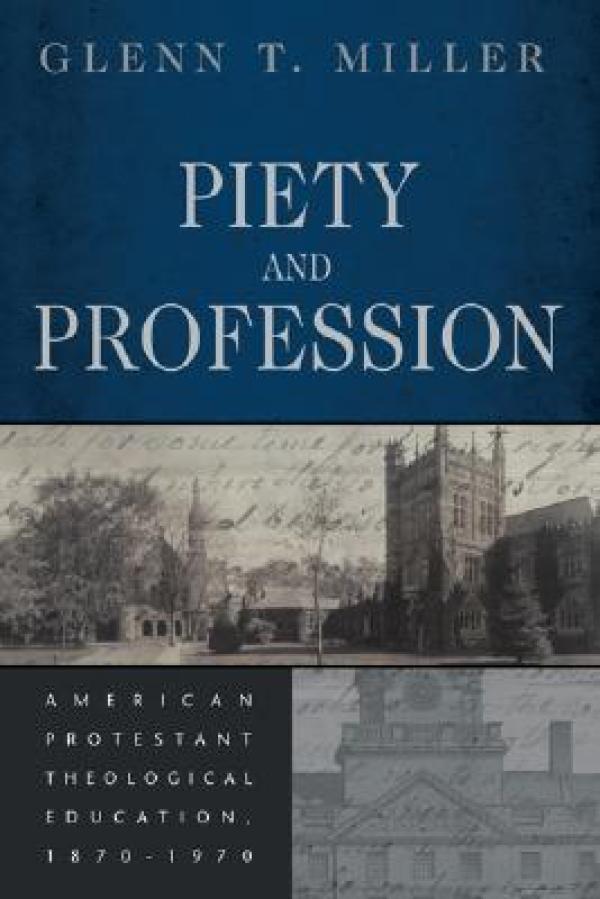
From the urbanization of the Gilded Age to the upheavals of the Haight-Ashbury era, this encyclopedic work by Glenn Miller takes readers on a sweeping journey through the landscape of American theological education, highlighting such landmarks as Princeton, Andover, and Chicago, and such fault lines as denominationalism, science, and dispensationalism. The first such exhaustive treatment of this time period in religious education, Piety and Profession is a valuable tool for unearthing the key trends from the Civil War well into the twentieth century. All those involved in theological education will be well served by this study of how the changing world changed educational patterns. (From the Publisher)
This issue on theological school faculty and doctoral students, who are the theological faculty of the future, revisits a topic first studied ten years ago by the Auburn Center for the Study of Theological Education. The findings of the present study, compared with those of Auburn’s earlier research, suggest that theological education is, on the whole, a stable enterprise. On many items and indicators, theological faculty and theology and religion doctoral students today look and sound very much like those surveyed ten years ago. In some other areas there are slight but steady changes over the decade that may indicate trends and a few dramatic changes that invite analysis and interpretation. This report also address a new topic—theological faculty members’ teaching practices and attitudes toward teaching. (From the Publisher)
A major and continuing problem for theological education and the practice of Christian ministry is how to best achieve a genuine integration between theory and practice, theology and experience. The key claim of this book is that theological reflection, beginning with experience, is a method of integration and that pastoral supervision is a vehicle for theological reflection. In establishing this claim, John Paver demonstrates that the model and method have potential to be a catalyst for reform within theological colleges and seminaries. Three different theological reflection models are developed and critiqued in this book, and their capacity to be developed in particular contexts is explored. This book does not stop at ministry, cultural and personal integration, but is bold enough to make recommendations for structural integration within the theological institution. (From the Publisher)
Discussions on teaching and learning within theological seminaries often center on the question of student diversity, focused primarily upon issues of race, gender, and ethnicity. At the same time that seminaries are challenged to deal with a multitude of pedagogical suppositions emerging from increasingly diverse learning goals, seminaries must also pay attention to the ways their students challenge an institution's core mission to train ministers for service in churches and denominations. Based upon the author's experience teaching in a mainline Protestant seminary, the essay discusses three student cultures that often overlap among today's seminarians. These three student cultures, referred to here as "church seminarian," "new paradigm seminarian," and "vocational seminarian," carry very different understandings of the seminary's role to prepare students for ministry. A critical discernment of these cultures might challenge seminary faculty to reevaluate their educational and missional suppositions amidst divergent student career objectives.
The exploration described is rooted in the projects of five participants in the 2004/05 Wabash Workshop for Pre-Tenure Theological Faculty (led by Toni Craven and assisted by Daisy Machado and Steve Delamarter). All the projects related technology and pedagogy. Javier Alanís (Lutheran Seminary Program in the Southwest) wanted to use images to help his students engage various concepts of the Trinity, being sensitive all the while to an educational context marked by all kinds of diversity. Russell Haitch (Bethany Theological Seminary) was brought into the world of online teaching and found himself trying to assess its potential from the standpoints of scripture, reason, experience, and a trinitarian theological-anthropology. Mark Vitalis Hoffman (Lutheran Theological Seminary at Gettysburg) wanted to help his students experience a fresh encounter with Jesus' parables and ended up in the esoteric field of video gaming theory (ludology) for help in conceiving an environment and process interactive enough to do justice to all of the possibilities. Arun Jones (Austin Seminary) wondered how he might use historical images of mission work in India to help his students experience some of the issues surrounding intercultural ministry. Brent A. Strawn (Candler School of Theology, Emory University) had some vexing and complex concepts relating to Old Testament introduction (the nature of the interactions between biblical narratives and ancient Near Eastern texts) that required new points of access in order to be able to capture the understanding and imagination of contemporary students in his setting. Over the course of the year together (one week in June 2004, a weekend in January 2005, and a week in June 2005), participants worked on their project as all of us in the workshop explored issues of teaching and learning.
Adult-learning theory challenges faculty to adapt their teaching to certain characteristics of adult learners, including self-direction: if adults direct the bulk of their lives outside of school, they should be permitted to direct their own educational experiences. To what extent is self-directed learning an optimal, or even realistic, methodology for seminary teaching? Does it matter what subjects we are teaching? This essay details an experiment with self-directed learning in a seminary ministry class: what worked, what might be improved, and how it challenges our view of ourselves as faculty to teach in this way. Student feedback from the course in question enhances our understanding of the best (and most challenging) features of the experiment.
Over the past fifteen years in New Zealand, theology has come in from the tertiary educational cold in various ways. One of the results or reasons for this has been willingness on the part of the state to accredit and provide funding for theological education and research. This has taken place largely through a compliance system of accreditation and resource allocation. The result has been academic recognition and a precarious financial boon for theology and some theological institutions and their students. But little attention has been paid to the epistemological and pedagogical temptations of compliance. Drawing on the recent experience of the writer, this article seeks to identify a number of the subtle temptations posed by state sponsored theological education and research.
Journal Issue.
Journal Issue.
This collection of essays presents the theological, pedagogical, and disciplinary framework on which multicultural theological education is built. While many seminaries and divinity schools have expressed their commitment to create diverse communities of faculty and students, fewer schools have developed methods of learning and teaching that are appropriate for these communities. Written by faculty members at McCormick Theological Seminary, a school renowned for its commitment to diversity, these essays provide examples of new ways of learning and teaching that will help shape and sustain multicultural theological education.