Resources
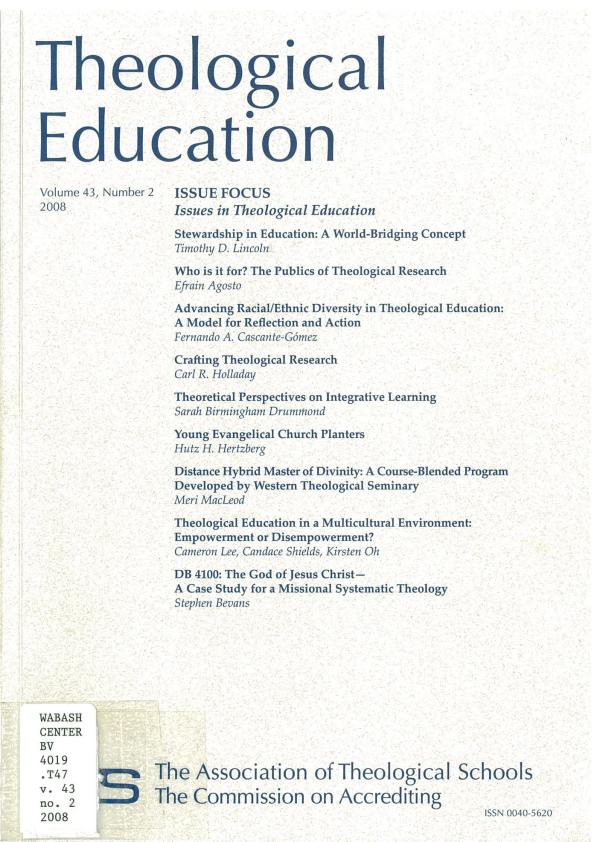
Journal Issue. Full text is available online.
Earthen Vessels is a thoughtful, conversational essay illuminating the broad contours of theological education today. Rather than using a historical or analytic approach to discuss theological education in North America, Daniel Aleshire uses what he terms "appreciative inquiry" to identify the strengths of theological schools at their best. (From the Publisher)
Teaching Reflectively in Theological Contexts explores the dynamics, principles, contradictions and tensions of teaching within theological contexts. It offers practical suggestions on modeling pastoral leadership, building trust with learners, negotiating the dynamics of team-teaching, questioning received truth, teaching through discussions, working with diversities, and building a culture of reflective teaching. (From the Publisher)
What does it mean to lead a truly "life-giving way of life"? What kinds of learning and teaching will best prepare ministers to foster such a way of life in their congregations? How might teachers of practical theology best understand and undertake their task to educate and form ministers? Respected scholars and ministers explore such questions in For Life Abundant, probing and clarifying the significance of practical theology in the classroom, in the wider academy, and in actual ministry settings. (From the Publisher)
Journal Issue. Full text is available online.
Journal Issue.
Although indebtedness is still not a major problem for most theological and rabbinical students, levels of indebtedness have risen steeply in recent years. These increases are usually the indirect and cumulative result of decisions made by theological and rabbinical schools. This article outlines the findings and recommendations of the National Study of Theological Student Indebtedness, conducted between 1990 and 1994 by the Auburn Center for the Study of Theological Education. We intend this report for those who must make decisions about the financing of theological education: administrators; faculty and trustees of theological and rabbinical schools; leaders of religious bodies that support such schools and their students; and present and prospective students. Those who seek a brief summary of the findings will find it in the italicized paragraphs that conclude each section of this articles. A detailed report on the research and its findings will be available at cost from the Auburn Center in mid-1995. (From the Publisher)
An examination of the history of American Protestant theological education which focusses on aims and purposes and how (if at all) those ideals were incarnated in particular schools. (From the Publisher)
A series of reflections on this period in theological education. (From the Publisher)

This study reports the results of the first-ever survey of graduates of theological and rabbinical schools in North America. The survey was sent to graduates from Protestant, Catholic and Jewish institutions who earned M.Div., M.A., Rabbinical or comparable degrees in 1995 and 2000. In addition, the Association of Theological Schools, the accrediting body for schools in the U.S. and Canada, provided data from their Entering and Graduating Student Questionnaires (ESQ and GSQ). In combination, these data provide answers to two crucial questions: 1) What do graduates do in the years after they complete their education and 2) How well do they think their theological training prepared them for their work? Generally, the news from this study is good. Large percentages of graduates assume the primary professional role for which their education prepares: leadership in a congregation or other religious organization. Attrition is fairly low. There are, however, causes for concern. Women graduates do not fare as well as men, and interest in congregational ministry is decreasing among recent graduates, especially among the growing population of younger students. Other positive findings include high ratings by graduates of their theological education, though practical training is not as highly rated as academic preparation. (From the Publisher)