Resources
Research begins with good questions. Undergraduate students often struggle with research projects because they do not know how to pose good research questions. This note describes a teaching strategy that is collaborative and digital, and enables students to practice asking research questions and acquire skills for evaluating them collectively. Working in groups and through a digital medium, students query each other's research interests and, in turn, inhabit the kinds of conversational practices that characterize authentic scholarly discourse.
More professors and institutions want to move from a detect-and-punish to an educate-and-prevent model for dealing with plagiarism. Understanding the causes of plagiarism, especially among international students, can aid in efforts to educate students and prevent plagiarism. Research points to a confluence of causal factors, such as time pressure, language differences, and unclear rules. Though not the primary factor, ethical differences between cultures are also germane. Overall, the plight of international students summons institutions to examine their ethical norms of attribution. Plagiarism has a cultural history tied to concepts of individual creativity, but its future may look quite different in an era with increased communal sharing of ideas and images.
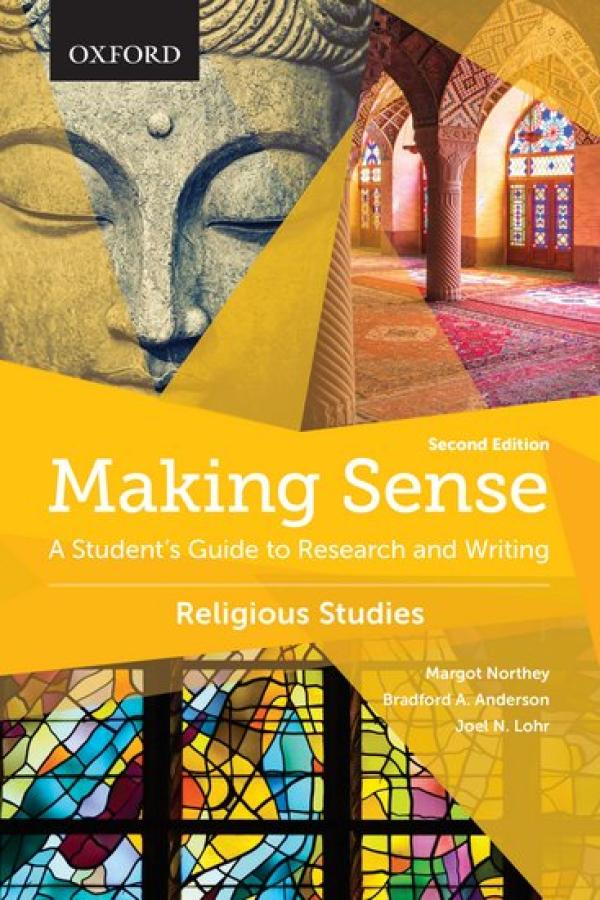
Click Here for Book Review Abstract: Features an overview of research and writing for students in religious studies, for a reasonable price, and can be used as a resource for a student's entire academic career. Uses straightforward language to discuss the basics of research and writing. Instructors agree that as an overview, the Making Sense series is much easier to digest than heavier writing style guides, and they appreciate the discipline-specific content. Features up-to-date guidelines for documentation and referencing and provides the most current guidelines for documentation in religious studies, including coverage of MLA, APA, and Chicago styles and referencing. Along with including the most up-to-date citation styles, the Making Sense series also features current examples, and useful information on using the internet as a research tool. More Accessible. This edition contains more bulleted points and summaries to make the content easier to reference and absorb. New to this Edition: Chapters are reordered to better match the writing and learning process Includes comprehensive coverage of new developments in technology-based research and writing Sections on MLA, APA, and Chicago style have been revised to be completely up to date (From the Publisher)
One page Teaching Tactic: Students work alone and in groups to identify effective research questions for their capstone essay.
Click Here for Book Review Abstract: In this book, Troy Hicks - a leader in the teaching of digital writing - collaborates with seven National Writing Project teacher consultants to provide a protocol for assessing students’ digital writing. This collection highlights six case studies centered on evidence the authors have uncovered through teacher inquiry and structured conversations about students’ digital writing. Beginning with a digital writing sample, each teacher offers an analysis of a student’s work and a reflection on how collaborative assessment affected his or her teaching. Because the authors include teachers from kindergarten to college, this book provides opportunities for vertical discussions of digital writing development, as well as grade-level conversations about high-quality digital writing. The collection also includes an introduction and conclusion, written by Hicks, that provides context for the inquiry group’s work and recommendations for assessment of digital writing. Book Features: An adaptation of the Collaborative Assessment Conference protocol to help professional learning communities examine students’ digital work. Detailed descriptions of students’ digital writing, including the assessment process and implications for instruction. Links to the samples of student digital writing available online for further review and to be used as digital mentor texts. (From the Publisher)
Emphasizing both reading and writing, The Elements of Difficulty helps readers to confront the challenges of interpreting difficult texts and to see those challenges as paths to knowledge, rather than impediments. This short, economical paperback enables readers to acknowledge, name, and assess the nature of their difficulties in reading and interpreting complex texts, with the ultimate goal of transforming confusion into understanding. (From the Publisher)
A site with resources for teachers to coach students when providing peer feedback and revision, to promote critical thinking and better writing.
Click Here for Book Review Abstract: Written in a tradition that encourages teachers to see classrooms as laboratories and themselves as artists, intellectuals and researchers, Teaching Writing While Standing on One Foot is a compelling work that will enthrall readers as well as give them knowledge, hope, and inspiration. Written from the perspective of a writer, teacher, father, home cook and learner growing up with a learning disability, Teaching Writing While Standing on One Foot combines essays, poems, recipes, legends, teaching tips and stories to explore the question “How do we teach what we can only learn for ourselves?” Prompts woven throughout the book invite readers to write the stories of their own lives. (From the Publisher)
Provides a brief explanation and instructions for students to encourage them to learn to annotate while reading texts — produced by a state university writing center. 
Click Here for Book Review Abstract: This innovative resource provides teachers with a road map for designing a comprehensive writing curriculum that meets Common Core standards. The authors zero in on several “big ideas” that lead to and support effective practices in writing instruction, such as integrating reading, writing, speaking, and listening; teaching writing as a process; extending the range of students’ writing; spiraling and scaffolding a writing curriculum; and collaborating. These “big ideas” are the cornerstones of best researched-based practices as well as the CCSS for writing. The first chapter offers a complete lesson designed around teaching narrative writing and illustrating tried and true practices for teaching writing as a process. The remaining chapters explore a broad range of teaching approaches that help students tackle different kinds of narrative, informational, and argumentative writing and understand complexities like audience and purpose. Each chapter focuses on at least one of the uncommonly good ideas and illustrates how to create curricula around it. Uncommonly Good Ideas includes model lessons and assignments, mentor texts, teaching strategies, student writing, and practical guidance for moving the ideas from the page into the classroom. Book Features: - Presents no-nonsense information about teaching writing in the era of CCSS, including ways in which the CCSS are misinterpreted. - Focuses on “the core of the core,” the bedrock on which effective teaching approaches rest. - Incorporates the voices and practices of many talented teachers of writing, including ELA teachers from urban, rural, and suburban schools, as well as ELL teachers. - Addresses teachers as respected, dedicated professionals whose experiences and good judgment are the linchpins of any reform. (From the Publisher)