Resources
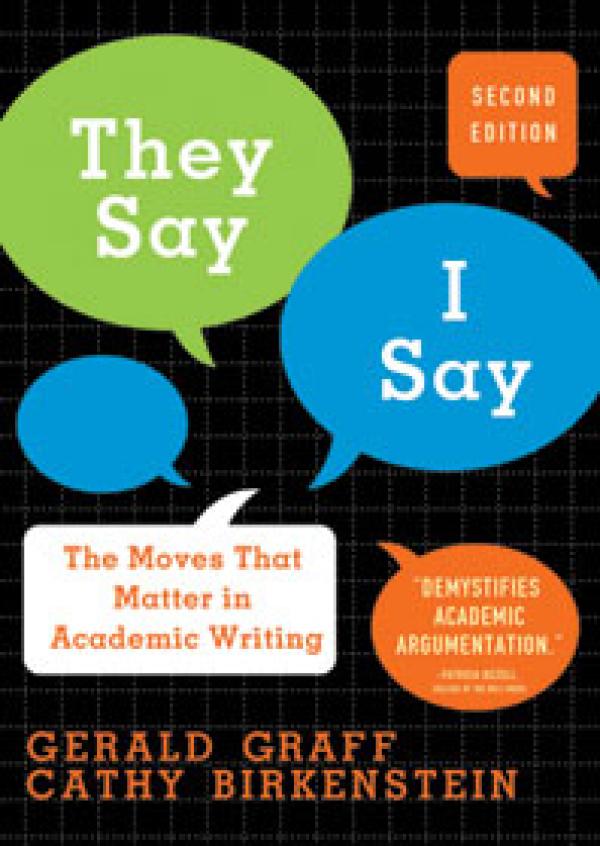
A textbook for students that provides insights for professors teaching writing. From the publisher: "The book that demystifies academic writing, teaching students to frame their arguments in the larger context of what else has been said about their topic–and providing templates to help them make the key rhetorical moves. "The best-selling new composition book published in this century, in use at more than 1,000 schools, They Say / I Say has essentially defined academic writing, identifying its key rhetorical moves, the most important of which is to summarize what others have said (“they say”) to set up one’s own argument (“I say”). The book also provides templates to help students make these key moves in their own writing. "The Second Edition includes a new chapter on reading that shows students how to read for the larger conversation and two new chapters on the moves that matter in the sciences and social sciences." (From the Publisher)
One page Teaching Tactic: using images as an analogy to help students understand the difference between plagiarism and other appropriate uses of scholarship.
Click Here for Book Review Abstract: Delineates Lacan’s theory of the four discourses as a practical framework through which faculty can reflect on where their students are, developmentally, and where they might go. University classrooms are increasingly in crisis—though popular demands for accountability grow more insistent, no one seems to know what our teaching should seek to achieve. This book traces how we arrived at our current impasse, and it uses Lacan’s theory of the four discourses to chart a path forward via an analysis of the freshman writing class. How did we forfeit a meaningful set of goals for our teaching? T. R. Johnson suggests that, by the 1960s, the work of Bergson and Piaget had led us to see student growth as a journey into more and more abstract thought, a journey that will happen naturally if the teacher knows how to stay out of the way. Since the 1960s, we’ve come to see development, in turn, only as a vague initiation into the academic community. This book, however, offers an alternative tradition, one rooted in Vygotsky and the feminist movement, that defines the developing student writer in terms of a complex, intersubjective ecology, and then, through these precedents, proposes a fully psychoanalytic model of student development. To illustrate his practical use of the four discourses, Johnson draws on a wide array of concepts and a colorful set of examples, including Franz Kafka, Keith Richards, David Foster Wallace, Hannah Arendt, and many others. “Graceful, provocative, thoughtful, and well researched, The Other Side of Pedagogy connects theory and teaching in compelling ways. This is a groundbreaking book that scholars of writing will want to read, reread, and teach.” — Joseph Harris, author of A Teaching Subject: Composition Since 1966 (From the Publisher)
One page Teaching Tactic: a structured writing group for graduate students.
One page Teaching Tactic: specific prompts for student presentations of a religious artifact they select.
A 10 minute YouTube clip from the beginning of a longer film produced to help teachers work with international students in writing environments. (http://www.amazon.com/Writing-Across-Borders/product-reviews/B004HU7SUY)  How do we assess international student writing and what teaching practices disadvantage international students and which help them improve as writers? 
The OpEd Project scouts and trains  under-represented experts to take thought leadership positions in their fields, connecting them with a national network of high-level media mentors, and channeling the best new experts and ideas directly to media gatekeepers who need them, across all platforms.
Web-scale discovery services promise fast, easy searching from a single Google-like box, pleasing users and making library resources more discoverable. Some librarians embrace the concept of giving users what they have come to expect from Google, while others are concerned that this will “dumb down” searching and undermine information literacy. In this article we explore the potential impact of Web-scale discovery tools on information literacy, focusing particularly on undergraduate research skills. We review the existing literature and present findings and experiences from two mid-sized academic libraries that have adopted EBSCO Discovery Service as their library home page portal.Web-scale discovery services promise fast, easy searching from a single Google-like box, pleasing users and making library resources more discoverable. Some librarians embrace the concept of giving users what they have come to expect from Google, while others are concerned that this will “dumb down” searching and undermine information literacy. In this article we explore the potential impact of Web-scale discovery tools on information literacy, focusing particularly on undergraduate research skills. We review the existing literature and present findings and experiences from two mid-sized academic libraries that have adopted EBSCO Discovery Service as their library home page portal.
Citation Machine automatically generates citations in MLA, APA, Chicago, and Turabian. Helps students avoid plagiarism.
In this Prezi (without voice-over), Thompson explains "open access" to educators and scholars. Includes attention to Open Educational Resources (OER), the relation of Creative Commons to "public domain" and traditional copyright, the difference between "open access" and "open source," different axes of "openness," and the economic crisis in academic publishing. Includes link to Google Doc capturing all URLs cited in the Prezi.