Home » Resources » Scholarship on Teaching » The Other Side of Pedagogy: Lacan's Four Discourses and the Development of the Student Writer
Scholarship
March 29, 2017
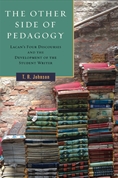
The Other Side of Pedagogy: Lacan’s Four Discourses and the Development of the Student Writer
- Author
- Johnson, T. R.
- Publisher
- SUNY Press, Albany, NY
- ISBN
- 9781438453194
- Table of Contents
-
Acknowledgments
Introduction: Recovering the Unconscious: Pedagogy’s Other Side
ch. 1 The Crisis: Forfeiting Our Most Valuable Asset
ch. 2 Contemporary Composition Studies: Development Means Joining Our Community, and That’s All There Is to Know
ch. 3 Why the “Growth” Movement Didn’t Grow—And an Alternative
ch. 4 Psychoanalysis and Pedagogy: Some Historical Context and Key Terms for Doing the Impossible
ch. 5 A Perfect Ignorance and Paralysis: The Discourse of the Master
ch. 6 Only Following Directions: The Discourse of the University
ch. 7 “Songs…dripping off my fingers”: The Discourse of Hysteric
ch. 8 Playing by Ear: The Discourse of the Analyst
Works Cited
Index
Click Here for Book Review
Abstract: Delineates Lacan’s theory of the four discourses as a practical framework through which faculty can reflect on where their students are, developmentally, and where they might go.
University classrooms are increasingly in crisis—though popular demands for accountability grow more insistent, no one seems to know what our teaching should seek to achieve. This book traces how we arrived at our current impasse, and it uses Lacan’s theory of the four discourses to chart a path forward via an analysis of the freshman writing class. How did we forfeit a meaningful set of goals for our teaching? T. R. Johnson suggests that, by the 1960s, the work of Bergson and Piaget had led us to see student growth as a journey into more and more abstract thought, a journey that will happen naturally if the teacher knows how to stay out of the way. Since the 1960s, we’ve come to see development, in turn, only as a vague initiation into the academic community. This book, however, offers an alternative tradition, one rooted in Vygotsky and the feminist movement, that defines the developing student writer in terms of a complex, intersubjective ecology, and then, through these precedents, proposes a fully psychoanalytic model of student development. To illustrate his practical use of the four discourses, Johnson draws on a wide array of concepts and a colorful set of examples, including Franz Kafka, Keith Richards, David Foster Wallace, Hannah Arendt, and many others.
“Graceful, provocative, thoughtful, and well researched, The Other Side of Pedagogy connects theory and teaching in compelling ways. This is a groundbreaking book that scholars of writing will want to read, reread, and teach.” — Joseph Harris, author of A Teaching Subject: Composition Since 1966 (From the Publisher)
Abstract: Delineates Lacan’s theory of the four discourses as a practical framework through which faculty can reflect on where their students are, developmentally, and where they might go.
University classrooms are increasingly in crisis—though popular demands for accountability grow more insistent, no one seems to know what our teaching should seek to achieve. This book traces how we arrived at our current impasse, and it uses Lacan’s theory of the four discourses to chart a path forward via an analysis of the freshman writing class. How did we forfeit a meaningful set of goals for our teaching? T. R. Johnson suggests that, by the 1960s, the work of Bergson and Piaget had led us to see student growth as a journey into more and more abstract thought, a journey that will happen naturally if the teacher knows how to stay out of the way. Since the 1960s, we’ve come to see development, in turn, only as a vague initiation into the academic community. This book, however, offers an alternative tradition, one rooted in Vygotsky and the feminist movement, that defines the developing student writer in terms of a complex, intersubjective ecology, and then, through these precedents, proposes a fully psychoanalytic model of student development. To illustrate his practical use of the four discourses, Johnson draws on a wide array of concepts and a colorful set of examples, including Franz Kafka, Keith Richards, David Foster Wallace, Hannah Arendt, and many others.
“Graceful, provocative, thoughtful, and well researched, The Other Side of Pedagogy connects theory and teaching in compelling ways. This is a groundbreaking book that scholars of writing will want to read, reread, and teach.” — Joseph Harris, author of A Teaching Subject: Composition Since 1966 (From the Publisher)