Resources
Making a Real Difference with Diversity provides readers with a step-by-step guide for implementing, evaluating, and sustaining comprehensive diversity work on campus. Drawn from a six-year diversity initiative involving twenty-eight independent California colleges and universities, the monograph offers a set of promising practices and selected quantitative and qualitative findings pertaining to efforts to enhance college access and success for underrepresented students, increase the presence of underrepresented minority faculty, and strengthen overall institutional functioning regarding diversity. (From the Publisher)
This book offers college and university teachers a practical guide for meeting the challenges of educating the burgeoning population of Latino students. The contributors, a stellar group of experienced leaders in higher education, clearly show that the changes to higher education needed to ensure Latino student success will benefit all students. In this book, the authors call for systemic change across the entire K-16 spectrum but put the focus on the challenges for higher education. The book outlines strategies for increasing access and retention, explores the role of professional associations in advocating change, and explains the importance of the contributions of Latino college graduates to the U.S economy. Latino Change Agents in Higher Education is a much-needed guide for higher education leaders no matter what type of campus or institution they represent. (From the Publisher)
African American Men in College is a much-needed resource that includes examples of real-world programs and activities to enhance academic success in the college environment for African American men. The examples are collected from a variety of institutions across the country.With contributions from leading practitioners and scholars in the field, African American Men in College explores the factors that promote a climate of academic success. The book shows how participation in extracurricular activities can create a positive social climate and examines the advantages of developing communication and leadership skills. It shows how fostering relationships with administrators and community leaders can promote academic success. The book also describes a proven mentoring program and examines the role spirituality and religion can play in bolstering successful college experiences. (From the Publisher)
Discussions on teaching and learning within theological seminaries often center on the question of student diversity, focused primarily upon issues of race, gender, and ethnicity. At the same time that seminaries are challenged to deal with a multitude of pedagogical suppositions emerging from increasingly diverse learning goals, seminaries must also pay attention to the ways their students challenge an institution's core mission to train ministers for service in churches and denominations. Based upon the author's experience teaching in a mainline Protestant seminary, the essay discusses three student cultures that often overlap among today's seminarians. These three student cultures, referred to here as "church seminarian," "new paradigm seminarian," and "vocational seminarian," carry very different understandings of the seminary's role to prepare students for ministry. A critical discernment of these cultures might challenge seminary faculty to reevaluate their educational and missional suppositions amidst divergent student career objectives.
Emerging from the particular experiences of the marginalized, postmodern pedagogies (bell hooks, Paolo Freire, feminist pedagogies) argue that education is more than conveying information from teacher to student. Rather education should encompass the transformative process of shaping character, values, and politics through the dynamic interaction among the teacher, the students' experiences, and the content of the instructional material. These perspectives argue that educators should reject "the banking model" of education, and teach to transform. However, religious studies with today's black college student tests the mettle of these approaches. On the one hand, historically black colleges and universities (HBCUs) have long practiced transformative education through a commitment to shaping both the minds and characters of their students. On the other hand, many of today's black college students are less receptive to transformation, particularly in the academic study of religion. This resistance to transformation is a reflection of (1) the socio-economic reality of the current student, and (2) a new black religiosity that portrays the world in binary terms. These economic and religious realities present a teaching context for which few religious scholars are prepared. This essay discusses the particularities of teaching religion to today's black college student by sharing the challenges, failures, successes, and joys of teaching religion at a small church-related, historically black women's college in the south. I will discuss the techniques that fail, and the way in which this unique context causes me to transform the way I teach religion. In the midst of a commitment to postmodern pedagogies, I feel a need to return to the banking model's establishment of authority and emphasis on content. As I negotiate with this method, I find ways to stealthily infuse transformative pedagogical techniques. I also discuss the way such a dramatic shift in pedagogy has transformed me, the teacher.
Students from different cultural backgrounds respond in a variety of ways to my teaching of biblical studies. Some sermonize or plagiarize quite unselfconsciously in their written assignments, while others consistently hand in work late or are silent members of the class. As I struggled with what these behaviors were saying about my teaching, I came to realize that limited ability in spoken and written English was not the only barrier. Deeper issues were at stake here about the nature of cross-cultural communication, teaching, and learning. In this note I analyze the issues of faith, authority, and styles of teaching and learning which underlie the "clash of educational cultures" (Ballard and Clanchy 1997, viii) occurring in the cross-cultural classroom. Then I suggest a number of strategies that I have developed to build bridges of understanding between the various educational cultures, to encourage deeper participation and to develop critical thinking.
Finding themselves teaching to increasingly diverse student populations, two mid-career faculty from different disciplines embarked on a common voyage to make their foundational courses more sensitive to student learning styles. Adrift in the seas of multiple intelligences and multiculturalism, the researchers quickly abandoned any hope of developing distinctive teaching portfolios for individual learning profiles. Instead, they structured the syllabus to be the passport into a common culture of teaching and learning in the classroom. Syllabus design and on-going "spot" assessments proved trusty guides in re-centering learning on the students' needs. In the process of outlining these two strategies for creating a common culture of teaching and learning, the article offers testimony that old dogs can learn new tricks! Additional materials, including syllabi used in these courses and in class assessment tools, can be found on the Web page of the Wabash Center for Teaching and Learning in Theology and Religion: http://www.wabashcenter.wabash.edu/journal/greenstortz.html
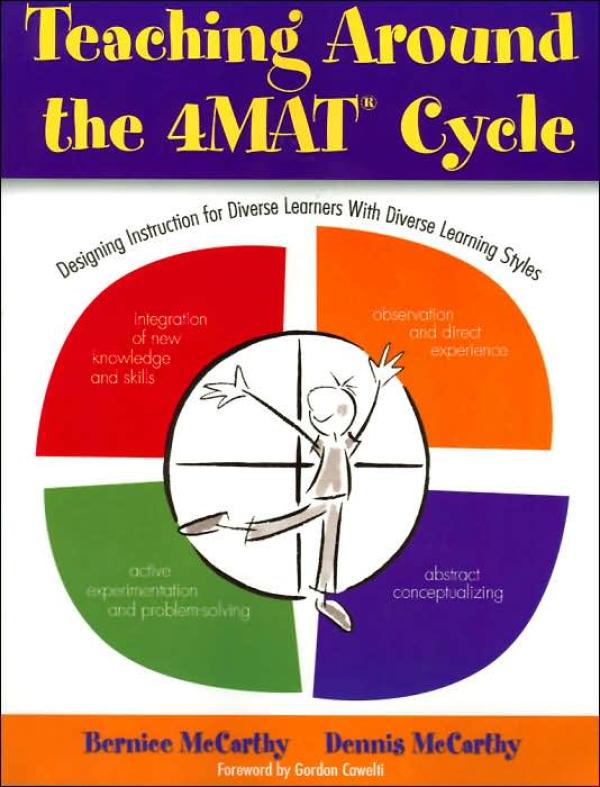
From the Publisher Learning styles are linked to preferences in the ways people perceive and process experience. Bernice McCarthy's unique 4MAT cycle is a brain-based teaching method that emphasizes diverse learning styles, honors learner individuality, teaches concepts as well as facts, and improves student thinking and performance on traditional as well as high-stakes assessments. With 25+ years of field testing and field use supporting its effectiveness, the 4MAT method uses a 4-quadrant cycle of learning that begins by engaging learners through direct experience, moving them toward: Reflective observation, Abstract conceptualizing, Active experimentation and problem-solving, Integration of new knowledge and skills. Learning happens as we unite our experiences and their meaning with actions that test those meanings in the world. This exciting new resource offers schools a powerful tool to enhance teaching and learning for students with all learning styles, backgrounds, and preferences.
Journal Issue.