Resources
Two decades after the first Women's Studies courses appeared on campuses in the US, feminist research and teaching are now thriving around the world. The editors of this book provide a rich sample of theoretical and practical reflections on classroom experience by teachers of Women's Studies over the past ten years, raising provocative questions which apply broadly to many areas of progressive teaching. The collection features new, unpublished and original work as well as a selection of the best articles to have appeared in recent years. (From the Publisher)
Applying theory to practice, Women Teaching for Change reveals the complexity of being a feminist teacher in a public school setting, in which the forces of sexism, racism, and classism, which so characterize society as a whole, are played out in multiracial, multicultural classrooms. "A fine book, a rich melding of critical theory in education, feminist literature, and pedagogical experience and expertise." Maxine Green, Columbia University. (From the Publisher)
What happens when teachers share power with students? In this profound book, Ira Shor--the inventor of critical pedagogy in the United States-- relates the story of an experiment that nearly went out of control. Shor provides the reader with a reenactment of one semester that shows what really can happen when one applies the theory and democratizes the classroom. This is the story of one class in which Shor tried to fully share with his students control of the curriculum and of the classroom. After twenty years of practicing critical teaching, he unexpectedly found himself faced with a student uprising that threatened the very possibility of learning. How Shor resolves these problems, while remaining true to his commitment to power-sharing and radical pedagogy, is the crux of the book. Unconventional in both form and substance, this deeply personal work weaves together student voices and thick descriptions of classroom experience with pedagogical theory to illuminate the power relations that must be negotiated if true learning is to take place. (From the Publisher)
Doctors, architects, lawyers and engineers are all trained in schools that emphasize technique but neglect the key element of artistry that distinguishes the true professional. Today's professional is a drudge, mechanically applying privileged knowledge to rote tasks. That is Schon's diagnosis of higher education, and as a remedy he recommends learning by doing. To teach skills of improvisation and problem-framing, he feels our universities should borrow the methods used in art studios, dance conservatories, athletics coaching, craft appenticeships and psychoanalytic training. In all these settings, a dialogue between student and coach in a low-risk atmosphere encourages creativity. Despite its academic prose, this primer by an MIT urban studies professor will enlighten students, teachers and professionals. Schon concludes the book (a sequel to The Reflective Practitioner with a description of his attempt to create a ``studiolike'' curriculum for MIT's city planning courses. (From the Publisher)
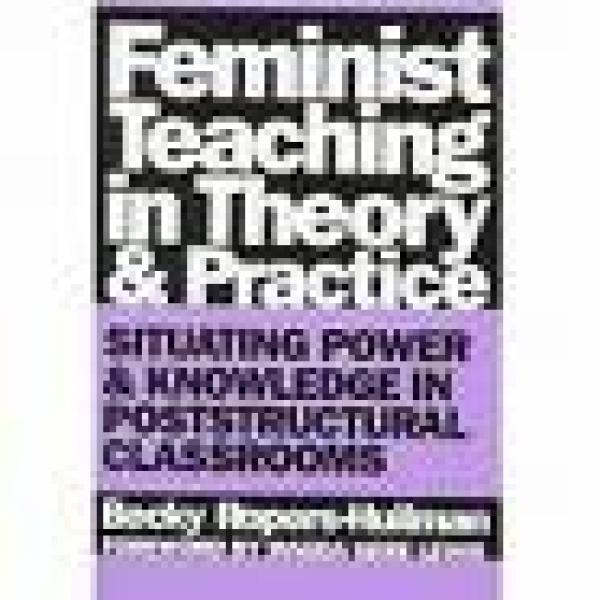
Using a feminist poststructural focus, Ropers-Huilman (Louisiana State Univ.) investigates feminist teachers' positions and styles in order to examine the practices of a theory of teaching. She explores teachers' reflections on power and gender, how they operate in the classroom, and their experiences as innovators in feminist teaching. No one particular approach or process is emphasized. The application of theory to practice allows the 22 teachers who were interviewed to explore and debate the interaction between students and teachers. The complexity of investigating feminist practices, rather than just the teachers themselves, allows a more flexible look at the issues and the social forces defining their interpretations. Ropers-Huilman explores factors contributing to the many forms of feminist teaching and how power affects and shapes the experience. (From the Publisher)
Here is a thoroughly original work on the meaning of teaching by one who has been widely credited with reshaping the field of religious education in the United States, and to have had a significant effect also in many other countries. Part 1 establishes a fundamental meaning for "to teach," grounding it in its most basic forms and moving from examples in the nonhuman world (what the mountain teaches the mountain climber) to communal and nonverbal forms of teaching among humans. Part 2 explores the languages of teaching and the diverse forms of speech appropriate to teaching: rhetorical forms, including storytelling and preaching; therapeutic languages; and religion's preservation of these languages in ritualized settings, including confessing and mourning. Part 3 draws out the implications of a full understanding of "to teach" for education, the school, and the teaching of morality. Showing How addresses schoolteachers, parents, counselors, ministers, administrators, and all who recognize teaching as a fundamental human act. By exposing the root meaning of teaching, the book represents a challenge to any proposals for educational reform. (From the Publisher)
Alasdair MacIntyre—whom Newsweek has called "one of the foremost moral philosophers in the English-speaking world"—here presents his 1988 Gifford Lectures as an expansion of his earlier work Whose Justice? Which Rationality? He begins by considering the cultural and philosophical distance dividing Lord Gifford's late nineteenth-century world from our own. The outlook of that earlier world, MacIntyre claims, was definitively articulated in the Ninth Edition of the Encyclopaedia Brittanica, which conceived of moral enquiry as both providing insight into and continuing the rational progress of mankind into ever greater enlightenment. MacIntyre compares that conception of moral enquiry to two rival conceptions also formulated in the late nineteenth century: that of Nietzsche's Zur Genealogie der Moral and that expressed in the encyclical letter of Pope Leo XIII Aeterni Patris. The lectures focus on Aquinas's integration of Augustinian and Aristotelian modes of enquiry, the inability of the encyclopaedists' standpoint to withstand Thomistic or genealogical criticism, and the problems confronting the contemporary post-Nietzschean genealogist. MacIntyre concludes by considering the implications for education in universities and colleges. (From the Publisher)
Drawing upon classical and modern theological resources as well as postmodern pedagogical theories, Peter Hodgson argues that God's Wisdom, incarnate in paradigmatic teachers such as Jesus of Nazareth, forms and transforms human beings by evoking critical thinking, heightened imagination, and liberating practice. This groundbreaking book reexamines the place of religion in liberal education and the relationship between religious and theological studies. (From the Publisher)
This book represents some of the last writings by Paulo Freire, who has been acclaimed one of the most important educators of the 20th century. Pedagogy of the Heart is filled with Freire's reminiscences of his early life and meditations "under my mango tree." Many of these will be familiar themes to those who have walked with Freire before. For those coming to his work for the first time, Pedagogy of the Heart will open new doors to the interrelations of education and political struggle. Further enhancing the text are substantive notes by Ana Maria Araujo Freire. (From the Publisher)
Drawing on media studies, literary theory, and the work of psychoanalytical feminist theorist Shoshana Felman, Ellsworth (curriculum and instruction, U. of Wisconsin-Madison) portrays the work of pedagogy as a performance practice. She argues that pedagogy's mode of address - its positioning of teachers and students in relation to one another - is crucial in the success or failure of education efforts. (From the Publisher)