Home » Resources » Scholarship on Teaching » Teaching Positions: Difference, Pedagogy and the Power of Address
Scholarship
March 29, 2017
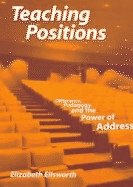
Teaching Positions: Difference, Pedagogy and the Power of Address
- Author
- Ellsworth, Elizabeth
- Publisher
- Teachers College Press, New York, NY
- ISBN
- 807736686
- Table of Contents
-
Acknowledgments
Introduction
Part I Teaching as a Scene of Address
ch. 1 Mode of Address: It's a Film Thing
ch. 2 The Paradoxical Power of Address: It's an Education Thing, Too
ch. 3 "Who" Learns? "Who" Teaches? Figuring the Unconscious in Pedagogy
ch. 4 Who Does Communicative Dialogue Think You Are?
ch. 5 Communicative Dialogue: Control Through Continuity
ch. 6 The Power of Discontinuity: Teaching Through Analytic Dialogue
Part II Teaching Through Paradoxical Modes of Address
ch. 7 A Paradox: Teaching as the Taking of Action Without a Positive Reference
ch. 8 A Second Paradox: The Paradox of Power and Authority in Teaching
ch. 9 A Third Paradox: Teaching as a Performance Suspended in the Space Between Self and Other
ch. 10 A Fourth Paradox: Teaching as Performance Suspended in Time - Interactive Pedagogy in New Media
ch. 11 A Fifth Paradox: Pedagogy as a Performance Suspended in Thought - The Power of a Magical Realist Address in Academic Writing
Coda
References
Index
About the Author
Drawing on media studies, literary theory, and the work of psychoanalytical feminist theorist Shoshana Felman, Ellsworth (curriculum and instruction, U. of Wisconsin-Madison) portrays the work of pedagogy as a performance practice. She argues that pedagogy's mode of address - its positioning of teachers and students in relation to one another - is crucial in the success or failure of education efforts. (From the Publisher)