Resources
Podcast Series. A podcast exploring conversations of Critical Digital Pedagogy, listening for ways to empower students and champion learning. It’s hosted by Chris Friend from Saint Leo University. It’s the aural side of Hybrid Pedagogy—a digital journal of learning, teaching, and technology.
One of the chief tenets for a successful and engaging online course is the development of an effective system that provides ongoing student interaction. Short essay with concrete suggestions for creating, sustaining, and assessing students’ online threaded discussions.
A brief list of research findings matched with implications for specific recommended practices for  effective online learning.
Click Here for Book Review Abstract: It is difficult to imagine a college class today that does not include some online component—whether a simple posting of a syllabus to course management software, the use of social media for communication, or a full-blown course offering through a MOOC platform. In Teaching Online, Claire Howell Major describes for college faculty the changes that accompany use of such technologies and offers real-world strategies for surmounting digital teaching challenges. Teaching with these evolving media requires instructors to alter the ways in which they conceive of and do their work, according to Major. They must frequently update their knowledge of learning, teaching, and media, and they need to develop new forms of instruction, revise and reconceptualize classroom materials, and refresh their communication patterns. Faculty teaching online must also reconsider the student experience and determine what changes for students ultimately mean for their own work and for their institutions. Teaching Online presents instructors with a thoughtful synthesis of educational theory, research, and practice as well as a review of strategies for managing the instructional changes involved in teaching online. In addition, this book presents examples of best practices from successful online instructors as well as cutting-edge ideas from leading scholars and educational technologists. Faculty members, researchers, instructional designers, students, administrators, and policy makers who engage with online learning will find this book an invaluable resource. (From the Publisher)

Journal Issue.
Click Here for Book Review Abstract: From wired campuses to smart classrooms to massive open online courses (MOOCs), digital technology is now firmly embedded in higher education. But the dizzying pace of innovation, combined with a dearth of evidence on the effectiveness of new tools and programs, challenges educators to articulate how technology can best fit into the learning experience. Minds Online is a concise, nontechnical guide for academic leaders and instructors who seek to advance learning in this changing environment, through a sound scientific understanding of how the human brain assimilates knowledge. Drawing on the latest findings from neuroscience and cognitive psychology, Michelle Miller explores how attention, memory, and higher thought processes such as critical thinking and analytical reasoning can be enhanced through technology-aided approaches. The techniques she describes promote retention of course material through frequent low‐stakes testing and practice, and help prevent counterproductive cramming by encouraging better spacing of study. Online activities also help students become more adept with cognitive aids, such as analogies, that allow them to apply learning across situations and disciplines. Miller guides instructors through the process of creating a syllabus for a cognitively optimized, fully online course. She presents innovative ideas for how to use multimedia effectively, how to take advantage of learners’ existing knowledge, and how to motivate students to do their best work and complete the course. For a generation born into the Internet age, educational technology designed with the brain in mind offers a natural pathway to the pleasures and rewards of deep learning, (From the Publisher)
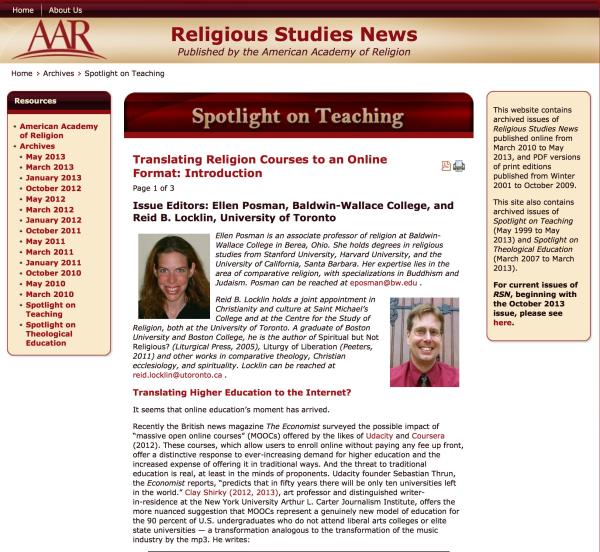
Journal Issue. In this issue of Spotlight, contributors suggest that the shift to online education involves a complex process of translation. Not unlike language translation, translation from traditional educational models to online environments requires a greater or lesser reconceptualization of education itself. Full text is available online.
Useful tools for online instruction, but also theory, administration, and methods of design. The contents of the entire book is available free online through pdf download. 
A user-friendly and practical tool to assist faculty in planning and implementing online courses. Based on the principles of teaching and learning proposed by Chickering & Gamson (1987): Student-Faculty Contact, Cooperation Among Students, Active Learning, Prompt Feedback, Time on Task, High Expectations, and Diverse Talents and Ways of Learning. 
University of Tennessee (Knoxville) site with a “course design chart” to guide you through the instructional design steps of analyzing, designing, developing delivering, and evaluating an online course. Plus a compendium of teaching tools and a glossary of definitions.