Resources
The authors of this volume are intent on promoting the advancement of critical professional development in higher education. They seek to accomplish this by highlighting existing practices and proposing a new model of professional development that is “critical, pragmatic, informed, and flexible” (2). The merits of this new model are said to be its nuance and its attention to the complex and constantly changing landscape of education, particularly higher education. The volume is divided into three parts. Part One focuses on what it means to be a professional, how this term is shaped, and how the discussion surfaces in education. The authors introduce critical professional development as the places where individual growth is shown as a collaboration of individual activity, policy, and institutional and organizational reforms. In support of this model, they advocate the establishment of institutional learning spaces and support structures to achieve their goal. Part Two explores the model’s validity through four case studies. In this section Lynne Barnes and Christine Hough join Appleby and Pilkington in providing examples of the proposed model to enhance teaching and other professional practices. Barnes discusses a training program for deaf teachers, Pilkington explores a framework for professional development, Hough describes her experience in engendering critical thinking in higher education underclassmen, and Appleby discusses her use of writing for professional development. Part Three reflects on these case studies and how they relate to the proposed model. This section also provides recommendations for the implementation of the model and its practice in various organizations. The exploration of professionalism in Part One is dense and jargon heavy, but in this case it is a welcome exception as much of the literature on teaching and learning is filled with clichés and buzz words. The text as a whole is starkly realistic, scholarly, and pragmatic rather than idealistic. As the authors concede, the definition of critical professionalism does not contain any original components; however, it is original in its holistic and practical conceptualization of professionalism in higher education. One limit to the text’s usefulness might be its aim to address both institutional and individual practices. It seems better suited for implementation at an institutional level. Individuals without institutional influence might struggle to implement the model. The text succeeds in providing a model that is not limited by discipline. It provides such a variety of “structures and spaces” (63) that anyone could achieve some benefit from reading the book, while a full implementation of this critical professional practice may be limited. The theory proposed in this volume has wide applicability, and is worthwhile in the fields of theology and religion. Hough’s case study was particularly insightful for those teaching theology and religion. In addition, the entire buffet of professional practices recommended in this text may not be accessible to every reader, but there is certain to be something here for the entire range of practitioners in higher education.
If you are looking for a book on teaching in higher education that does not scare you off with its heft, or frustrate you with its discipline-specific content, or confuse you with so many tips your head spins, then this little book might be just the thing for you! The authors combine their 110 years of faculty development and educational experience to offer their “Ten Top Traits for Terrific Teachers,” targeting the basic dispositions, skills, and strategies that have the greatest impact on deep student learning. Furthermore, they encourage teachers to reflect on their practice with a series of rubrics and action plans: “To improve by increments you must do something” (108). Throughout, they give snapshot summaries of the best research, all in a conversational tone. In an unusual turn, the first half of the book deals, not with mastery of content or course design, but with the internal drivers of the teacher. According to the research, teachers in the classroom have the most impact on students’ success, especially those teachers who exhibit a set of dispositions, or “positive ideologies of self, others, and the very act of teaching” (17-18). More specifically, these teachers demonstrate passion for their subject, professing, and student success; they care deeply, build excellent rapport with students and colleagues, and demand excellence from students and themselves. These dispositions can be learned. The second half of the book addresses the more external markers of excellent teaching. The authors promote solid organization that clearly identifies student learning outcomes and directly links related assessment and learning activities (47). They promote the use of CRISP to create a unity of purpose in individual classes: Contextualize; Review; Iterate; Summarize; and Preview (49-54). They encourage teachers to be “mentors from the middle,” to assume as necessary such roles as facilitator, coach, artist, critical reflector, model, and scholar (61). The authors encourage the use of technology in service of higher-level learning goals, and they recommend the most useful and cost-effective strategies (71-77). They encourage teachers to integrate their teaching, scholarship, and service in order to stimulate student interest and to model scholarly behavior (95). They promote experimentation and welcome creativity into the classroom both by accident and by design. Finally, they invite teachers to consider their teaching environments – everything from the space in which they teach to the psychological space they create for student risk-tolerance (105-109). While not specifically addressing educational strategies in religion and theology, this little volume compacts significant research on teaching and learning into accessible portions – enough to get started but not too much to overwhelm – with support from a concise and pertinent bibliography. And it invites readers to set plans in place for improvement and on-going assessment with its set of rubrics. The book is a useful entry point for both new and seasoned teachers to revitalize and to enhance their teaching practice. It is my choice for use in faculty development initiatives.

Roger S. Nam Last week, Kate Blanchard challenged us to think about our roles as religious educators in light of Chapel Hill. How can I, as a biblical studies professor, teach students to think critically about the events that transpired?...
This book explores the role of authenticity in higher education. Kreber’s work contributes to the Scholarship of Teaching and Learning movement, which includes post-secondary educators from a variety of disciplines who emphasize teaching as a scholarly discipline in its own right (Huber and Morreale, Disciplinary Styles in the Scholarship of Teaching and Learning: Exploring Common Ground [Washington, D.C.: AAHE] 2002). Kreber criticizes the movement, however, for being insufficiently attentive to issues of power and social justice, and she posits her research as a corrective (5). Authenticity, Kreber argues, involves not only reflective awareness of one’s own inner motives and dispositions, but also critical consciousness of the power relations that determine one’s place in the social order (26-27, 38-39). Authenticity inteaching promotes awareness of one’s positionality as a teacher (50-52, 133-140, 171), and it leads one to serve the best interests of one’s students. Authenticity through teaching, meanwhile, defines, and ultimately attains, the students’ ultimate interest: coming into their own authenticity. Higher education thus comes to promote a more just and sustainable world (44-49). Authenticity In and Through Teaching unfolds in eight chapters, plus a conclusion. Chapter 1 engages philosophical and pedagogical literature to interrogate the concept of authenticity. Chapter 2 contains Kreber’s core argument, summarized above. In Chapter 3, Kreber explores the implications for the Scholarship of Teaching and Learning movement, arguing that it is distinguished from pedagogical theory by its reflective stance: it involves the application of research to one’s own teaching practice (75). For these reasons, in Chapter 7 she challenges the notion of the scholarship of teaching as an evidence-based practice. In Chapter 4, she draws on Alasdair MacIntyre’s unique connection between practice and virtue to argue for a moral imperative in teaching practice (MacIntyre, After Virtue: A Study in Moral Theory [Notre Dame, Ind.: University of Notre Dame Press] 2007). Chapters 5 and 6 invoke the critical self-reflection inherent to authenticity as a means to counteract the distorting effects of power in the university classroom. Chapter 8, finally, argues that authentic scholarship of teaching and learning demands public engagement. Operating within the framework of engaged pedagogy, Authenticity In and Through Teaching provides a useful, coherent, and comprehensible framework for conceptualizing the practice of teaching. It also serves as a point of entry to contemporary scholarly literature in several disciplines, including pedagogical theory, moral and existential philosophy, and critical social theory. Finally, the moral imperative that Kreber derives from her understanding of authenticity, rooted as it is in virtue theory, would be particularly applicable in liberal arts and seminary contexts (where the moral shaping of the student is part of the educational process). I recommend this book for scholar-teachers who want to expand their awareness of theoretical literature on pedagogy and bring it to bear on their teaching practice.
Whose side are we on when we teach (4)? Theological education and religious studies have sometimes been the type of elitist, domesticating education that Paulo Freire warned against – education that supported colonial powers. Peter Mayo’s book is not written specifically for teachers in seminaries or religious studies, but it offers both challenge and resources for profound reflection on issues of the politics of knowledge relevant to all theological and religious work. Mayo calls educators to move toward social justice and revitalization of the public sphere in ways reminiscent of Freire. Through Mayo, readers find companions in liberating movements for an authentically dialogical approach to education. What’s more, Mayo offers encouragement through his awareness of the movements of “globalization from below,” insisting on integration of theory and practice for substantive democracy. First, Mayo poses pedagogical and philosophical questions situating Freire’s contribution in the tradition of John Dewey’s “education for democracy” (36). Readers must consider Mayo’s judicious acknowledgement of both the excesses and contributions of socialism, Marxism, and Neo-Marxist thought. Furthermore, readers are challenged to consider ways their pedagogy approaches knowledge as dynamic rather than static (92). Next, Mayo explores common ground for potential partnerships rooted in shared work and theory. Postcolonial, peace activist, anti-racism, neo-Marxist, liberation feminist, and other emancipatory educators will find companions in this call to confront the spread of hegemonic global capitalism. Like an invitation to a remarkable symposium, the gift in Mayo’s book is an introduction to the work of key figures who echo Freire including: Lorenzo Milani, Margaret Ledwith, Julius Nyerere, Paula Allman, Antonia Darder, and Henry Giroux. Each of these thinkers invites study in their own diverse contexts. Mayo points out common threads of shared praxis and analysis in their work providing directions for further study and unifying a growing movement. In this way, Mayo’s book offers encouragement for those engaged in critical, emancipatory work. Despite evidence of increasing militarism and corporate encroachment on daily life, the reader finds sustaining encouragement in growing global movements for social transformation. We are encouraged by robust manifestations of Freire’s influence that extend from Brazil around the world, in places including: Malta, Italy, California, Nottingham, England, Rhode Island, and Tanzania. Mayo illustrates local educators/actors confronting corporate globalization while at the same time weaving together transnational networks of support. Educators in theology and religious studies will find rich resources for pedagogy that is both critical and emancipatory in this volume. The breadth of voices included and the depth of Mayo’s familiarity with Freire’s ethos and writing spark new dialogue for transformational teaching. Although this book could be accused of being overly ideological, those making such an accusation could be called to examine their own political commitments for complicity with systems of injustice. If teachers were true to Freire’s vision, we would be in conversation with each other across borders and cultural contexts. Mayo both models and invites us to join that work uniting reflection and action. Problems of xenophobia, racism, and cultural accommodation persist in theological education and religious studies as well as other forms of higher education. Educators interested in political mobilization, community development, and liberating praxis will find Mayo posing key problems in transformative ways.
Kate Blanchard Last Wednesday most of us opened our cyber-devices to a feed full of news about three young Muslim students in North Carolina who were murdered at home by a gun-toting white neighbor, apparently acting in defense of some...
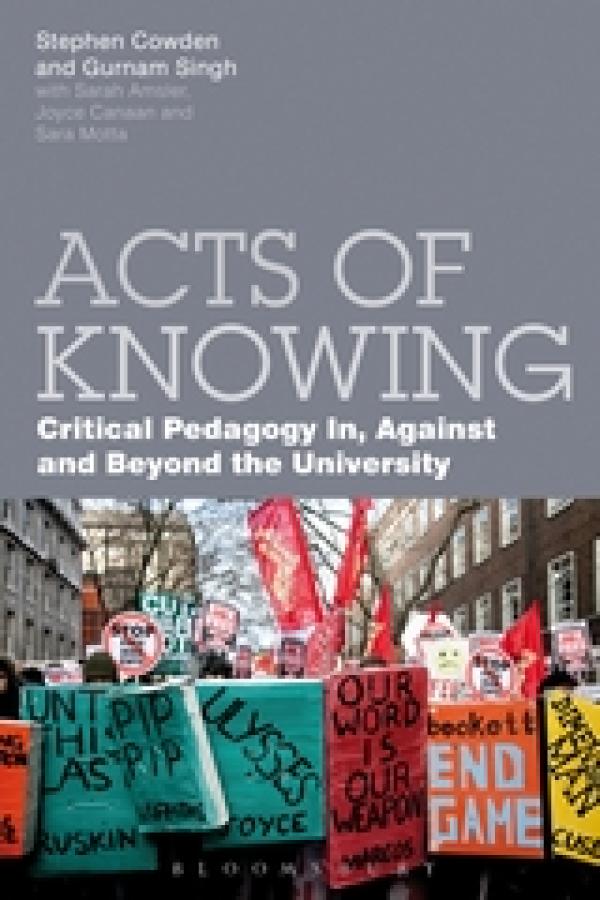
Readers who believe there ought to be profound differences between universities and businesses will rejoice in reading these probing and rousing responses to the commodification of education, theorized here as one result of “the global dominance of neoliberalism”(5). The voices in this collection, primarily scholars in the United Kingdom, turn to critical pedagogy, broadly defined, as the best resource for unmasking and dethroning the dehumanization of this ethos. While Paolo Freire’s thought undergirds the collection, these scholars draw on a wide array of critical theorists to address many intertwined issues regarding the inherently political nature of education and its transformative and justice building potential. After a short introduction which traces the broad outlines of its critical approach, the collection divides into two parts. Part One, “Perspectives on the Crisis in Education,” includes four essays by U.K. scholars and Part Two, “Dialogues on Critical Pedagogy and Popular Education,” consists of edited transcripts of six interviews, originally podcasts funded by the U.K. Higher Education Academy Subject Centre for Sociology, Anthropology, and Politics. Each interview, conducted by one of the editors of the volume, is with an educator who has been shaped by and employs critical pedagogy. The outstanding first two essays, co-authored by the editors, explore issues of student debt and consumerist pedagogies. Each of these essays offer careful, convincing, and devastating analysis of ways by which what is “sold” as beneficial to students (for example, student loans, use of student evaluations) often works against their best interests. The third essay draws cogent connections between critical pedagogy and radical democracy, concluding with an emphasis that, while critique is necessary, it is limited by remaining within the frame of the oppressive structures it opposes. Insights of critique must be used to build new structures, new ways of relating and forging solidarities for change. In the fourth essay, the author reflects on student response to her critical pedagogy in a Master’s level class. In Part Two, the six interviews are conducted with professors of social work, sociology, community education, information management, education, and aboriginal studies. As editor Singh explains, the decision to include interviews is intended to present critical dialogue as process. In addition, after each interview there are helpful lists of references and suggested readings. In one interview, Freire’s Catholic heritage is acknowledged and the interviewer refers to his own unspecified “tradition” (presumably Sikh), but without the development which would have been fascinating to read. Religious studies teachers may be disappointed that, aside from this glancing reference and aspects of the interview on indigenous knowing, there are no attempts to integrate religious or spiritual concerns with the ethical contours of critical pedagogy. Unfortunately, numerous typographical errors also are evident throughout the book, including occasional omission of an important word (such as “not”). But for those committed to higher education as a social good, this collection will be provocative and inspiring.
Eric Barreto, Kate Blanchard and Roger Nam I’ve started wondering recently if scholarship boils down to the courage to say something aloud, the courage to say something in the midst of a chorus full of others saying similar or different things. This same description could well be applied to...
Eric D. Barreto The Onion is a paragon of satirical news. Unfortunately, too many of us are not in on the joke. Literally Unbelievable is a website that captures those priceless moments when beguiled individuals post “news” items from The Onion as if they were a reputable source of information...
Eric Barreto (Ph.D., Emory University) Associate Professor of New Testament Luther Seminary I first discovered that I loved to teach when I was 19 years old at the front of a classroom of 70 adolescents in the city of Urumqi, a huge city in northwest China. Supposedly, I was teaching...