Resources
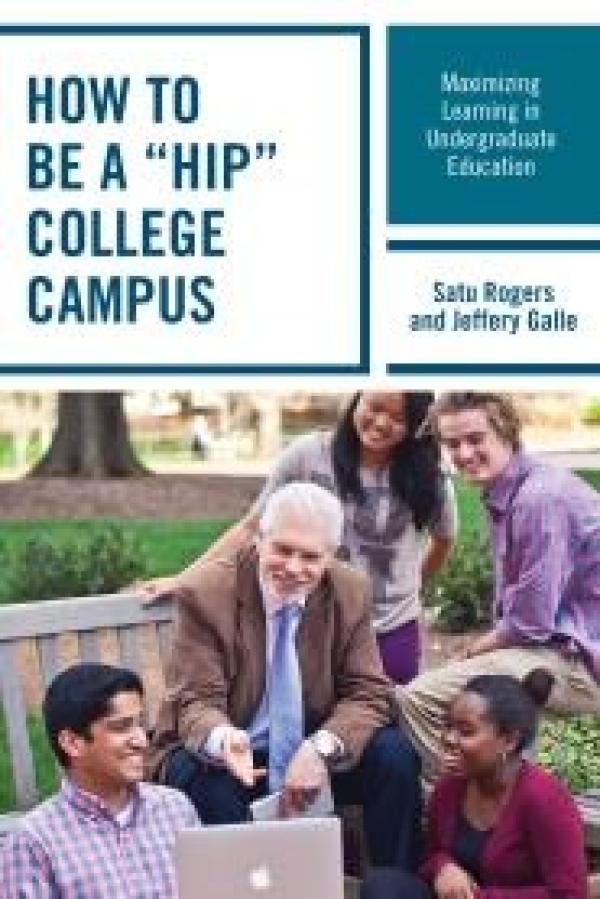
Outcomes-based learning invites the question of how to best produce them, and this book introduces the reader to seven high-impact practices (HIPs), namely high expectations, close and frequent student-faculty interaction, effective teaching strategies, undergraduate research, collaborative learning, service learning, and diversity. Chapters are organized around these seven features. The authors use their own school, Oxford College of Emory University, as a test case for their hypothesis that these features provide the best means for student success as measured in desire to continue learning, graduation rate, STEM interest, and community engagement. Institutions promoting HIPs provide intentional support to their students for these practices, cultivate diversity, and blur the boundaries between classroom and extracurricular life. The book is seasoned with excerpts from faculty and student interviews and almost constant reference to the last thirty years of research on academic practice. High expectations are created in classroom synergy between students and instructors, where instructors lead students in exploring beyond the basic subject information students are expected to learn on their own. Students report appreciation for being pushed beyond introductory knowledge and for gaining the self-knowledge that they underestimate their own learning capacities, something they would not have learned without high expectations. High expectations are successful when students have more opportunities to interact with faculty. This works best at smaller institutions and requires the institution’s support to work. While faculty report that interaction helps them tailor their instruction to students’ needs and abilities, they also caution against an over-customization that reduces a subject’s breadth and prevents students from being challenged by new and unfamiliar material. As expected, high-impact teaching calls for active learning techniques, with fourteen such practices – called “Inquiry Guided Learning” – described in the third chapter. Among them are student discovery (as in problem-solving), systematic construction of knowledge, cross-disciplinary integration, addressing misconceptions, creating surprise in the classroom, and using mistakes strategically. These practices are not formulas set forth by the authors but were derived from student-faculty conversations about good teaching at Oxford College. The reader looks in vain, however, for the redemption of the lecture as a component in active learning. In any case, faculty are advised to use practices that fit their personality and their discipline; some fit better than others. Collaborative learning is enhanced through student research projects, which should be found across the disciplines (STEM fields have done the best job here). Such learning is best coupled with collaborative leadership in student life activities. The greater benefit accrues the less division there is between a campus’s academics and student life. Students learn leadership skills and gain confidence if collaboration with their peers is encouraged in both areas. Service learning includes collaboration and moves students beyond mere cognition to an experience the authors describe as spiritual and aimed at the “whole student.” And, the more diverse a campus, the better the outcome of any sort of collaborative activity. The conclusion offers readers ways and means of implementing these HIPs on their own campuses. Flexibility and adaptation are key, and in the process, more HIPs may be devised from conversations among all parties in different campus contexts.
Facilitative Collaborative Knowledge Co-Construction is the second volume in a series under the Jossey-Bass New Directions for Teaching and Learning imprint (see Carolyn Jones Medine’s review of volume 1, From the Confucian Way to Collaborative Knowledge Co-Construction, posted April 15, 2016). Van Schalkwyk and D’Amato both have experience at the Centre for Teaching and Learning Enhancement at the University of Macau, China. As such, this volume and its predecessor aim at improving the learning experience of Asian students, particularly in Confucian teaching contexts. In the first volume, the “authors provided a framework that was designed to encourage teachers as they move from a Confucian way of teaching toward a more collaborative way of providing a co-constructed knowledge base in the classroom” (i). “One can certainly train students to memorize facts and follow algorithms, but unless they know what the algorithms mean and when and how to use them, their mastery of the subject is only superficial. Moreover, most of the knowledge that is acquired by rote learning will be lost quickly because it has no connection to anything meaningful in students’ minds and lives” (3), argue the editors. One challenge in considering this volume for use in US-based contexts is that it is firmly aimed at those who have traditionally taught using rote learning and memorization of facts – repeated references to “the Asian classroom” make this clear. One questions the degree to which such methodologies are entrenched among religious and theological educators in this country. Certainly constructivist learning is a challenge for any number of traditional educators, but involving students in problem-solving or helping them see the value of personal reflection and application in their learning is less foreign to many of us. Where these insights may be useful is in reminding faculty of the unique needs of international students coming from Confucian-based systems. Chapters in this volume focus on the value of constructivist, cooperative, and collaborative learning; relational intelligence; insights from neuropsychology; sociocognitive skills and emotional intelligence; and “engendering critical reflective thinking within a collaborative teaching and learning context” (2-3). Mary M. Chittooran’s chapter on “Reading and Writing for Critical Reflective Thinking,” for example, contextualizes specific tools like questioning, feedback, and the presentation of alternative explanations, demonstrating how each might best be used with Asian students. Chittooran also explores sixteen different reading and writing activities; any of these might spur creative ideas for teaching a variety of students. Helen Y. Sung’s exploration of emotional intelligence offers seventeen suggested questions to help expand students’ emotional fluency. There is some repetitiveness between chapters, particularly as various authors review the characteristics of Confucian learning environments and how education is changing. This volume may lend itself best to “cherry picking” whatever portions or techniques are needed for a given professor’s context or students. Most of Amato’s chapter on brain-based learning with Yuan Yuan Wang, for example, may translate over to a variety of educational contexts. Their advice that “learners should not be grouped by age but should be grouped by processing or aptitude levels in most learning activities” (55) is as germane in a Biblical languages class as it is in a room full of international students.
Youshaa Patel Assistant Professor of Religious Studies Lafayette College These days, Islam is no stranger to controversy. Although we may deplore the mainstream media’s deliberate sensationalization of Muslim conflicts, as professors we can also exploit conflict in the classroom to help our students achieve their learning objectives. Many of my.

Martin Nguyen Associate Professor, Faculty Chair for Diversity Fairfield University In the teaching of Islam, there are many ways through which we can engage our students in the classroom. My intention here is to share one assignment that I have developed over the years that has proven to be incredibly.

Cláudio Carvalhaes Associate Professor McCormick Theological Seminary One of the joys of teaching is to teach with somebody else. In my years of teaching, I have had many great experiences and I cherish each one of them very much. In past blogs I said that to teach is to create
Part of the series “New Directions for Adult and Continuing Education,” Meeting the Transitional Needs of Young Adult Learners is the first entry to address young adult learners in thirty years. As such, it is a welcome contribution to the series, as well as a valuable resource in its own right. Faculty teaching traditional undergraduates, as well as those in continuing and adult education roles, will find much of value here. The terms “young adult” and “youth” are used across the essays in the volume, though without a single common definition. Generally, “young adult” refers to individuals from ages eighteen to twenty-five, though with some flexibility on both sides; adult education may begin at sixteen, as Davis notes (chapter 6). Chapter 1, by Joanna Wyn, introduces several key concepts that recur in subsequent chapters. Wyn offers a nice overview of the scholarship of youth transitions, new adulthood, and age. She argues that the “metaphor of transition” — a frequent feature in discussions of young adulthood — should be replaced with a “metaphor of belonging” that emphasizes relationships and connections (9). Indeed, many of the following chapters take up this call for an emphasis on relationships and belonging. Chapters 2 through 8 follow a basic model of identifying a specific community, reviewing the literature, data, or relevant theoretical work relating to that community, and concluding with suggestions for instructors. Thus Brendaly Drayton (chapter 2) introduces and theorizes cultural difference, with special attention to ethnic difference and the experience of young adults positioned in multiple cultures. Drayton encourages instructors to use texts from a range of cultures as well as collaborative learning practices. Rongbing Xie, Bisakha (Pia) Sen, and E. Michael Foster (chapter 3) offer a similar introduction to “vulnerable youth,” a broad category that encompasses socio-economic disparities, mental health, welfare, and involvement with the justice system. Noting the problem of youth who “age out” of social services, they call on educators to be informed and competent allies for vulnerable youth and to provide social support. Jessica Nina Lester (chapter 4) makes a similar argument with respect to “youth with dis/ability labels.” The pedagogical emphasis in these chapters is on the affective and relational, encouraging instructors to engage beyond course material. Steven B. Frye’s contribution addresses young adults in faith communities (chapter 5). Instructors in confessional contexts may find his insights helpful; in other contexts, less so. The final three chapters are the work of the editors, C. Amelia Davis and Joann S. Olson. Davis (chapter 6) discusses adult education programs as they serve young adult learners, and offers some helpful suggestions for strengthening these programs. Olson (chapter 7) takes up the transition from school to workplace, arguing that educators can intentionally create classroom and school experiences that prepare students for, and ease the transition to, the workplace. She also offers a number of useful examples, including discussing class assignments. A final chapter by Olson and Davis (chapter 8) offers a concise overview of key themes from the preceding chapters. This is a valuable collection of essays, which much to offer all educators working with young adults.

Tat-siong Benny Liew Class of 1956 Professor in New Testament Studies College of the Holy Cross After about six months and fifteen horrible haircuts in the San Francisco Bay area I finally found somebody who could give me a decent haircut, and I became a loyal customer for the

Molly Bassett Associate Professor of Religious Studies Georgia State University A week into the spring semester, the fall term seems like it was forever ago! In my last post, I talked about the informal evaluations my students took, and since writing that post, I have thought about some of the.
Nancy Lynne Westfield Associate Professor of Religious Education Drew Theological School Please indulge this low-grade rant. I believe the notion of “safe space” in adult classrooms is un-interrogated and oversubscribed. The question is … Safe for whom? Well-intentioned teachers, in wanting students to attempt deep conversation, wrongly presume adult students..
Nancy Lynne Westfield Associate Professor of Religious Education Drew Theological School The projects have, at sometimes, crashed and burned. There have been the occasional minor derailments. In several instances there were irreconcilable differences and un-repairable circumstances. Once I declared utter, dismal failure. On the other hand, there have also been...