Resources
In the cooperative controversy technique, two opposing sides are clearly drawn over a single issue, and learners on both sides cooperate to understand both sides and arrive at a personal position. Students respond enthusiastically to the exercise, are helped in exploring emotional responses to issues, and learn how, not what, to think. (MSE)
(Text not available on web.) Reviews purposes of teacher questions, types of questions, strategies for questioning, tactics for fielding student responses,and tactics for fielding student questions.
This paper argues that instructors can enhance the effectiveness of oral instruction through attention to both the verbal and nonverbal aspects of their teaching. After defining and offering 2 means of achieving effective speaking, the paper discusses how lecturers should analyze their delivery, and makes 32 recommendations for improving delivery, focusing on vocal problems, positive vocal strategies, use of body, and positive body delivery characteristics. Finally, the paper offers suggestions for putting the 32 recommendations into practice, specifically discussing identification of problems, delivery style, mental focus, and preparation. Fourteen references are attached.

If we take a passive view of classroom behavior, we fail in a crucial part of our role as educators: creating a democratic and effective learning environment for a diverse student body. (From the Publisher)
Responsive Teaching: An Ecological Approach to Classroom Patterns of Language, Culture, and Thought, the fourth title in this series, provides a conceptual basis for recognizing the classroom as an ecology of lingistic and cultural patterns that should be taken into account as part of the teacher's professional decision making. It argues that the orchestration of classroom behavior cannot be separated from the students primary culture. Chapters discuss the metaphorical nature of language and thought, primary socialization, non-verbal communication, framing and social control, the classroom as an ecology of power, culturally responsive supervision, and educating teachers for the 21st century - all from a cultural and linguistic point of view. The authors challenge the Cartesian tradition of viewing the student as a culture-free individual, and the classroom as a problem in management. They draw on Gregory Bateson's ideas help to illuminate student behavior as a form of communication about social relationships - one that relies heavily on culturally embedded patterns - and to reveal the classroom as a mental ecology where thought processes of others are encoded in the metaphorical language used to introduce new concepts. The book emphasizes that responsive teaching involves being sensitive to how the ecology of patterns (behavior and thought) reflects cultural differences and may be a source of miscommunication and alienation. (From the Publisher)

I help people have difficult conversations for a living. I facilitate dialogues–usually in communities deeply divided over issues that touch on people’s values and worldviews. I have spent much of the last three years working with professors as their classrooms increasingly fit that description. In Jill's terms, I help people wobble, but not fall down. Jill talks about wobble in terms of letting something happen and getting out of the way. That is a piece of it for sure, but there is a choreography to wobble, a delicate but purposeful crafting of space, time, language, movement, and furniture that makes wobble possible. The purpose is to break people out of the conversations that hold us back from seeing complexity in ourselves and others. It is meant to crack the surface conversation to reveal new possibilities, to deepen understandings of values and lived experience, and to unmask our own assumptions. I call it “choreography” because every choice we make while facilitating a conversation invites some responses and discourages others. And every choice we make leads people to focus either on us or on each other. If we call on people, it invites people to raise their hands and wait for us to conduct. If we don’t, it invites people to give and yield focus as they move in and out of the conversational space. It is choreography at its most subtle. If we ask people to sit quietly and reflect for two minutes before answering, we invite the second and third thought that someone has, not just the first. The work of dialogue is disruptive of old patterns. It disrupts dynamics of dominant voices monopolizing the space–including ours. It weakens the power of the first speaker. It breaks the pattern of asking questions we already know the answer to while our students try to read our minds. It invites silence as a space of intention and reflection rather than of fear and disengagement. It invites empathy rather than judgement. It prompts uncertainty rather than certainty and curiosity rather than declamation. It allows for wobble rather than steady motion along the straight and narrow. When I visited Jill’s class, I stood up and talked about dialogue in front of rows of chairs, with people raising their hands and I called on them–ironic. It was a fine conversation. But when I sat down to watch the rest of the class, Jill didn’t just allow or encourage wobble, she choreographed it. Jill asked the students to move the chairs into pairs of arcs facing each other. A wobble happened. Then Jill sat outside the circle. Another wobble. Outside the circle is one of those places that disrupts the old pattern, a place of intellectual humility. It disrupts the pattern of students relying on us for the prompt, the answer, the nod of approval. Then she asked a question she didn’t know the answer to. Wobble. She gave people a chance to reflect before speaking. Wobble. This is not just allowing something to happen; these are a set of choices we make–a choreography that when done right makes possible a new kind of conversation that breaks the dominant polarized and divisive rhetoric or silencing that we see so often in our discourse. What happens when we choreograph wobble is that students rise to their own power and possibility, and move through their own wobbling moments to muster the momentum to move together. In Jill’s class, the conversation had to be interrupted after 40 minutes to announce something about papers, but it would have gone on. Even if Jill and I had quietly snuck out of the room, it would have gone on because the students had turned toward each other and engaged. Whether we recognize it or not, much of our public discourse is designed for simple, polarizing, escalating episodes of attacking and defending well-worn positions. We have opportunities to design and incubate a new discourse, one designed for the generation of ideas, the exploration of new ground, the contemplation of complexity. The patterns we have to break are strong and so our choices must reflect that. Our choreography must reflect the need of this moment; the need to turn to one another with curiosity, complexity, and care.

I am a cyclist. I ride a hybrid commuter bike to work most days and have a road bike that has taken me up mountain passes and on to country roads outside of Dallas where views of fields and livestock replace the asphalt jungles of the Metroplex. I picked up cycling almost a decade ago when it became clear that I needed some kind of response to the combined stresses of pre-tenure professional life and young children at home. I got on the bike for outside time, physical challenge, and personal space. I’ve stayed on the bike for all of these reasons, and also for what time on the bike has taught me about attentiveness, mindfulness, thinking spaces, and more recently, about wobble: those moments when things slow down, or haven’t quite started up; when direction, volition, and commitment are in play. In cycling, wobble happens when mounting, dismounting or moving slower than 2 miles per hour, often during a turn. As things go, this is also when it happens in classrooms. When conversations aren’t strictly guided, when listening replaces lecture, when a set authority structure is open to flux, intellectual patterns can come a little out of balance and preconceived ideas can change. Put another way, transformative learning can occur. Without the wobble, feet firmly on the ground, we can never get on the bike and ride. My interest in wobble stems from some conversations about diversity and intellectual humility I’ve been having with colleagues from various places and disciplines, and also from a recent workshop for faculty and graduate students here at Southern Methodist University on conflict and conversation in religious studies classroom spaces (thanks to Wabash for funding this with a small grant). The workshop focused on understanding why contentious issues can be difficult to talk about, and also offered concrete methods for facilitating useful conversations across difference. John Sarrouf, an experienced facilitator and Director of Strategic Partnerships at Essential Partners, led that workshop for us. John was also kind enough to come and speak to my undergraduate class about the work he does. It was in that encounter that I saw wobble in action. John greeted the class and then asked if they were talking about the upcoming presidential election. My otherwise talkative, engaged, and engaging students shrunk at the very suggestion. Shoulders hunched, faces turned to their desks, they shook their heads. They were thrown off balance, visibly uncomfortable, almost at a standstill. Then, John asked what it would take to be able to have those conversations. Under what conditions could they speak? Their heads came up, they made thoughtful suggestions, and by the end of John’s 10 minute time, they had recalled productive discussions around Black Lives Matter, religious differences, and their experiences in our class. They had turned an intellectual corner and were up and riding (thinking) again. In an online discussion post that followed, one student mentioned a change in his thinking in response to a suggestion John made about talking to understand rather than to persuade. Something in the wobble allowed him to hear, consider, and embrace a suggestion. He learned something. As in mounting and dismounting a bicycle, the wobble needs to be controlled. Too much and forward momentum turns into a crash, too little and we never get that second foot off the ground. Now that I am attentive to wobble, though, and have learned to use it by letting silence happen in discussions — by getting mindfully out of the way, or by not shying away from controversy when it arises — I have come to recognize its real potential. Or more accurately, I can see it for what it is. Before I saw discomfort or disengagement, things I wanted to minimize. Now I am more likely to see the beginning of forward momentum. I see the beginning of transformative, interesting thought, even around topics as challenging as religion. I hope my students can see the same.
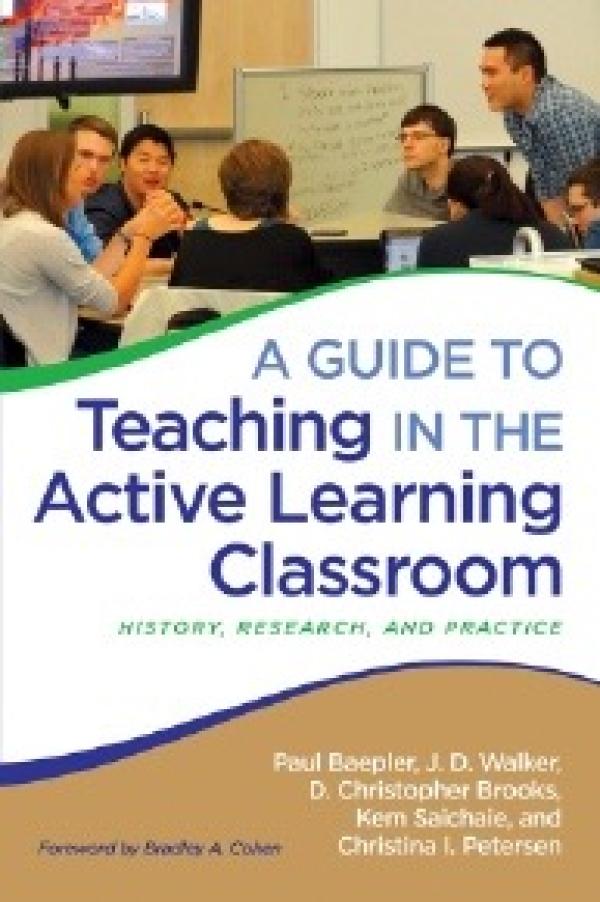
This book examines a particular type of classroom organization known as the “active learning classroom.” This type of classroom is not a lecture hall, but rather, is a room where there is no clear front or back, where students sit in movable chairs around round tables that facilitate group work shared with the larger group via screens. The very organization of the classroom forces the professor to have their back to at least some of the students all the time. This type of classroom interaction seems to be designed for larger class sizes, helping to transform a large lecture hall of students into a classroom where teacher and student interaction, as well as student-to-student interaction, is maximized. These types of classrooms have been shown to have a positive impact on students’ grades, which could be attributed to the room configuration inhibiting certain negative activities while encouraging positive ones. Active learning classrooms provide four main advantages: “immersion learning, the social dimension of learning, collaborative learning, and the performance aspect of teaching and learning” (16). Teaching in an active learning classroom is no longer just transmission of knowledge but a collaborative effort engaging the students for better and more long-term retention of knowledge. The subtitle of the book is “History, Research, and Practice.” The history of this method of teaching is covered in chapter one. The research that supports the practice is the focus of chapters two and three. Chapter two focuses more on the research aspects while chapter three focuses on the role that social interactions have in learning. The core of the book, chapters three through eight, gives practical suggestions on how to implement the teaching method, and presents common difficulties and how to overcome them. The last three chapters focus on how to help professors learn this method of teaching, a suggested methodology on how to study whether the change of teaching method had a positive impact on student learning, and what the future might hold for this teaching method. The book advocates a particular physical organization of the classroom. This is not up to the individual professors, but to the institutions in which they work. Even if one does not have the particular physical layout advocated in this book, there are a number of helpful tips for professors who seek to more actively engage their students. With chapters titled, “Assignments and Activities,” “Managing Student Groups,” and “Assessment and Feedback,” it is easy to find practical suggestions on how to make the classroom less didactic and more engaged. Each chapter has helpful and clear subheadings that make it easy to scan for the topic that one needs. Many of these methods are helpful in the religious studies classroom to help engage the student for a greater learning outcome. The examples in the book range from the sciences through to the humanities, helping a humanities professor get ideas on means of implementing the method in their own classroom.

Cláudio Carvalhaes Associate Professor McCormick Theological Seminary One of the joys of teaching is to teach with somebody else. In my years of teaching, I have had many great experiences and I cherish each one of them very much. In past blogs I said that to teach is to create