Resources
An important backdrop to the achievement of the Millennium Development Goals involves consideration of the impact of a ‘new demographics’ derived from the interaction of two global developments. First, high levels of internal and cross-border mass migration, stimulated by climate change, violence and disparities in wealth and social stability within and between different countries and the global South and North. Second, the phenomenon of increasing longevity and rapidly ageing populations, especially in the developed world. This book explores the central role that socially engaged higher education might potentially play in helping address these challenges, enhancing lifelong learning opportunities and facilitating more positive outcomes for both individuals and societies. The contributors to this book are scholars of higher education and lifelong learning based in twelve countries from Europe (Germany, Ireland, Slovenia, Sweden and the United Kingdom), the Americas (Brazil, Canada, Mexico and the USA), Japan, Australia and New Zealand. (From the Publisher)
From Pen America, a resource for faculty, staff, and students providing practical, principled guidance for how campuses can best remain open to all voices. Sections on resources and the law, on such issues as: Academic Freedom, Campus Climate, Discrimination & Harassment, Diversity & Inclusion, Hateful expression, Invited Speakers, and Protests on Campus.
As recently as 2012, massive open online courses (MOOCs) looked poised to revolutionize higher education, but in just a few years their flaws and problems have made them into a less relevant model. In More than a Moment, Steven D. Krause explores MOOCs and their continuing impact on distance learning in higher education, putting them in the context of technical innovations that have come before and those that will be part of the educational future. Krause writes about his own experiences as a participant in several MOOCs and the experiences of faculty who developed and taught MOOCs. Contrary to many early claims from educational entrepreneurs, they were never entirely “new,” and MOOCs and their aftermath are still at the heart of the tensions between nonprofit universities and for-profit entities, particularly online program management firms, in delivering distance education. While MOOCs are no longer a threat to education in the United States, they are part of the ongoing corporatization of education and remain part of conversations about experienced-based credit, corporate training, and open education. Presenting historical, student, teacher, and administrative perspectives, More than a Moment is a well-rounded treatment that will be of interest to academics and entrepreneurs interested in distance education, online pedagogy, online program management, and public-private partnerships in higher education. (From the Publisher)
Click Here for Book Review This book offers a moral rather than instrumental notion of university education whilst locating the university within society. It reflects a balancing of the instrumentalization of higher education as a mode of employment training and enhances the notion of the students’ well-being being at the core of the university mission. Compassion is examined in this volume as a weaving of diverse cultures and beliefs into a way of recognizing that diversity through a common good offers a way of preparing students and staff for a complex and anxious world. This book provides theoretical and practical discussions of compassion in higher education, it draws contributors from around the world and offers illustrations of compassion in action through a number of international cases studies.
Click Here for Book Review Our current system of higher education dates to the period from 1865 to 1925, when the nation's new universities created grades and departments, majors and minors, in an attempt to prepare young people for a world transformed by the telegraph and the Model T. As Cathy N. Davidson argues in The New Education, this approach to education is wholly unsuited to the era of the gig economy. From the Ivy League to community colleges, she introduces us to innovators who are remaking college for our own time by emphasizing student-centered learning that values creativity in the face of change above all. The New Education ultimately shows how we can teach students not only to survive but to thrive amid the challenges to come. (From the Publisher)
Rape Culture and Religious Studies: Critical and Pedagogical Engagements stages a critical engagement between religious texts and the problem of sexual violence. Rape and other forms of sexual violence are widespread on college and university campuses; they also occur in sacred texts and religious traditions. The volume addresses these difficult intersections as they play out in texts, traditions, and university contexts. The volume gathers contributions from religious studies scholars to engage these questions from a variety of institutional contexts and to offer a constructive assessment of religious texts and traditions. (From the Publisher)
Click Here for Book Review During times of rapid social and religious change, leadership rooted in tradition and committed to the future is the foundation upon which theological schools stand. Theological education owes itself to countless predecessors who paved the way for a thriving academic culture that holds together faith and learning. Daniel O. Aleshire is one of these forerunners who devoted his career to educating future generations through institutional reforms. In honor of Aleshire’s decades of leadership over the Association of Theological Schools, the essays in this book propose methods for schools of various denominational backgrounds to restructure the form and content of their programs by resourcing their own distinctive Christian heritages. Four essayists, former seminary presidents, explore the ideas, doctrines, and ways of life in their schools’ traditions to identify the essential characteristics that will carry their institutions into the future. Additionally, two academic leaders focus on the contributions and challenges for Christian schools presented by non-Christian traditions in a rapidly pluralizing landscape. Together, these six essays offer a pattern of authentic, innovative movement for theological institutions to take toward revitalization as they face new trials and possibilities with faithfulness and hope. This volume concludes with closing words by the honoree himself, offering ways to learn from and grow through Aleshire’s legacy. (From the Publisher)
Click Here for Book Review In Race on Campus, Julie J. Park argues that there are surprisingly pervasive and stubborn myths about diversity on college and university campuses, and that these myths obscure the notable significance and admirable effects that diversity has had on campus life. Based on her analysis of extensive research and data about contemporary students and campuses, Park counters these myths and explores their problematic origins. Among the major myths that she addresses are charges of pervasive self-segregation, arguments that affirmative action in college admissions has run its course and become counterproductive, related arguments that Asian Americans are poorly served by affirmative action policies, and suggestions that programs and policies meant to promote diversity have failed to address class-based disadvantages. In the course of responding to these myths, Park presents a far more positive and nuanced portrait of diversity and its place on American college campuses. At a time when diversity has become a central theme and goal of colleges and universities throughout the United States, Race on Campus offers a contemporary, research-based exploration of racial dynamics on today’s college campuses. (From the Publisher)
Click Here for Book Review As interest in competency-based education (CBE) continues to grow by leaps and bounds, the need for a practical resource to guide development of high-quality CBE programs led the authors to write this book. Until now, there has been no how-to manual that captures in one place a big picture view of CBE along with the down-to-earth means for building a CBE program. A variety of pressures are driving the growth in CBE, including the need for alternatives to the current model of higher education (with its dismal completion rates); the potential to better manage the iron triangle of costs, access, and quality; the need for graduates to be better prepared for the workforce; and the demands of adult learners for programs with the flexible time and personalized learning that CBE offers. Designed to help institutional leaders become more competent in designing, building, and scaling high-quality competency-based education (CBE) programs, this book provides context, guidelines, and process. The process is based on ten design elements that emerged from research funded by the Gates Foundation, and sponsored by AAC&U, ACE, EDUCAUSE, and the Competency-Based Education Network (C-BEN), with thought partners CAEL and Quality Matters. In short, the book will serve administrators, higher education leaders, faculty, staff, and others who have an interest in CBE by: • Giving context to enable the audience to discover the importance of each design element and to help frame the CBE program (the “why”); • Providing models, checklists, and considerations to determine the “what” component for each design element; • Sharing outlines and templates for the design elements to enable institutions to build quality, relevant, and rigorous CBE programs (the “how”). (From the Publisher)
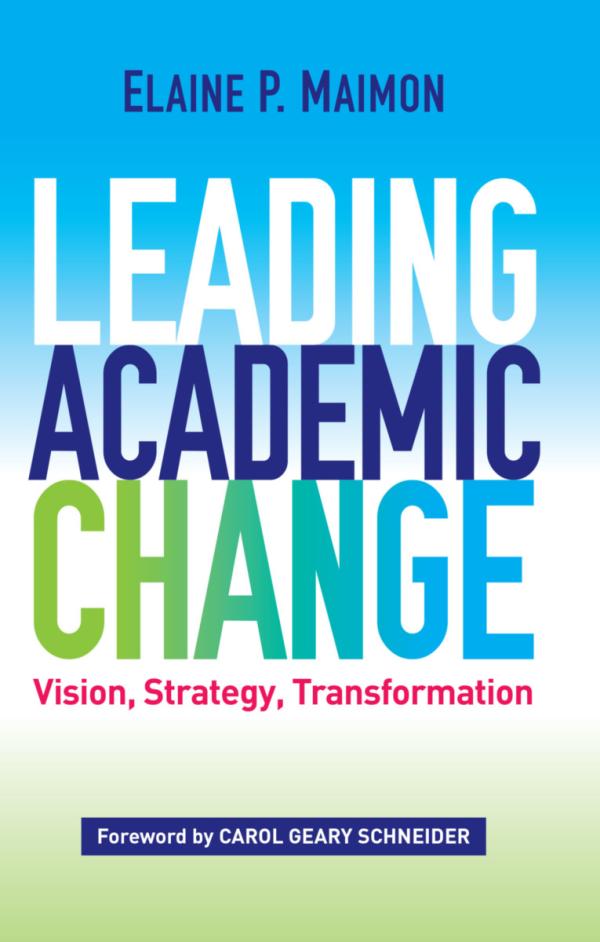
Click Here for Book Review Written by a sitting college president who has presided over transformative change at a state university, this book takes on the big questions and issues of change and change management, what needs to be done and how to do it. Writing in a highly accessible style, the author recommends changes for higher education such as the reallocation of resources to support full-time faculty members in foundation-level courses, navigable pathways from community college to the university, infusion rather than proliferation of courses, and the role of state universities in countering the disappearance of the middle class. The book describes how these changes can be made, as well as why we must make them if our society is to thrive in the twenty-first century.