Resources
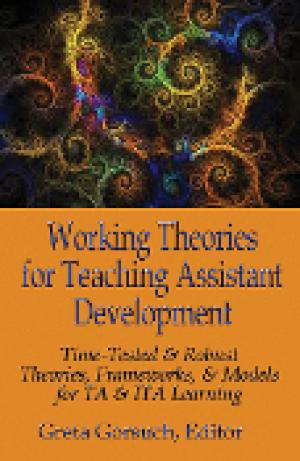
This extensive, edited volume showcases established and emerging scholars in the field of Teaching Assistant (TA) and International Teaching Assistant (ITA) education. Working Theories goes beyond reporting good practices or program descriptions, which typically comprises many books on TA and ITA development.  Instead, Working Theories places time-tested, robust theories, frameworks, and models of TA and ITA learning and development at the center of graduate student education by providing a scholarly venue for description, explication, and application of these theories. In turn, these theories and models from psychology, sociology, pedagogy, discourse analysis, and second language learning will be presented in such as way as to inform good practice, but above all, motivate future research. (From the Publisher)

Journal Issue.

America is being held back by the quality and quantity of learning in college. This is a true educational emergency! Many college graduates cannot think critically, write effectively, solve problems, understand complex issues, or meet employers' expectations. We are losing our minds—and endangering our social, economic, and scientific leadership. Critics say higher education costs too much and should be more efficient. But the real problem is value, not cost; financial 'solutions' alone won't work. In this book, Keeling and Hersh argue that the only solution - making learning the highest priority in college - demands fundamental change throughout higher education. (From the Publisher)
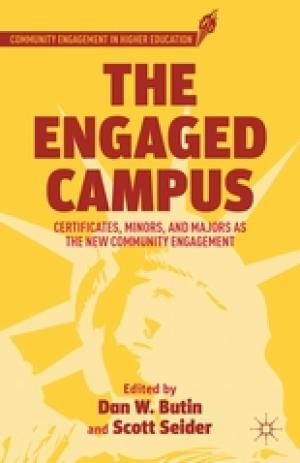
The Engaged Campus offers a set of emerging best practices and articulation of critical issues for faculty and administrators committed to developing, strengthening, or expanding majors or minors in community engagement at their respective institutions. (From the Publisher)

Engages a topic of pressing concern for government, business, and education leaders around the world: the race to establish 'world-class' universities. Some herald the globalization of higher education as the key to a dynamic and productive 'knowledge society.' Others worry that modern universities have come to resemble multinational corporations. (From the Publisher)
The degree to which your post-secondary school understands and supports students from poverty makes all the difference in meeting your recruitment, retention, and graduation goals. Understanding your students starts with better information about their personal experience of poverty, and about the skills and strengths they bring with them to college. Supporting your students involves creating opportunities to access a variety of resources, remedial education relevant to their lives, and fully engaged relationships inside of school and out. You'll learn to: Recognize the impact of economic class on student preparedness and educational success Build on students' existing resources, experiences, and abilities Encourage student success through curriculum design and programming Partner with communities and businesses to support academic progress Help students look beyond the classroom through service learning and civic engagement (From the Publisher)
Journal Issue.

Journal Issue.
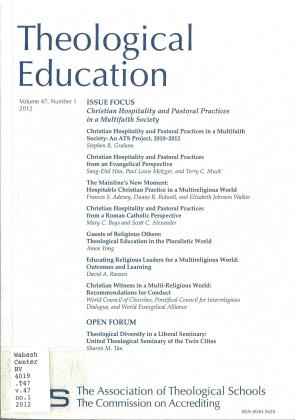
Journal Issue. Full text is available online.
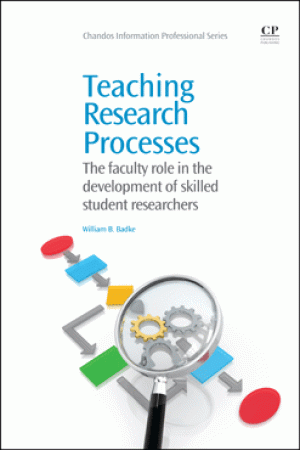
- engages the domain of teaching faculty rather than librarians only  - analyzes the reasons why the research processes concept represents a gap in academia  - focuses on research ability as a process that can be taught within disciplines  -  provides concrete examples to help faculty teach research processes while meeting existing academic goals Information literacy may be defined as the ability to identify a research problem, decide the kinds of information needed to tackle it, find the information efficiently, evaluate the information, and apply it to the problem at hand. Teaching Research Processes suggests a novel way in which information literacy can come within the remit of teaching faculty, supported by librarians, and reconceived as ‘research processes’. The aim is to transform education from what some see as a primarily one-way knowledge communication practice, to an interactive practice involving the core research tasks of subject disciplines. This title is structured into nine chapters, covering: Defining research processes; Research ability inadequacies in higher education; Research processes and faculty understanding; Current initiatives in research processes; The role of disciplinary thinking in research processes; Research processes in the classroom; Tentative case studies in disciplinary research process instruction; Research processes transforming education; and Resourcing the enterprise. The book concludes by encouraging the reader to implement the teaching of research processes. Readership: This book is intended for university professors, academic administrators, academic librarians, and students in library and Information Studies programs (From the Publisher)
Wabash Center Staff Contact
Sarah Farmer, Ph.D.
Associate Director
Wabash Center
farmers@wabash.edu