Resources
One page Teaching Tactic: a worksheet to help students place each new theological text into its broader conversation partners.
One page Teaching Tactic: helping students to reflect on their reading practices.
A 1000 word essay in response to a Call for Papers on the wider context of your course.
Religious studies classrooms are microcosms of the public square in bringing together individuals of diverse identities and ideological commitments. As such, these classrooms create the necessity and opportunity to foster effective modes of conversation. In this essay, I argue that communication attuned to shared human needs – among them needs for safety, respect, and belonging – offers a transformative response to the potential self-silencing and peer-conflict to which religious studies classrooms are prone. I develop this claim with reference to the research on teaching religious studies conducted by Barbara Walvoord and the pedagogy of theologian and Swarthmore University President Rebecca Chopp in formulating an “ethics of conversation” with her students. Building on this foundation, I make a case for developing an “ethos of conversation” in the religious studies classroom based on psychologist and peace activist Marshall Rosenberg's method of “nonviolent communication.” While addressing the roles of conflict and toleration in the classroom through the perspectives of Alasdair MacIntyre and Jeffrey Stout, I argue that Rosenberg's approach to communication is a powerful asset to education that models constructive engagement in the macrocosm of civic life.
A growing interest in the communication to students of the mission and identity of a higher education institution prompted this study about the presence of Catholic, Jesuit values in the introductory religious studies course at a faith-based university. To conduct this study a survey instrument was developed, piloted, further refined, and then administered again to about four hundred and fifty students. The study's results showed that the introductory course had a positive effect on the majority of students surveyed, namely, those who had no Catholic schooling or only had a Catholic elementary school education. Statistically significant advances in several areas of knowledge about Catholic teachings endorsed by Catholic bishops and the pope occurred. Although less extensive, knowledge of Jesuit values also advanced in the course.
Established in 2000–2001, the Center for Religious and Cross-cultural Studies (CRCS) is the only master's level religious studies program at a non-religiously affiliated university in Indonesia. In many respects, the program is experimental, operating within the dynamic political and religious environment of the Muslim world's youngest and largest democracy. Like other large democracies such as India or the United States, the Indonesian government and courts have their challenges and opportunities in navigating a multiplicity of religions. In Indonesia, this took on particular urgency in the context of religiously-charged conflict in the 1990's and early 2000's which helped lead to the establishment of the CRCS. This paper seeks to explore how students and key faculty relate to the program's mission and approach to the study of religion while tracing the development of religious studies as a discipline in Indonesia. Special attention is paid to the political and, at times, controversial aspects of approaching religion with secular and pluralistic frameworks and language. It was informed by interviews and surveys conducted between January and May of 2010.
Several charts and graphs are presented regarding undergraduate education in the U.S. including a graph on marital status of students, a pie chart on part-time student enrollment, and a table which lists percentages for students attending community, public, and private colleges.
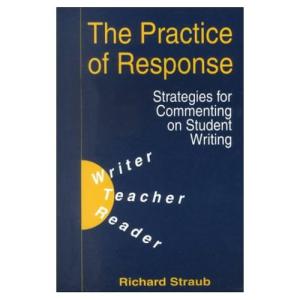
This book sets out to help teachers gain a practical understanding of response to student writing---essentially, by examining sample comments by knowledgeable teachers. It displays and analyzes over 30 sets of comments from a variety of settings, by a variety of teachers, all of them informed by composition studies. It defines the strategies these teachers put into practice. And it situates teacher repines in the larger context of writing instruction. (From the Publisher)
Wabash Center Staff Contact
Sarah Farmer, Ph.D.
Associate Director
Wabash Center
farmers@wabash.edu