Resources

Journal Issue.

Landing a tenure-track position is no easy task. Achieving tenure is even more difficult. Under what policies and practices do faculty find greater clarity about tenure and experience higher levels of job satisfaction? And what makes an institution a great place to work? In 2005–2006, the Collaborative on Academic Careers in Higher Education (COACHE) at the Harvard Graduate School of Education surveyed more than 15,000 tenure-track faculty at 200 participating institutions to assess their job satisfaction. The survey was designed around five key themes for faculty satisfaction: tenure clarity, work-life balance, support for research, collegiality, and leadership. Success on the Tenure Track positions the survey data in the context of actual colleges and universities and real faculty and administrators who talk about what works and why. Best practices at the highest-rated institutions in the survey—Auburn, Ohio State, North Carolina State, Illinois at Urbana-Champaign, Iowa, Kansas, and North Carolina at Pembroke—give administrators practical, proven advice on how to increase their employee satisfaction. Additional chapters discuss faculty demographics, trends in employment practices, what leaders can do to create and sustain a great workplace for faculty, and what the future might hold for tenure. An actively engaged faculty is crucial for American higher education to retain its global competitiveness. Cathy Ann Trower's analysis provides colleges and universities a considerable inside advantage to get on the right track toward a happy, productive workforce. (From the Publisher)
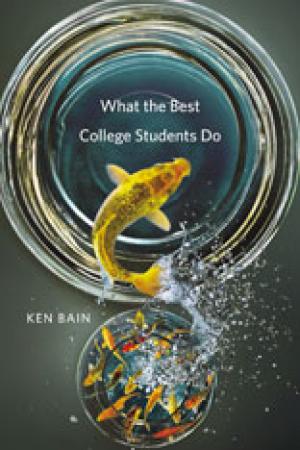
The author of the best-selling What the Best College Teachers Do is back with more humane, doable, and inspiring help, this time for students who want to get the most out of college—and every other educational enterprise, too. The first thing they should do? Think beyond the transcript. The creative, successful people profiled in this book—college graduates who went on to change the world we live in—aimed higher than straight A’s. They used their four years to cultivate habits of thought that would enable them to grow and adapt throughout their lives. Combining academic research on learning and motivation with insights drawn from interviews with people who have won Nobel Prizes, Emmys, fame, or the admiration of people in their field, Ken Bain identifies the key attitudes that distinguished the best college students from their peers. These individuals started out with the belief that intelligence and ability are expandable, not fixed. This led them to make connections across disciplines, to develop a “meta-cognitive” understanding of their own ways of thinking, and to find ways to negotiate ill-structured problems rather than simply looking for right answers. Intrinsically motivated by their own sense of purpose, they were not demoralized by failure nor overly impressed with conventional notions of success. These movers and shakers didn’t achieve success by making success their goal. For them, it was a byproduct of following their intellectual curiosity, solving useful problems, and taking risks in order to learn and grow. (From the Publisher)

Journal Issue.

Journal Issue.
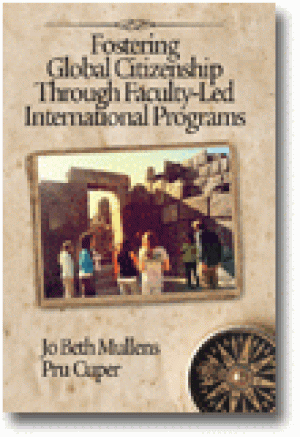
With awareness of both the opportunities and challenges presented by globalization, there is a growing trend among colleges and universities across the country to commit goals and resources to the concept of internationalizing their campuses. This can occur in a number of different ways but a common thread involves exploring the concept of global citizenship and finding ways to embed this concept in undergraduate curricula. For faculty, this may call for moving out of a presumed comfort zone in the traditional classroom and determining new approaches to teaching a generation of students who will live and work in a more global context. A method for accomplishing this work that is growing in popularity involves offering short-term, faculty-led field courses to international settings. In fact, today more college students are participating in such short-term study abroad opportunities than the more traditional semester and/or yearlong programs. Faculty and administrators who want to capitalize on short-term, study abroad programs as a means for internationalizing their campuses need practical resources to help them realize this challenging but important goal. They not only need support in developing the course curricula and logistics, but also in constructing authentic means for assessing the multi-faceted learning that occurs. Short-term international programs, when carefully planned and executed, engage the participants (both students and faculty) in unique learning experiences that can involve service, research, and critical analysis of what it truly means to be a global citizen. Such work helps define the somewhat nebulous but worthy goals of internationalizing campuses and fostering global citizenship. The authors of this text are professional educators with deep experience in global education and curriculum development. They offer a valuable resource for the development, execution and assessment of faculty-led international field courses that is at once theoretical, practical and motivational. Whether readers are considering offering an international field program for the first time and need guidance; are veteran field course leaders who would like to take their work to the next level; or are administrators attempting to encourage and provide needed support for faculty-led international programs, this book will prove invaluable. (From the Publisher)
Journal Issue.
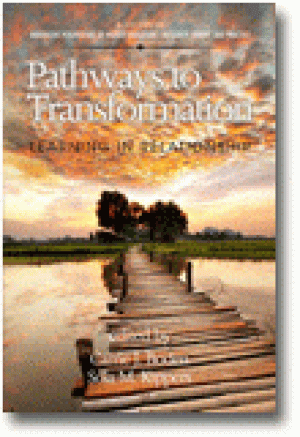
Pathways to Transformation: Learning in Relationship is an edited collection that synthesizes current research on transformative learning and expands the current knowledge-base. This book is timely and significant as it provides a synthesis of some of the most exciting research in two fields: adult education and human services. The objectives of this themed edited collection, Pathways to Transformation: Learning in Relationship, are threefold. First, this collection serves as a space to synthesize current research on transformative learning. Through an extensive literature review, the editors have discerned several important strands of research in the area of transformative learning and solicited chapters dealing with these topics. The second objective of the collection is to expand the current knowledge-base in the area of transformative learning by creating a space for dialog on the subject and bringing together diverse voices. The third objective of the collection is to transcend the field of adult education, with a specific goal to reach an audience in human services (psychology, counseling, social work, marriage and family therapy). (From the Publisher)
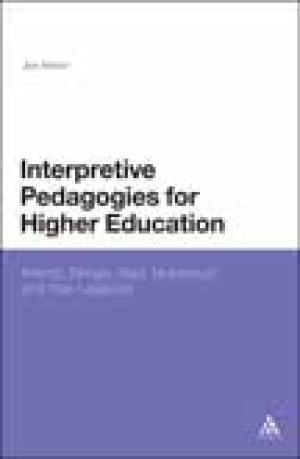
Interpretive Pedagogies for Higher Education focuses on providing a humanistic perspective on pedagogy by relating it to the interpretive practices of particular public educators: thinkers and writers whose work has had an immeasurable impact on how we understand and interpret the world and how our understandings and interpretations act on that world. Jon Nixon focuses on the work of four public intellectuals each of whom reaches out to a wide public readership and develops our understanding regarding the nature of interpretation in the everyday world: Hannah Arendt’s work on ‘representative thinking’, John Berger’s injunction to ‘hold everything dear’, Edward Said’s notion of ‘democratic criticism’, and Martha Nussbaum’s studies in the intelligence of feeling. These thinkers provide valuable perspectives on the nature and purpose of interpretation in everyday life. The implications of these perspectives for the development of a transformative pedagogy – and for the renewal of an educated public – are examined in relation to the current contexts of higher education within a knowledge society. (From the Publisher)
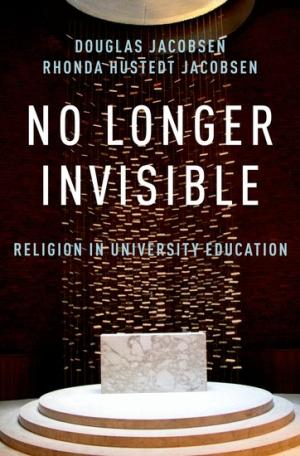
Drawing on conversations with hundreds of professors, co-curricular educators, administrators, and students from institutions spanning the entire spectrum of American colleges and universities, the Jacobsens illustrate how religion is constructively intertwined with the work of higher education in the twenty-first century. No Longer Invisible documents how, after decades when religion was marginalized, colleges and universities are re-engaging matters of faith-an educational development that is both positive and necessary. Religion in contemporary American life is now incredibly complex, with religious pluralism on the rise and the categories of "religious" and "secular" often blending together in a dizzying array of lifestyles and beliefs. Using the categories of historic religion, public religion, and personal religion, No Longer Invisible offers a new framework for understanding this emerging religious terrain, a framework that can help colleges and universities-and the students who attend them-interact with religion more effectively. The stakes are high: Faced with escalating pressures to focus solely on job training, American higher education may find that paying more careful and nuanced attention to religion is a prerequisite for preserving American higher education's longstanding commitment to personal, social, and civic learning. (From the Publisher)
Wabash Center Staff Contact
Sarah Farmer, Ph.D.
Associate Director
Wabash Center
farmers@wabash.edu