Resources
Blog post from Daily Struggles. Provides highlights of Paulo Freire’s work Pedagogy of the Oppressed. Discusses four levels of consciousness; the critique of educational banking; dialogics and conscientization; dialogics and antidialogics; the role of revolution; and utopia.
This essay is a revised version of the "Introduction" to Critical Literacy in Action, edited by Ira Shor and Caroline Pari (1999). Discusses and defines critical literacy and links to critical pedagogy.
Blog post from In the Library with the Lead Pipe. Highlights similarities and differences between information literacy and critical thinking, especially as they relate to library instruction.
PDF provides key elements regarding critical literacy. Provides definitions; reasons to teach critical literacy; and ways to teach critical literacy. Includes bibliography of suggested resources.
Chronicle of Higher Education article. Discusses critical thinking and the necessity of pushing past skepticism to consider the importance of values.
This article is adapted from Critical Thinking Basic Theory and Instructional Structures by Richard W. Paul and Linda Elder. Highlights five key points to consider when incorporating critical thinking concepts in course planning. Part of a longer segment on higher education instruction.
2014 article in The Guardian. Argues against E.D. Hirsch’s notion of “cultural literacy” in favor of the critical pedagogy espoused by Freire, Giroux, and others.
Edited volume in PDF from American Sociological Association from a variety of contributors. Includes reflective essays; illustrative essays; exercises, assignments, and projects; and syllabi.

This new book, constructed from Paulo Freire’s writings near the end of his life, is characterized by the eloquence of his dreams—dreams that constituted the utopia underlying Freire’s lifelong work. Freire challenges all educators to create Circles of Dialogues, or reflective spaces, for passionate and critical reflection that is coherent and humanizing, favoring the oppressed peoples of the world. The chapters, crafted toward the end of the twentieth century, reflect Freire’s deep concern with the assault by neoliberal policies on the basic democratic rights of the dispossessed, as he argues for the right and facility of the people to take power by reinventing power democratically. Freire’s critical reflections were prescient of the twenty-first century’s revolts and denunciations of autocratic and antidemocratic policies during the Arab Spring, the Occupy movement, and other courageous demonstrations for social justice throughout the world. Once more, Freire challenges our conscience in accessible, deep, thought-provoking writings that urge us to rehumanize popular education, employing “critical reflection steeped in history, [and] a more critical knowledge of how society works and functions.” (From the Publisher)
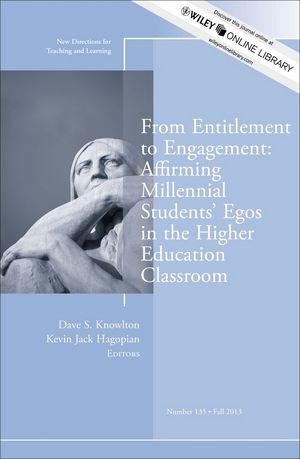
Click Here for Book Review Abstract: This volume addresses theories and practices surrounding the entitled, self-absorbed students called Millennials. Stereotypical Millennials are often addicted to gadgets, demand service more than education, and hold narrow perspectives about themselves and those around them; when seen through this lens, Millennial students can understandably frustrate the most dedicated of professors. The contributors show how new and better educational outcomes can emerge if professors reconsider Millennials. First and foremost, many of these students simply don’t fit their stereotype. Beyond that, the authors urge faculty to question commonly held assumptions, showing them how to reevaluate their pedagogical practices, relationships with students, and the norms of college classrooms. Contributors focus on practical means to achieve new and more evocative outcomes by treating Millennial students as serious collaborators in the learning process, thereby helping those students to more closely identify with their own education. The assignments that professors give, the treatment of topics that they broach, and the digital tools that they ask students to employ can shift students’ concerns away from a narrow focus on impersonal, technical mastery of content and toward seeing themselves as Millennial thinkers who fuse their lives with their learning. 
This is the 135th volume of this Jossey-Bass higher education series. New Directions for Teaching and Learning offers a comprehensive range of ideas and techniques for improving college teaching based on the experience of seasoned instructors and the latest findings of educational and psychological researchers. (From the Publisher)
Wabash Center Staff Contact
Sarah Farmer, Ph.D.
Associate Director
Wabash Center
farmers@wabash.edu