Resources
In its creative integration of the disciplines of writing, rhetoric, and theology, Writing Theology Well provides a standard text for theological educators engaged in the teaching and mentoring of writing across the theological curriculum. As a theological rhetoric, it will also encourage excellence in theological writing in the public domain by helping to equip students for their wider vocations as writers, preachers, and communicators in a variety of ministerial and professional contexts. (From the Publisher)
What is the place of corporate warship in theological education? Certainly it is not unexpected to have ministry students attending seminary chapel, but what are the expectations for the students who attend chapel? Is it to form their liturgical sensibilities into conformity with a particular worship tradition or style? Or is it to provide a safe place to try things that one would be reluctant to experiment with in congregational worship? Although common worship for ministry students is almost a given in all theological schools, there are few common understandings about it goals and purposes. Common Worship in Theological Education is the first book to address the theological, pedagogical, and political issues involved in the planning and execution of seminary chapel. It offers voices from across the theological and ecumenical spectrum about chapel, as well as involving multiple disciplines in the conversation. This volume provides the first comprehensive survey of the worship issues at stake in seminary education today. The essays in this collection provide the foundation for a productive conversation within a seminary faculty or among colleagues within a theological discipline. This volume makes the case that the chapel ought to have a seat at the table when the education mission of a theological school is being discussed. So pull up a chair and prepare for a fascinating conversation. (From the Publisher)
In this volume - the third book in the Missional Church series - eminent missional church expert Craig Van Gelder continues to track and contribute to the expanding missional church conversation, inviting today's brightest minds in the field to speak to key questions concerning church leadership. (From the Publisher)
Journal Issue. Full text is available online.
This book is about teaching, interfaith dialogue and theological education. The core of the book: six critical case studies of seminary taught, degree courses in interfaith dialogue. The cases give expression to a broad range of dialogical pedagogies and course formats, and they include the courses’ syllabi and bibliographies. By critical case we mean one that describes not only the context, content, methods and related goals and rationale of the course, but also presents an evaluation of the course and discussion of the implications of the evaluation for teaching interfaith dialogue in theological institutions. (From the Publisher)
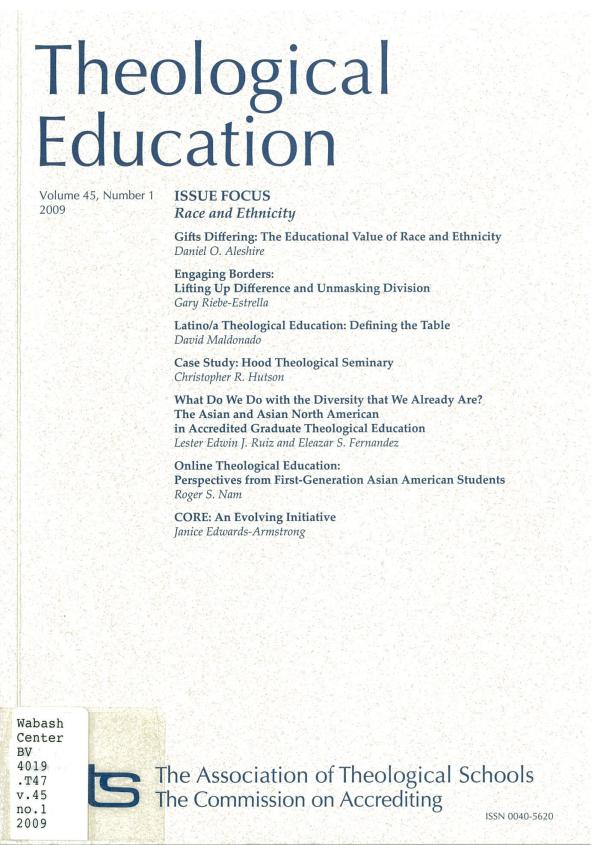
Journal Issue. Full text is available online.
For Life Abundant, the fruit of sustained reflection among systematic theologians, practical theologians, and pastors, is an important new work that deserves attention. The volume provokes creative and critical thinking about practical theology. Its contributors conceptualize the field as a disciplined practice of imagination and skill residing at the confluence of Christian tradition and living ecclesial communities, and ask what such a construal of practical theology might mean for theological education. Given the significance of For Life Abundant, Teaching Theology and Religion asked three theological educators who are located in different regions, types of institutions and fields, to review and respond to it. Rebecca Slough describes the volume’s central questions and organization, and considers how it might contribute to the deliberations of a seminary faculty regarding a school’s curriculum. Martha Stortz shows how the process and structure of For Life Abundant are in themselves illustrative of the conceptualization of practical theology for which it argues. Kwok Pui-Lan notes the volumes strengths and goes on to probe its lacunae, particularly with regard to global, gender and multi-cultural considerations relevant to a robust construal of pastoral theology in our time. While the authors of these three reviews and responses to the volume did not interact as they wrote them, together they comprise a conversation that should be on-going. TTR invites further responses to the volume.
Love, says the apostle Paul, "does not rejoice over injustice, but rejoices in the truth" (1 Corinthians 13:6). The theological explorations undertaken here all deal in one way or another with the liberating promise and the perplexing problem of truth in Christian life and witness, and with the ways that Christian theology and theological education in their various modes struggle both to seek the truth and to foster the aptitude to honor it. (From the Publisher)
This paper explores the way students learn theology through a small qualitative research project. It is undertaken in conversation with current higher education learning theory. This learning theory suggests that it is important to discover how a student conceptualizes learning and how they perceive the teaching environment. Students interviewed increasingly spoke of the value of this academic or more cognitive side of learning as they learned "deep approaches." Important in this movement to deep, transformational learning was the presence of a relational teaching environment in which peers and teachers played a crucial role. This present study offers support to the view that the tradition of the learning community remains important for deploying deep approaches to the learning of theology in higher education. The paper argues that these relational principals of teaching and learning remain important in the face of the increased use of technology-based tools and other pedagogical challenges to theological education today.
A challenging intercultural teaching experience provided an opportunity for engaging embodied pedagogies that facilitated border crossings of language, age, gender, and experience. Influenced by the work of Augusto Boal, the author describes how improvisation, role-play, music, and drawing led seminary students in Mexico into sacred time and space toward relevant learning. Drawing upon the critical pedagogy of several educators yields implications for teaching theology and religion. The essay also invites readers into dialogue about how such border crossings can benefit their own teaching.