Resources
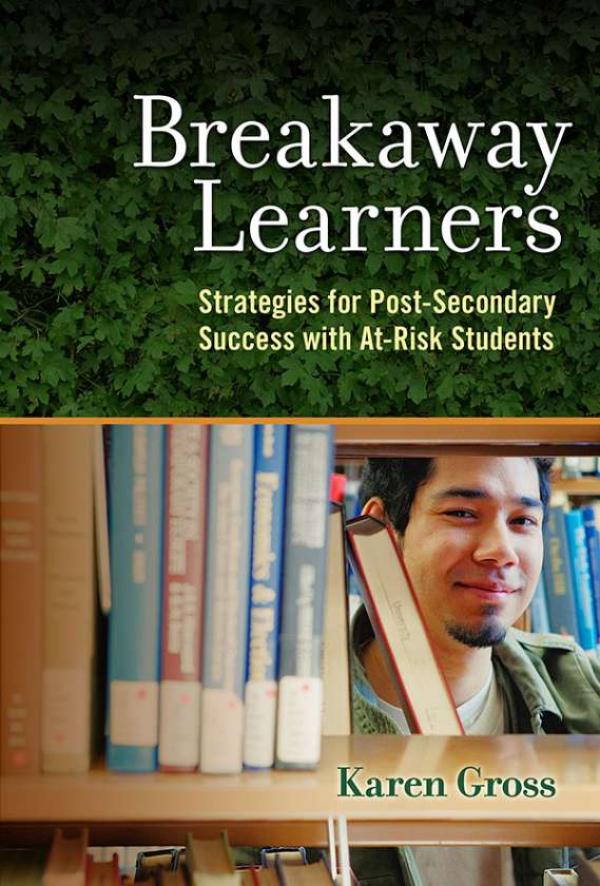
Click Here for Book Review This powerful book explores how institutions of higher education can successfully serve “breakaway” students—first-generation, low-income students who are trying to break away from the past in order to create a more secure future. The gap between low-SES and high-SES students persists as efforts to close it have not met with great success. In this provocative book, Gross offers a new approach to addressing inequities by focusing on students who have succeeded despite struggling with the impacts of poverty and trauma. Gross draws on her experience as a college president to outline practical steps that postsecondary institutions can take to create structures of support and opportunity that build reciprocal trust. Students must trust their institutions and professors, professors must trust their students, and eventually students must learn to trust themselves. Visit the book’s website at breakawaylearners.com.(From the Publisher)
Click Here for Book Review Dancing in the Rain offers a lively and accessible guide aimed at helping education leaders thrive under pressure by developing the inner strengths of mindfulness and self-compassion, expressing emotions wisely, and maintaining a clear focus on the values that matter most. Jerome T. Murphy, a scholar and former dean who has written and taught about the inner life of education leaders, argues that the main barrier to thriving as leaders is not the outside pressures we face, but how we respond to them inside our minds and hearts. In this concise volume, Murphy draws on a combination of Eastern contemplative traditions and Western psychology, as well as his own experience and research in the field of education leadership. He presents a series of exercises and activities to help educators take discomfort more in stride, savor the joys and satisfactions of leadership work, and thrive as effective leaders guided by heartfelt values. Every day, education leaders find themselves swamped in a maelstrom of pressures that add to the complex challenges of educating all students to a high level. With humor and compassion, Dancing in the Rain shows educators how to lead lives of consequence and purpose in the face of life’s inescapable downpours. (From the Publisher)
This article focuses on Reflective Structured Dialogue as a set of practices developed in the context of conflict resolution that are well suited to handling quotidian uneasiness and extraordinary moments of disruption in religious studies classrooms. After introducing Reflective Structured Dialogue's history, goals, and general practices, the authors consider its uses in classroom settings. They argue that a classroom in which teachers understand themselves as facilitators, and in which students are experienced in structured dialogue practices – including being comfortable in a state of intellectual “wobble” – is one more apt to be able to engage with, and more likely to benefit from, disruptive events.
One page Teaching Tactic: a discussion exercise on the first day of class fools students in order to disrupt their prior assumptions of what constitutes a “real religion."
One page Teaching Tactic: discussion of a classical text that moves students from description to analysis and evaluation.
This article reports on a practitioner action research project focused on developing, trialing, and reflecting upon a continuous and formative-assessment plan for a foundational New Testament survey course. Three pedagogical convictions are discussed and drive the design of the assessment. Seven to nine assessment items (depending on level of study) based on course learning outcomes and informed by Bloom's taxonomy of learning, were developed and implemented. Students provided feedback on the assessment through an anonymous online survey. The results demonstrate that students preferred continuous assessment to an exam and major essay, and that they better achieved the course learning outcomes. In conclusion, this style of assessment is effective in driving and assessing student learning and so provides a basis for further action reflection.
What does it mean to teach virtue, or to learn it? We consider this question through an institutional review board (IRB) supported research study attending to student learning experiences in undergraduate ethics courses at a Catholic university with an explicit commitment to social justice. This essay draws on and interprets qualitative data concerning the outcomes of select pedagogical approaches that involve exposing students to the experiences of others: the use of narratives; participation in structured experiential learning activities; and community engagement through deep listening and facilitated dialogue. We focus our interpretation around the implications of these pedagogies in relation to student understanding of and attitudes regarding three character traits identified as “other-regarding” virtues in theological and philosophical scholarship – altruism, compassion, and solidarity. This paper considers the implications of these pedagogies and the practical effects of different sorts of teaching strategies on students' self-understanding as moral agents
Grammar-translation pedagogy is the standard for biblical language instruction. Second language acquisition scholars have argued that grammar-translation is ineffective and not empirically justified. Moreover, evidence suggests most seminary graduates do not use biblical languages effectively in ministry. Task-based instruction is an important alternative pedagogy which focuses on the tasks students will be using the language for and designs the curriculum around those tasks. A task-based approach de-emphasizes translation and memorization of forms. Instead, the emphasis from the beginning is on biblical interpretation and exposition. Available software based resources offer new possibilities for task-based teaching, as students can identify forms and vocabulary and have access to a library of resources. A task-based pedagogy using these tools enables students to quickly develop skills in biblical interpretation that are normally reserved for the third or fourth semester of study. Task-based pedagogy offers great promise for effective and efficient biblical language pedagogy.
What are grades doing in a homiletics classroom? This article traces the function of grades through the broader history of the educational system in the United States and then makes suggestions for how grades can be used more effectively in teaching preaching. Beginning in the nineteenth century, teachers used grades to rank and motivate students, as well as communicate across institutions. With the more recent assessment movement, educators have conceptualized grading as the larger process of evaluating the success of learning objectives. The commission on accreditation for the Association of Theological Schools does not view grades as part of its assessment, but it evaluates theological schools on whether they achieve intended learning outcomes. Theological educators need to be able to evaluate whether their teaching fulfills their schools' mission and learning objectives. For homiletics, the author measures learning through pre- and post-preaching feedback and incorporates professor- and student-crafted rubrics.
Click Here for Book Review Buddhist studies is a rapidly changing field of research, constantly transforming and adapting to new scholarship. This creates a problem for instructors, both in a university setting and in monastic schools, as they try to develop a curriculum based on a body of scholarship that continually shifts in focus and expands to new areas. Teaching Buddhism establishes a dialogue between the community of instructors of Buddhism and leading scholars in the field who are updating, revising, and correcting earlier understandings of Buddhist traditions. Each chapter presents new ideas within a particular theme of Buddhist studies and explores how courses can be enhanced with these insights. Contributors in the first section focus on the typical approaches, figures, and traditions in undergraduate courses, such as the role of philosophy in Buddhism, Nagarjuna, Yogacara Buddhism, tantric traditions, and Zen Buddhism. They describe the impact of recent developments-like new studies in the cognitive sciences-on scholarship in those areas. Part Two examines how political engagement and ritual practice have shaped the tradition throughout its history. Focus then shifts to the issues facing instructors of Buddhism-dilemmas for the scholar-practitioner in the academic and monastic classroom, the tradition's possible roles in teaching feminism and diversity, and how to present the tradition in the context of a world religions course. In the final section, contributors offer stories of their own experiences teaching, paying particular attention to the ways in which American culture has impacted them. They discuss the development of courses on American Buddhism; using course material on the family and children; the history and trajectory of a Buddhist-Christian dialog; and Buddhist bioethics, environmentalism, economic development, and social justice. In synthesizing this vast and varied body of research, the contributors in this volume have provided an invaluable service to the field (From the Publisher)