Resources
One page Teaching Tactic: students annotate popular song lyrics to help them review material from the course by analyzing that material in a new context.
One page Teaching Tactic: a highly structured scaffolding of assignments to support students' ethnographic site visit to a local religious place of worship.
One page Teaching Tactic: students work in groups to identify and discuss differences between scholarly and non-academic sources.
One page Teaching Tactic: using worksheets to provide a structure for a group of students to increase their reading and analytic skills by walking together through a longer and more complex text.
This Forum emerges from a session initiated by the Professional Development Committee at the 2017 conference of the Society of Biblical Literature in Boston. A panel of five Bible scholars, from both theological education and undergraduate contexts, provide brief descriptions and analyses of a specific course they have taught online. They describe creative assignments such as role play, online field trips, evaluating web sites, and staged debates. They analyze the opportunities for developing undergraduates' critical thinking skills as well as seminarians' formation for ministry. A comparison of online and face‚Äêto‚Äêface teaching contexts reveals shifts in our understanding of how learning happens and our own identities as teachers. The Forum concludes with questions from the floor, which turn the conversation toward institutional support for pedagogical and technological hurdles.
Many courses in higher education rely on the hierarchical organization of Bloom's taxonomy to categorize and sequence learning. Introductory courses on scripture often emphasize remembering content and background as a basis for applying the sacred text to one's life. However, a review of the literature demonstrates little support for the widely assumed hierarchical nature of Bloom's taxonomy. Furthermore, this study examined the performance of traditional and non‚Äêtraditional students in a New Testament survey course on a comprehensive exam (a Remember task) and an application assignment (an Apply task) and found no correlation between the two. Furthermore, students struggled most with the interpretation portion of the application assignment, prompting the realization that interpreting a sacred text is a complex hermeneutical enterprise incorporating multiple levels of the taxonomy. Thus, introductory scripture courses may be better organized around the central, integrating practice of interpretation supported by needed information and application skills.
Site visits provide an irreplaceable learning experience to students in both religious studies and the emerging field of interfaith studies. The conceptual core of this thesis is the claim, drawn from feminist epistemology, that an embodied pedagogy – a pedagogy which engages students not only intellectually, but as embodied beings who inhabit a space, engage in physical activities, and undergo various sensory experiences – is ultimately more enriching than a pedagogy centered exclusively in the classroom. Factors that make a site visit a successful instance of embodied pedagogy include the provision of sufficient context to students in advance for them to understand and appreciate the experience, an opportunity afterward to reflect on this experience in an intentional way, ensuring the site and the community whose space it is are treated with proper respect, and ensuring that the religious sensibilities of one's students are also similarly respected.
Inspired by the #FergusonSyllabus, the #StandingRockSyllabus, the #BlackIslamSyllabus and others, this reading list provides resources for teaching and learning about anti-Muslim racism in the United States. 
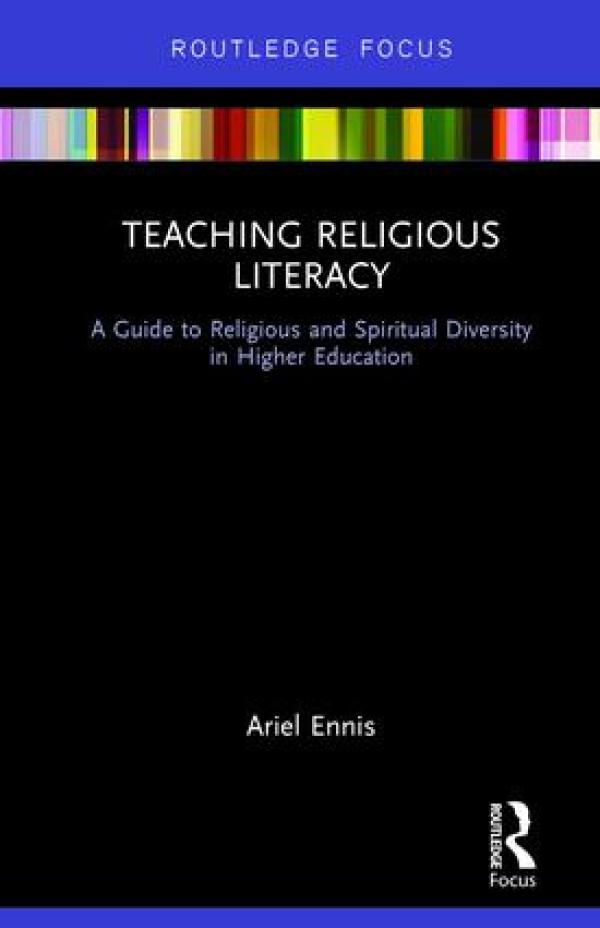
Click Here for Book Review Offering resources and initiatives on religious and spiritual diversity in higher education, this book describes the conceptual foundations for teaching religious literacy and provides a sample curriculum with a facilitator's guide and assessment tools needed to evaluate its development among students. With a clear understanding of the diversity of religious and spiritual experiences found on college and university campuses, Ennis offers a much-needed framework for facilitating conversations about religion and spirituality in colleges and universities. By working from a comprehensive overview of NYU’s award-winning Faith Zone training program, this book breaks down the methodology and tools required to create religious literacy training curricula at campuses around the world.
In our ostensibly secular age, discussing the real-world contexts and impacts of religious traditions in the classroom can be difficult. Religious traditions may appear at different times to different students as too irrelevant, too personal, or too inflammatory to allow them to engage openly with the materials, the issues, and each other. In this “Design & Analysis” article Aaron Ricker describes an attempt to address this awkward pedagogical situation with an experiment in role-play enacted on the model of a mock conference. This description is followed by four short responses by authors who have experimented with this form of pedagogy themselves. In “Conplay,” students dramatize the wildly varying and often conflicting approaches to biblical tradition they have been reading about and discussing in class. They bring the believers, doubters, artists, and critics they have been studying into the room, to interact face-to-face with each other and the class. In Ricker's experience, this playful and collaborative event involves just the right amount of risk to allow high levels of engagement and retention, and it allows a wide range of voices to be heard in an immediate and very human register. Ricker finds Conplay to be very effective, and well worth any perceived risks when it comes to inviting students to take the reins.