Resources
Boyer describes a teaching method which uses popular movies to explore themes encountered in the New Testament. Topics include, for example, martyrdom in Witness and The Gospel of Luke and apocalypse in Waterworld and The Book of Revelation. A modernized film interpretation of Shakespeare's Rome. (From the Publisher)
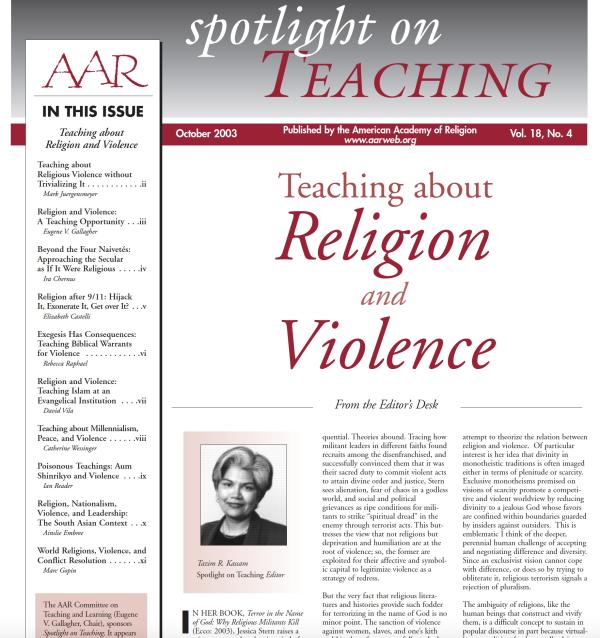
Journal issue. Full text is available online.
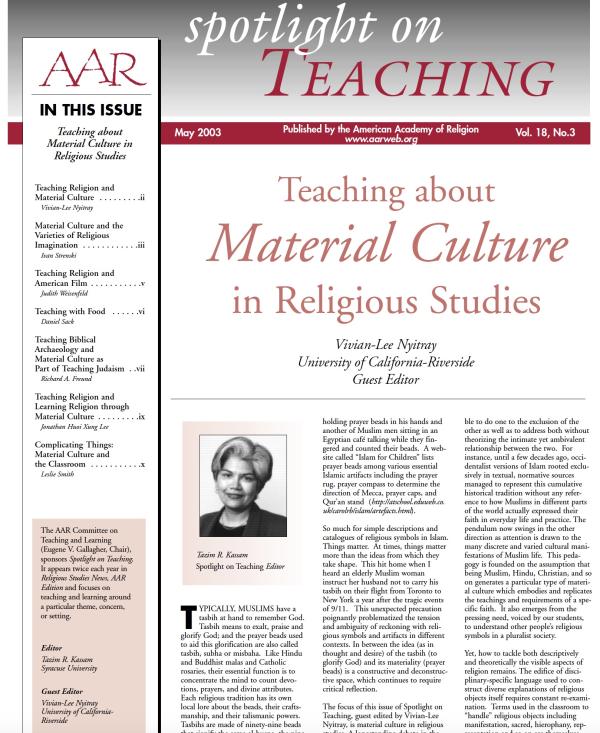
Journal issue. Full text is available online.
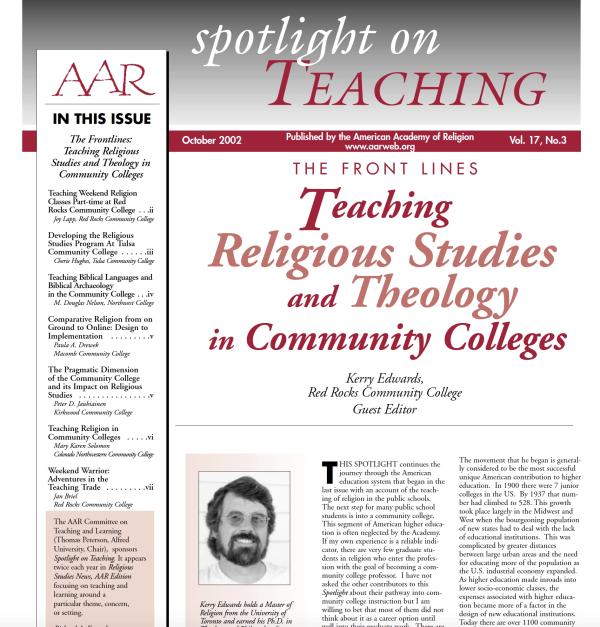
Journal issue. Full text is available online.
This essay will argue that the internet provides an “added-value” to education, providing resources for more effective teaching and enhancing the learning of the students. The internet emphasizes written communication, facilitating clarity of thought and serving as the basis for critical thinking. The internet emphasizes the social dimensions of learning, and the students’ own role in their learning. This essay will illustrate the value of the internet for teaching and learning through a case study of transforming a traditional introductory course on the Bible into a distance course.
Learning to think in a discipline is a demanding scholarly task that is not often associated with the development of university students. Although the intellectual development of postsecondary students is gaining increased attention, relating student development to the process of inquiry in different disciplines is unexplored terrain. This book attempts to come to a deeper understanding of thinking processes by exploring the approaches to thinking taken in different disciplines and then considering how these could be applied to student intellectual development. Drawing on more than twenty-five years of research, Janet Donald shows how knowledge is structured and how professors and students perceive learning in their fields-and offers strategies for constructing and using knowledge that will help postsecondary institutions to promote students' intellectual development within and across the disciplines. The author first creates a framework for understanding student intellectual development and for learning to think in different disciplines. In succeeding chapters, she describes the principal methods of inquiry in each discipline and their effects on learning to think, examining what this means for students and how we might use it to improve the instructional process. For faculty members, this book provides insight into the representation and development of curricula, courses, and programs to improve teaching and learning processes. Professors of education may find a specific use for the comparisons across disciplines in planning courses on teaching methods, as an aid in providing students with insight into how disciplines or fields of study are constructed, and in refining their own conceptual framework in their field. Administrators, particularly of programs and departments, will find suggestions for policy initiatives that are needed to create a supportive learning environment and for organizing teaching and learning. (From the Publisher)
AAR Teaching Religious Studies Series (Oxford University Press) Despite the importance of Islam in global affairs and the role of Islamic Studies in Religious Studies, little attention has been given to the basic questions of how Islam should be taught. This volume brings together a number of leading scholars of Islamic Studies with rich experience in teaching Islam in a diversity of undergraduate settings, from large public universities to small private colleges. Topics addressed include Islamic law, the Quran, Sufism, women in Islam, Islam in America, and teaching about Islam through Arabic literature and the use of new information technology. Along with providing practical information about structuring courses and assignments, the contributors examine the place of Islamic Studies in the larger theoretical framework of Religious Studies and liberal arts curricula. (From the Publisher)
AAR Teaching Religious Studies Series (Oxford University Press) One of the central questions of the field of Religious Studies is "What is religion and how might we best understand it?" Sigmund Freud was surely a paradigmatic cartographer of this terrain. Among the first theorists to explore the unconscious fantasies, fears, and desires underlying religious ideas and practices, Freud can be considered one of the founders of the field. Yet Freud's legacy is deeply contested. With his reputation at perhaps its lowest point since he came to public attention a century ago, students often assume that Freud is sexist, dangerous, passe, and irrelevant to the study of religion. How can Freud be taught in this climate of critique and controversy? The fourteen contributors to this volume, all recognized scholars of religion and psychoanalysis, describe how they address Freud's contested legacy by "teaching the debates." They describe their courses on Freud and religion, their innovative pedagogical practices, and the creative ways they work with resistance. Part I focuses on institutional and curricular contexts: contributors describe how they teach Freud at a Catholic and Jesuit undergraduate institution, a liberal seminary, and a large multicultural university. In Part II contributors describe courses structured around psychoanalytic interpretations of religious figures and phenomena: Ramakrishna, Jesus and Augustine, myth and mysticism. Part III focuses explicitly on courses structured around major debates over gender, Judaism, anti-Semitism, religion, and ritual. Part IV describes courses in which psychoanalysis is presented as a powerful pedagogy of transformation and insight. (From the Publisher)
AAR Teaching Religious Studies Series (Oxford University Press) Claude Levi-Strauss's mid-twentieth century work in structural anthropology revolutionized the study of myth, kinship, and totemism, with lasting effects in cultural studies generally and especially in religious studies. This book provides an introduction to this revolution through generous reproductions of some of Levi-Strauss's most important writing on religion. Reactions and responses, both positive and negative, to the revolution are also included, as well as some of Levi-Strauss's replies to his critics. A general introduction by the volume editor provides a framework for understanding the historical development and contemporary meaning of structuralism for religious studies. This volume provides an unparalleled resource for teaching students about structuralism through Levi-Strauss's own essays and classic critiques of the theory. (From the Publisher)