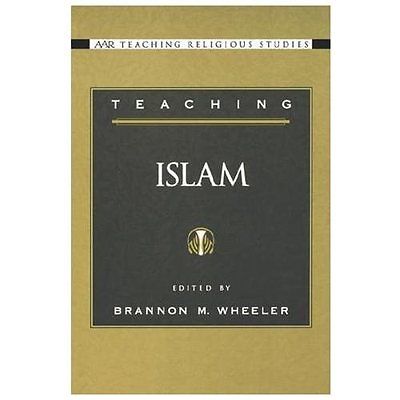
- Author
- Wheeler, Brannon M., ed.
- Publisher
- Oxford University Press, New York, NY
- ISBN
- 195152255
- Table of Contents
-
Part One Theoretical and Pedagogical Frames For Presenting Islam In The Religious Studies Classroom
ch. 1 What Can't Be Left Out: The Essentials of Teaching Islam as a Religion (Brannon M. Wheeler)
ch. 2 On the ``Introduction to Islam'' (A. Kevin Reinhart)
ch. 3 Recent Critical Scholarship and the Teaching of Islam(Keith Lewinstein)
ch. 4 Islamicate Civilization: The View from Asia (Bruce B. Lawrence)
Part Two Dimensions of Muslim Faith, Community, and Order
ch. 5 The Essential Shari'ah: Teaching Islamic Law in the Religious Studies Classroom (Jonathan E. Brockopp)
ch. 6 Disparity and Context: Teaching Quranic Studies in North America (Jane Dammen Mcauliffe)
ch. 7 Between Orientalism and Fundamentalism: Problematizing the Teaching of Sufism (Carl W. Ernst)
ch. 8 Engendering and Experience: Teaching a Course on Women in Islam (Zayn Kassam)
Part Three Contemporary Issues and Challenges In Teaching Islam as a Religion
ch. 9 The Wedding of Zein: Islam through a Modern Novel (Michael A. Sells)
ch. 10 Teaching about Muslims in America (Marcia K. Hermansen)
ch. 11 Corporating Information Technology into Courses on Islamic Civilization (Corinne Blake)
ch. 12 Teaching Religion in the Twenty-First Century (Tazim R. Kassam)
Index
AAR Teaching Religious Studies Series (Oxford University Press)
Despite the importance of Islam in global affairs and the role of Islamic Studies in Religious Studies, little attention has been given to the basic questions of how Islam should be taught. This volume brings together a number of leading scholars of Islamic Studies with rich experience in teaching Islam in a diversity of undergraduate settings, from large public universities to small private colleges. Topics addressed include Islamic law, the Quran, Sufism, women in Islam, Islam in America, and teaching about Islam through Arabic literature and the use of new information technology. Along with providing practical information about structuring courses and assignments, the contributors examine the place of Islamic Studies in the larger theoretical framework of Religious Studies and liberal arts curricula. (From the Publisher)
Despite the importance of Islam in global affairs and the role of Islamic Studies in Religious Studies, little attention has been given to the basic questions of how Islam should be taught. This volume brings together a number of leading scholars of Islamic Studies with rich experience in teaching Islam in a diversity of undergraduate settings, from large public universities to small private colleges. Topics addressed include Islamic law, the Quran, Sufism, women in Islam, Islam in America, and teaching about Islam through Arabic literature and the use of new information technology. Along with providing practical information about structuring courses and assignments, the contributors examine the place of Islamic Studies in the larger theoretical framework of Religious Studies and liberal arts curricula. (From the Publisher)