Resources

The call for educational practitioners to be critically self-reflective is fairly common today. This is in large part due to the work of pedagogical theorists, such as Stephen Brookfield, who have challenged educators to routinely assess and hone our teaching practices. Indeed, since the beginning of my teaching career, I have been encouraged by mentors to reflect critically on my teaching through the four lenses Brookfield identifies: (1) students' eyes, (2) colleagues' perceptions, (3) personal experience, and (4) theory.[1] Recently, however, I have noticed a pattern in my critical reflection: it becomes all-encompassing and far-reaching during the aftermath of national traumas. For example, in these few weeks following the shooting at Stoneman Douglas High School in Parkland, Florida, I have been thinking, “What are we doing wrong? What am I doing wrong? What else should I be doing?” The sickening coincidence that the shooting occurred on Ash Wednesday, the first day of Lent according to the Christian liturgical calendar that I observe, added an unavoidable urgency to my usual Lenten critical reflection. Because the main area of my social engagement is through my teaching and writing, the tragedy of yet another mass shooting prompted me to reconsider everything I have ever done in the classroom. Similar moments of wholescale critical reflection were stirred within me after other tragic events over the past few years. For example, I vividly remember this process of questioning all of my pedagogical assumptions and practices after the presidential election of 2016 and the deaths of Trayvon Martin, Tamir Rice, Eric Garner, and Michael Brown. In the genre of educational theory, I believe Jack Mezirow would define each of these events as a “disorienting dilemma.”[2] He has poignantly described how traumatic events can often lead us to scrutinize previously unquestioned assumptions and to identify how our assumptions have limited our thought-processes and actions up to the point they occurred. For me, each of these national tragedies has led me to uncover my previous assumption that “I need to be an expert in what I teach.” Based on this assumption, I had believed that my expertise in the area of “systematic theology” did not qualify me to teach about civic action or politics at all. So, if I wanted to teach about anything that engaged in social or racial justice (which I desperately did), I would need to go back and get another Ph.D. in critical race theory. However, through my critical reflection, particularly through Brookfield’s fourth lens of theory, I have come to understand the inaccuracy of my previous viewpoint and have begun to embrace a much more accurate alternative: all teaching in higher education must entail “ideology critique.” Indeed, I have taken a tip from Brookfield’s own theory. As he defines it, “Ideology critique is part learning process, part civic action.” It “focuses on helping people come to an awareness of how capitalism, White Supremacy, patriarchy, ableism, heterosexism and other ideologies shape beliefs and practices that justify and maintain economic and political inequity.”[3] I now understand ideology critique as a necessary and central component to critical reflection. National traumas led me to intuit this assumption, and Brookfield’s theory led me to embrace it. Moreover, through my critical reflection--specifically through Brookfield’s first lens, that of my students’ eyes--I know that it is not just me that is questioning everything I have been doing (cognitively and behaviorally) after a national tragedy, but my students are too. I have found that leading them through a critical reflection, which entails ideology critique, is helpful for them as well. The three core assumptions Brookfield identifies as comprising ideology critique are helpful for framing such discussions about the unjust ways the world is organized: “(1) that apparently open, Western democracies are actually highly unequal societies in which economic inequity, racism and class discrimination are empirical realties; (2) that the way this state of affairs is reproduced as seeming to be normal, natural and inevitable (thereby heading off potential challenges to the system) is through the dissemination of dominant ideology; and (3) that critical theory attempts to understand this state of affairs as a prelude to changing it.”[4] Of course, this activity of leading students in a reflection on these assumptions is not the primary focus of my lesson plan in every class. After all, I am responsible for teaching them theological methods and theories—that is, the areas in which I have been trained. But what I know now for sure is that I can and necessarily must lead them in a critical reflection concerning dominant ideology, especially in the aftermath of national tragedies and traumas. I am curious to know how and to what extent others engage in ideology critique in the classroom: In what ways and in which theory do you frame your discussion? How do you balance the demands of the course content for which you are responsible and the demands of the students and contemporary society begging for ideology critique? [1] Stephen Brookfield, Becoming a Critically Reflective Teacher (San-Francisco: Jossey-Bass, 1995). [2] Jack Mezirow, Learning as Transformation: Critical Perspectives on a Theory in Progress (San Francisco: Jossey Bass, 2000). [3] Stephen Brookfield, “The Concept of Critical Reflection: Promises and Contradictions,” European Journal of Social Work, 12.3 (September 2009): 298-299. [4] Ibid., 298.
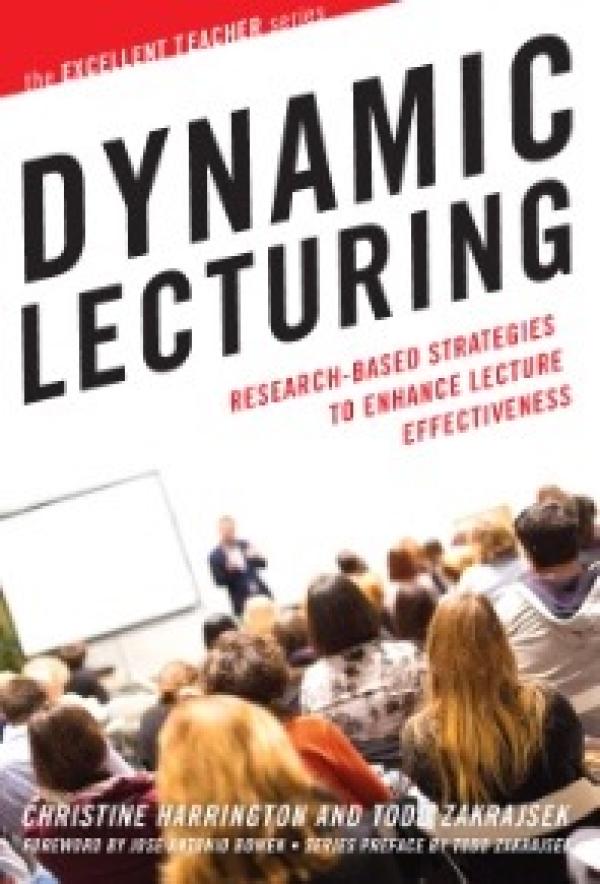
Against the prevailing tide in higher education, Christine Harrington and Todd Zakrajsek argue that lectures, when prepared well and incorporated appropriately, are one of the most effective ways to enhance learning. The first part of their book is focused on making this case and on delineating the different forms a lecture can take. The second part of the book focuses on ways to make lectures more effective for learners. That second part takes up the bulk of the book (7 of the 11 chapters). The third part provides tools and resources for preparing and evaluating lectures. These final two chapters give helpful rubrics, charts, and questionnaires that can easily be adapted for one’s own lectures or for evaluating others’ lectures. This book would be a useful addition to an individual professor’s library and, most especially, to a center for teaching and learning library. Both authors of Dynamic Lecturing are trained in psychology and have experience in teaching and learning and faculty development centers, so the examples are often from social science or natural science classrooms. However, many of their suggestions could easily be adapted to theology and religious studies. Using research from the scholarship of teaching and learning, they argue that lectures are efficient and effective for novice learners but are less so for expert learners (by which they mean advanced undergraduates and graduate students). This book, therefore, would be most useful for faculty who frequently teach lower-division courses for undergraduates; it could still be quite useful for those wanting to make their lectures more effective, even if they work with other learner populations and use other kinds of teaching tools. This distinction between novice and expert learners is significant in the context of theology and religious studies: in certain courses, students may enter the classroom assuming they are the experts (for example, if the course focuses on their own religious tradition, especially if the professor is not another “insider”). Harrington and Zakrajsek’s discussion of techniques like pre-testing may be a way to address this unique dynamic: if a student took a pre-test and found that they did not know as much as they thought they knew, they might find themselves more open to learning from a professor’s lecture. As their title suggests, this is not a book about individual teaching choices, but rather is focused on research-based strategies: nearly every paragraph has multiple citations that refer the reader to studies done on teaching and learning. A bibliography accompanies each chapter, so references are easy to track down, if desired. The studies are often explained well, so the reader knows what the research suggests; there are times, however, when the conclusions seem overstated. For example, a study used to argue that lectures are more helpful than active learning sessions to novice learners is explained in a parenthetical note: 88% of students agreed or strongly agreed that a lecture helped them learn course content compared with 49% of students who agreed or strongly agreed that active learning sessions helped them learn course content (10). Self-reporting is not the same as demonstrating mastery of the content. In other places, the authors note that students are not always the best judges of their own learning (see, for example, studies on learners’ overconfidence [115]). The research cited throughout the book is not limited to self-reporting and includes very helpful data on what promotes student engagement and learning.
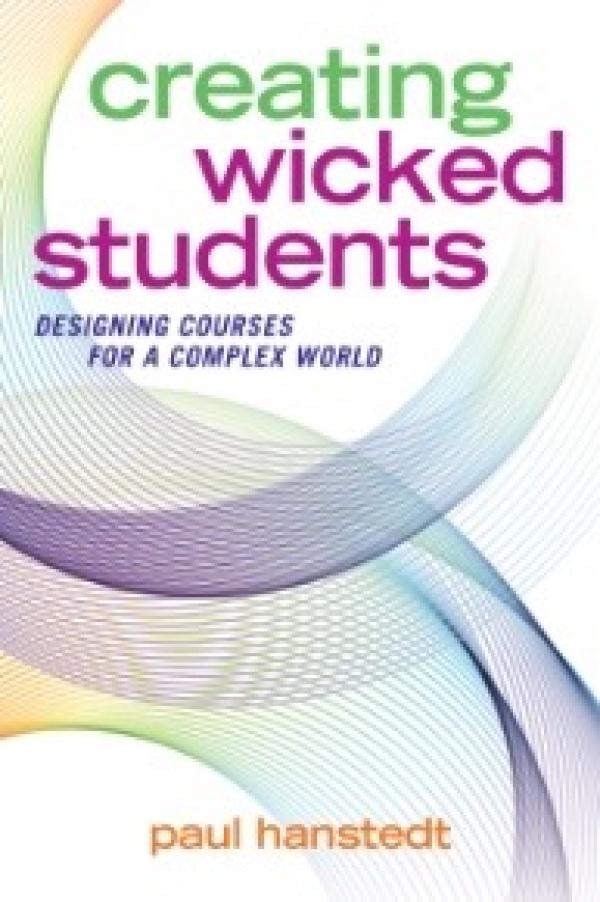
Creating Wicked Students: Designing Courses for a Complex World Paul Hanstedt Sterling, VA: Stylus Publishing, 2018 (x + 180 pages, ISBN 978-1-62036-697-4, $24.95) One might assume that a text called Creating Wicked Students would discuss types of “wicked” problems – complex social-environmental issues that cannot be solved with existing modes of inquiry and decision-making – that instructors might address through a problem-based learning approach. However, this work actually is an introduction to course design most useful for beginning instructors or those redesigning their courses according to sound pedagogical principles. Situating himself against those who view higher education as solely preparing students for the workforce or transmitting content, Hanstedt emphasizes the importance of instilling a sense of authority in our students by helping them develop skills and attitudes that will empower them to make meaningful change in the world. Hanstedt’s holistic vision of education includes attitudes and dispositions alongside skills and content mastery, and will likely resonate with instructors in religious studies and theology. Although he does not explicitly refer to our disciplines, he does offer examples, anecdotes, and insights from colleagues in a variety of fields and institutions, which is a strength of the book. He references seminal work in the scholarship of teaching and learning – including that of: George Kuh (2008, High-Impact Educational Practices, AACU); James Zull (2002, The Art of Changing the Brain, Stylus); and David Krathwohl (2002, “A revision of Bloom’s taxonomy,” Theory into Practice 41) – but does not engage with previous scholarship on wicked problems. Readers interested in learning more about pedagogical approaches to wicked problems could consult the work of the work of: Brown et al. (2010, Tackling Wicked Problems, Routledge); Carcasson (2017, “Deliberative Pedagogy as Critical Connective” in Deliberative Pedagogy, Michigan State University); or Lee (2016, “Systems Thinking,” in Resilience by Design, Springer). This book could be useful as an introduction to course design for someone less familiar with the fundamentals, such as how to develop measurable learning outcomes, align course goals with institutional goals, nest content within higher-order goals, engage students’ prior knowledge, or incorporate applied learning. The structure of the book allows for one to follow it step-by-step as a course design manual, and it also includes recursive “intermissions” to encourage reflection along the way. In addition, his discussion of how to prompt critical thinking through multiple-choice exams offers helpful strategies for encouraging students to explain their thinking on ambiguous questions with follow-up questions that explain or justify their choice (92-98).
Classroom discussions are never to be used as therapy – by student or by teacher. While I believe teaching and learning has the capacity to summon the elements of healing, I do not subscribe to asking teacher or learner to participate in classroom sessions structured for therapy in any respect. The doing of therapy must be left to the psychological professionals. No assignment or classroom discussion should invite students into a therapeutic contract. I make this declaration because personal disclosures are often part of the teacher/learner relationship. Choosing authentic and healthy ways of revealing one’s self to students is a part of teaching, and it requires reflection, intention, planning, and great care. Parker Palmer has taught us, “we teach who we are,” so it behooves us to take great care that in sharing ourselves we do not share our craziness, our brokenness, our hot-mess-selves. We should resist any temptation or impulse to disclose personal, raw stories of pain, trauma, and personal wounding under the guise of providing conceptual examples or building trust with our students. Students do not deserve to be burdened by our emotional or psychological fragilities. Equally, we must take care not to coax students into personal disclosures that continue, or compound, their wounding. In other words, too much shared personal information is never a way to strengthen the dynamics of a classroom discussion, lesson plan, or teaching relationship. I have a colleague who does not subscribe to Palmer’s line of thinking about the teaching of one’s self. Instead, he subscribes to the notion that we teach through a series of personas that can be created, crafted, and honed. Then, over the years, by cultivating these personas, we can convey, portray, perform the self who is needed to be a good teaching presence in the classroom. This perspective reminds me of the poem “We Wear the Mask” by Paul Laurence Dunbar. The first stanza reads: We wear the mask that grins and lies, It hides our cheeks and shades our eyes,— This debt we pay to human guile; With torn and bleeding hearts we smile, And mouth with myriad subtleties. While I don’t think this is what my colleague intends, I suspect our adult learners are savvy enough that they recognize a good persona or a flimsy persona for just what it is - a persona. The irony is that even your choice of persona reveals a bit about who you are. Regardless of your philosophy of self-disclosure, the key is not to over-share. Only a few of us are reckless and blindly cross boundaries or wantonly choose to participate in inappropriate disclosures that lead to inappropriate behaviors. Most of us are not in danger of harming students. Most of us simply want to find ways of portraying our healthiest selves for the good of the learning ecology. The month when my mother was dying (2010), I was teaching as best I could - that is, only just barely. I thought I was doing an adequate job. One day during class my teaching assistant, Amy, pulled me aside and told me I had assigned the same small group exercise the week before. She looked at me with eyes afraid she had told me the wrong thing. I thanked her for her feedback. When I gathered the students back from the small groups, my first impulse was to explain myself, which would have meant telling the class I was distracted because my mother was dying. I recoiled from this disclosure feeling that it was too intimate, too raw, too much sharing. My next impulse was to continue with the planned discussion and end class a few minutes early. I went with my second impulse. Being authentic in classrooms does not mean telling all your business. Students are not in our classrooms to take care of us. Similar practices and sensitivities are needed for student disclosures. I have had moments when adult learners launch into telling very personal, sometimes painful stories, about family situations. In these moments I ask them to “STOP!” I try to be light-hearted in my command to cease, but I ask that traumatic experiences not be told, then I ask the student to tell us the point of the story, rather than the detailed story itself. If needed, I talk with the student after class in an effort to refer him/her to counseling. Referral is a needed skill in teaching. Additionally, I ask that in written assignments, care be taken not to disclose anything to me that they would not disclose to the entire class. Reading the stories of pain and trauma in assignment form can be worse than hearing the stories told in the classroom setting. I have a friend, brilliant scholar, who has chosen only to lecture in classroom sessions. Occasionally, she will turn to questions about the lecture in the last few minutes of the session. She has intentionally decided never to allow for student discussions. This strategy was deployed because she was weary of the personal stories of students that were nearly impossible to redirect toward the course agenda. She was unnerved by the disclosures of gossip which were used to thicken the discussion and entertain. She found it a waste of time to listen to students who had not done the readings and instead chose to filibuster by over-sharing. While I do not applaud her decision, I understand her decision. The best strategies I know for helping students and myself not to lapse into disconnected, personal storytelling is to be clear about my aims, objectives, and goals for each course, each session, each learning activity and then to keep those goals central to all discussions. It takes a precision of discipline to stay on-target with the aims and to train students to respect these parameters of disclosure and discussion. It takes a strong, even hand to set and maintain a climate that encourages strong discourse (even personal stories which are applicable to the conversation) and discourages over-sharing. I start the first day of the class with this kind of climate setting in mind. I tell students that we do NOT have a contract of confidentiality in our discussions and to consider anything said in this space as shareable with the world. I tell them that if they need to speak confidentially, then please see their therapist, spiritual director, or counselor, as I will be doing the same thing. I have gotten considerable feedback from students that they appreciate not to be asked to over-share in classrooms.

Is there a pedagogical responsibility to traumatize our students? I’m not thinking of some unbridled notion of “tough love” in grading, or an exaggerated insistence that actions have consequences, or even routine attempts to challenge assumptions and perspectives. Rather, is there a pedagogical responsibility to make students feel less safe, less secure, less stable, to insist that the world is more sinister, more dangerous, more potentially harmful than they might at first suspect or admit? I grapple with this question in many of my courses. For example, I teach a course focused on cinematic representations of Jesus that strives to enable students to read such films rhetorically, in conversation with their own historical and cultural moment as well as the current one. To do this well, we have to tease out the ways in which the films support (and resist) anti-Semitism, nationalism, misogyny, racism, homophobia, erotophobia, and Christian imperialism. In a general education course that explores American histories of race, gender and sexuality through horror films, we grapple with very similar issues. Students resist ideological critiques of these films claiming that such analyses read too much into them or make too much out of minor details or simply exaggerate the importance of “mere entertainment.” Students also emphasize their historical distance from these films—racist and sexist imaginaries may have infected the forties, fifties, sixties, seventies . . . even the early aughts, but those problems have been resolved, and we occupy a more enlightened moment. Part of my work in these courses is to push back, gently but persistently, against these defenses and resistances and force an encounter with ugly, painful, dehumanizing energies. Part of my work is to help students see what they might be unwilling to see about the ways various cultural representations try to prevent them from seeing. Questions about confronting students with potentially traumatizing material are often resolved by appealing to students’ identities. In a recent Facebook conversation, a group of colleagues discussed whether it would be appropriate to screen video of the white supremacist rally in Charlottesville in class. There was a concern about protecting students of color and a desire to confront white students. While these priorities made—and make—sense to me, they aren’t fully consonant with my experience as a teacher. I have had female students challenge claims that an argument or analysis is sexist, had queer-identified students champion fairly optimistic assessments of the presence of religious homophobia, and had students of color contest of racism in representations. By no means am I suggesting that my assessment of the cultural, political, and ethical dynamics of materials is always correct—and I certainly try to create classroom spaces where students can respectfully challenge interpretations offered by course materials, their classmates, and me—but it seems important to note that it may very well be those students who are most likely to be targeted by certain systems of unjust and injurious power—i.e., those students who we worry most about (re-)traumatizing—who may be least willing to acknowledge their vast reach. These challenges were most pronounced in a course I co-taught a couple of years ago entitled “The Violence of Hope.” This course interrogated the ways in which discourses of progress, restoration, healing, and redemption—in politics, ethics, and religion—disguised, perpetuated, or intensified violence. The course pressed the notion that we are all inevitably and inextricably implicated in and complicit with systems of violence and that our attempts at amelioration are often mechanisms of acceleration. Many of our students had deep activist commitments. Most of our students confessed feelings of hopelessness and frustration as the course progressed. Ultimately, what I think made the course work—what I think makes my film courses work, my Queer Theory coursework, my courses focused on sexuality and religion work—is that there was an acknowledgment of the enormity and seriousness of the questions raised by the materials under consideration and a genuine, patient attempt to grapple with them. In my teaching, I heed the call to traumatize my students. I work to make them more paranoid—or paranoid in new keys. But this is never the goal of my courses. By the same token, it is never my goal to solve the problems I raise, answer the questions I pose—or even offer palliative care for the injuries I may inflict. Instead, I seek to help students develop the skills, the habits, and the dexterity to negotiate the fraught, uncertain, and ever-shifting terrain that comprises their world. Consistent with my sense of responsibility, the only way to develop such capacities is to enter hostile territory.
Teaching-learning is often a perilous process. Occasionally, in the midst of delivering carefully structured lectures, facilitating balanced yet critically engaging discussions, or working with students one-on-one, life intervenes in a dramatic and direct fashion. Three years ago, I was teaching a summer course on Methodist church history for Master of Divinity students pursuing ordination at Perkins School of Theology at Southern Methodist University. Right after we began the section on Black Methodism, Dylann Roof walked into a Bible study class at Emanuel African Methodist Episcopal Church in Charleston, South Carolina and killed nine people, including the pastor. The world was rife with shock and grief. We, ourselves church leaders, Bible study teachers, and ministerial workers, were actively engaged in crafting understandings of ecclesiastical history in order to refine vocational skills. Students (and instructor) processed painful emotions derived from a current event that hit close to home. Empathy with the victims and their families mingled with rage, disbelief, and ultimately, compassion for the tormented assailant. Socrates reportedly once said, “I cannot teach anybody anything. I can only make them think.” For me, as instructor, a pedagogical opportunity had arisen. I found myself addressing a contemporary demonstration of the societal and cultural terror that necessitated the original founding of Black Methodism while teaching a section on Black Methodism in a Methodist history class. In that moment, critical analysis of the broader sweep of church history and its convergence within the present was essential. It was important to help students utilize the historical information they were acquiring in light of current events. Balancing both sets of data, the historical record and the contemporary event, opened the way for collective inquiry, sharing, and judging right there in the classroom. This experience reveals a wider view of pedagogical method. By allowing students to ask and respond to critical questions, underlying assumptions are revealed. Students are then invited to further examine the nature of their assumptions. Have key events and concepts been adequately accessed? Does other relevant information exist that may shed light on these assessments? What are the logical implications of this view? Are there alternatives? If so, are they just as reasonable? Thus, one of the ways student-learners develop critical thinking skills is through the facilitation of teacher-learners who ask questions and respond to answers with more questions. While acknowledging the contributions of students equitably (and encouraging all to participate) facilitators move the discussion forward by engaging questions that maintain focus on the stated goals of the course. This includes summarizing the status of reflections, critical points, and remaining questions. However, it is also crucial to keep in mind that students may harbor feelings of trauma and stress sparked by the evaluation of historical knowledge and associated current events. Creating a classroom that nurtures the student voice through affirmation of shared experience fosters safe space. The use of critical thinking in analyzing history, which is oftentimes quite troubling, engenders the technique of practical engagement with personal and social traumas. And, sensitivity to cultural diversity, religious difference, and doctrinal belief is paramount in cultivating a healing environment. This includes the overt recognition and appreciation of differing and conflicting opinions. Paying attention to the energy of the class, body language of students, and other contextual signs will determine choice of direction that a teacher-learner may take, even while encouraging rational analysis of stated views. Taking a synergistic approach, that is, dialectical interaction among teacher-learners and student-learners, therefore allows room for reasoned critique of hypothetical assumptions as well as the emotional processing of potentially painful experiences. Effective execution requires heightened attention to the needs of students and patience with the flow of communication. This can be challenging, particularly when unexpected realities shatter benignly anticipated teaching moments carefully structured by course design. Instructors must, therefore, be gentle with themselves and practice flexibility in meeting the demands of challenging and/or controversial teaching moments. Although teaching does involve the transmission of knowledge, the ultimate goal of teaching lies in the cultivation of tools that allow students effective engagement in critical discernment of the world, leading to reasonably based decision making. In our Methodist History course, the shootings by a crazed supremacist at the historic Mother Emmanuel Church were a sobering occasion that offered the chance for systemic appraisal of institutional structures in church and society that continue to perpetuate racial violence. This unfortunate and deeply traumatic event provided context to evaluate broadly how various interlocking systems lead to experiential sufferings that are typically passed down generationally. As we grappled with the pain enkindled by this senseless act (which will reverberate in the annals of traumatic historical events) insightful theological and practical observations, deduced by critical analysis, were honed. Like the rest of the world, our class did not emerge emotionally unscathed by facing the horrors of history alive and well in today’s world that mournful day. We did, however, incorporate pedagogical tools, that, with repeated and improved use, are designed to foster growth and empowerment in teaching, learning, and living as responsible citizens.
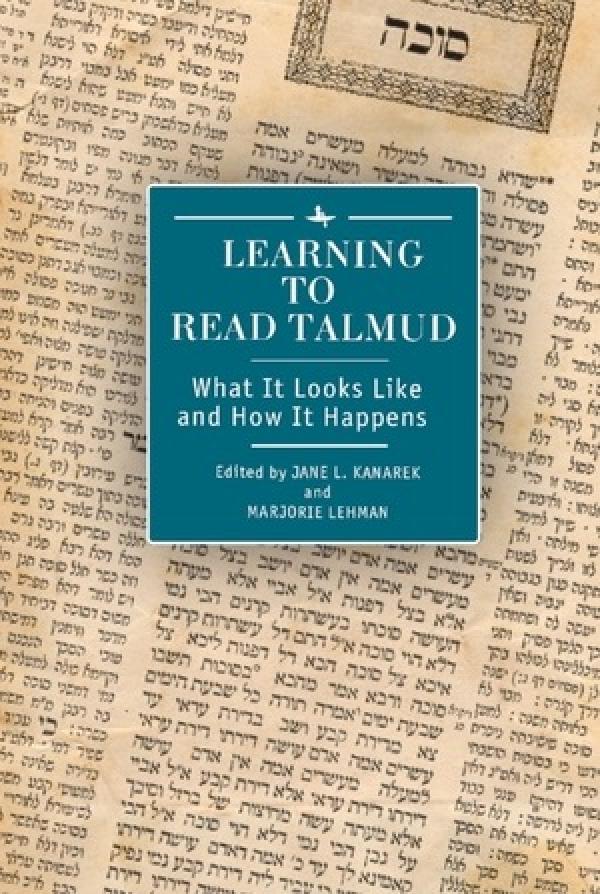
The subtitle says it all. This is not a how-to book that will teach one how to read the Talmud, but a book on how to teach others to read the Talmud. It is part of a “growing field of the scholarship of teaching and learning (SoTL), a field that seeks to expand the research agendas of scholars in a particular discipline to include research into the teaching or learning of that discipline or both” (xii). Each chapter is written by a different instructor of Talmud, all of whom have various methods and goals for teaching Talmud to their students. While the title might sound like it severely restricts its audience to those who teach Talmudic students, it doesn’t. Insofar as the book examines various methods for teaching a text that is both ancient and in a foreign language, the book could be useful for anyone who teaches primary texts, especially primary texts that involve a foreign or dated language. The book does not advocate a particular method of teaching or approach to reading the Talmud, recognizing that the best method and approach would depend on the goals of the class and the students’ previous exposure to Hebrew in general and the Talmud in particular. Some of the instructors focus more on the technicalities of the languages, such as Berkowitz and Tucker. Others, such as Gardner and Alexander, focus more on how one teaches the text to non-specialists. Kanarek examines the role of using secondary readings to understand the primary text in teaching. Whatever one’s style of teaching or goal for a primary text in a foreign language, one can find various ideas for how to implement them in the classroom. Each chapter gives a brief background as to the intent and assumptions of the instructor, specific examples of what was done, student feedback or responses, as well as post-class reflections. Berkowitz discusses the usefulness of study guides for assisting students in asking the right questions about grammar and vocabulary to aid their understanding and make technical terms seem less alien. Tucker exemplifies in his approach how to help students appreciate and not gloss over difficulties in the texts. Kanarek examines how different types of secondary readings can help students in different ways discover and appreciate issues in the texts. Gardner considers how explaining the narratives and surrounding culture aids non-specialists in understanding and appreciating the texts. Alexander structures her class to help students appreciate the possibility of more than one answer. All in all, this book offers some very practical ideas on teaching original and foreign texts.
Several years ago, I was expecting a guest speaker in one of my courses. To prepare for the colleague’s visit, I asked my students what questions they had for the person. Silence. And not a quizzical silence, just a dead silence. I tried to prime the pump by repeating the guest’s research agenda as well as the topics of our course’s conversation. The response by students was underwhelming – the not so faint sound of crickets could be heard. I signaled my dismay by using a displeased tone of voice and reminded the students that they must have questions. In distress, a woman blurted out, “I don’t have any questions!” I realized she meant that she did not have any deficits. She thought questions only signaled what she was supposed to know, but did not. Questions, for her, were a confession of inadequacy, unpreparedness, and ignorance. I had failed to teach that questions were tools of curiosity and a method of inquiry to interact with the guest lecturer. Since that moment, I have been trying to cultivate and nurture student curiosity. In this journey, I have learned that what I am curious about is not necessarily what my students are curious about. I have learned that some students have no curiosity for classroom learning because their energies are tied up in modes of survival, credential earning, and the distractions of family and wage earning. These students are difficult to gather-in. I have learned that students have been told that their genuine curiosity is without merit, so they have learned not to voice their real questions or pursue their authentic passions. I have learned that some deep, marvelous curiosity is voiced in a language/vocabulary that is academically unsophisticated and I have worked to train my ear to hear these curiosities. I have challenged myself to “think like my students” and try to anticipate the kinds of questions and inquiry they will levy toward a reading or learning activity. I want to align with them and use their inquiries as starting points. I’ve had some success with this tactic – but it’s not easy. Mostly I’ve learned that students are so eager-to-please that when I tell them they are to formulate their own genuine curiosity about a topic – they do. Last semester I had two kinds of assignments in my seminar. First, the students were to consider the assigned readings, then like jazz musicians, riff off of the author’s argument. I called them Riff Reports. The instructions were to bring to the class a report about what the reading sparked in their thinking and imagination. I challenged them, “Bring your own insights, curiosity – do not repeat the reading, do not report the reading. Consider your own passion, interests, situations, then build, expand, add your voice, perspective, and idiosyncrasies to the conversation.” At the beginning of the semester, I modeled in class sessions what I meant by Riff Reports by doing my own version of riffing off of the readings. In my three-hour session, I would do a one-hour riff, then two students, each taking 30 minutes, would riff off of the same reading. This would give the class three riffs from one reading – a cornucopia of meaning and wonder! Second, by the end of the semester, the students completed a Curiosity Report, building off of the reading, their Riff-Reports, my Riff-Reports, and the conversations we had in class sessions. The Curiosity Report could culminate in a critical reflection essay or it could be a creative portrayal. Regardless of its final embodiment (the student’s choice), the report had to include a method of inquiry which addressed the student’s own curiosity. Students were invited to explain why this curiosity was important to them and their people. They had to sit with the librarian to create a bibliography, interview experts, and go on field trips to visit the locales needed to satisfy their inquiries. By mid-semester, students gave oral reports about their topics, questions, and inquiry methodology. By the end of the semester, students gave an expanded presentation and then handed in a written form. Watching and helping students formulate their own curiosity was a very different way to teach than telling them what was important, critical, or required in the disciplinary canon. Helping them develop, unearth, and investigate their own agendas was not the same as performing my passions, thoughts, and ideas for them at the front of the class. Witnessing their process of being inspired by our reading, then taking a kernel of their own idea and working it up into a full project, was very meaningful to me. This witnessing gave me a real sense of reverence for their ability to think, create, and hope – I felt as if I was witnessing beauty. In every case, students selected topics that were personally relevant, intimately related to their life circumstances, and in some cases, life-giving. Our librarian called me to comment on the breadth and uniqueness of their topics and how interested he was to help students who were interested in inquiry. In two instances, I sent students to talk with faculty colleagues whose research interest matched the students. In both instances, the conversations were generative for both student and colleague. Finding like-minded thinkers feels like water in the desert. At the risk of romanticizing the experience, I did have one student who, in my opinion, got lost in the process. The student preferred being told what to do and how to do it. When that was not the task, the effort needed for discovery and self-motivation was too much. The student was able to articulate a fascinating question of inquiry, but could not follow through on investigation and creative research methodology. Pursuing curiosity requires time for introspection, consideration of on-going context and conversation, and the where-with-all to investigate. Structuring classrooms for student curiosity seems like a no-brainer, but it has taken me many years to get here.

In graduate school, I spent a year teaching at San Quentin State Prison while writing my dissertation. I loved my Religion and English classes at the prison and frequently remarked to friends that teaching incarcerated men, many of them in their mid-thirties or beyond, was strikingly similar to teaching 18-22-year-old undergraduates at UC Berkeley. “They make the same excuses about why they couldn’t do the reading,” I loved to tell fellow graduate student instructors. The students, those on the inside and on the outside, also often struggled over the same points – how to write a persuasive thesis, how to conduct research, how to understand unfamiliar religious practices. Eventually, I found a job at Rhodes College in Memphis, TN, and left both Berkeley and San Quentin behind. After several years at Rhodes, a colleague invited me to teach in another prison education program, this time a “great books” program at the West Tennessee Women’s Prison. I jumped at the chance and offered to cover the Hebrew Bible. Strategically, I decided to teach the two books I was already teaching to Rhodes undergraduates in my Feminist Biblical Interpretation class: Ruth and Esther. This suggested several advantages: I would already be prepared for what the students would have to say about the texts, what directions the conversation might take, and I thought women might be interested in reading texts where female relationships, like that between Ruth and Naomi, are foregrounded. I entered the first class at WTWP confident in what would happen. I had just taught Ruth to my traditional undergraduates a week before and the Rhodes students had had excellent discussion, especially about Ruth and Naomi and their relationship (Ruth, you’ll recall, is urged by her mother-in-law Naomi to leave after her husband dies; Ruth replies with the famous words, “Where you go, I will go; Where you lodge, I will lodge; your people shall be my people, and your God my God. Where you die, I will die— there will I be buried” [Ruth 1:16, NRSV]). My Rhodes students were open to the possibility of queer readings of Ruth and Naomi – generally, they were interested in finding and ferreting out pockets of homoeroticism in the text – though also critical of Naomi as “a whiner.” Ruth, meanwhile, seemed less a loyal friend or lover than a burden – “like someone else’s pet you have to take care of,” as one student put it. The women at WTWP were also very enthusiastic to talk about Ruth, but they had different understandings of the relationships in the text. They were, on the whole, far more sympathetic to Naomi and “what she’s been through.” They were mostly (though not entirely) reluctant to see the relationship between the two women as homoerotic, but they placed great value on reading it as a strong friendship. Ruth and Naomi had each been through a great deal. They needed each other. This experience of teaching the same text in two very different groups was a valuable pedagogical reminder to me about the dangers of making assumptions about students and how they will respond to the text. It was also useful in thinking about trauma. Many incarcerated women are survivors of trauma, especially violence and sexual violence. Incarceration challenges family bonds and strains relationships. All of this is well known. What I did not realize until teaching Ruth in prison, however, was the unique hermeneutic perspective it gives students into the text. These women read the book with greater empathy, and with greater attention to the dynamics of its relationships. They understood why Ruth and Naomi needed each other. (Relatedly, when we read Esther the following week, they took a dim view of the men in the text, especially Ahasuerus for his sexual exploitation of women and Mordecai for his strategic exploitation of his niece Esther. These readers intuited what scholars such as Nicole Duran and Randall Bailey have argued, that the book of Esther is a work of male exploitation). The traditional undergraduates at Rhodes have their own traumas, and these too influenced their reading. College students are especially attuned to the fraught relationships between children and parents -- this came across in their reading of the book. Sexual exploration is also a cause of interest, as well as anxiety, in college -- these readers were more open to the possibility of queer romance in the text. The traumas that shape our lives shape, as well, how we read texts. This is a simple lesson, but one that the students in my two Ruth classes helped me understand better.
The questions that inform my teaching and scholarship focus on representations of violence. This means I spend a good deal of time studying such representations. I learned several years ago that my capacity to answer relatively straight-forward questions like “But is that film really gory?” or “Will I find that book really disturbing?” has dwindled into non-existence. Turns out that when a significant portion of your media consumption is comprised of images of war, torture, sexualized degradation, and racialized brutality, your attunement to the average consumer’s tastes atrophies. From the outset, then, I acknowledge that I might not be the most reliable guide to help sort out how to teach traumatic materials. By the same token, I have taught, written about, and meditated on an array of traumatic materials—and my students, in the main, after initial phases of feeling overwhelmed and disoriented by the questions and contents that organize my courses, have reported finding something valuable in them. So, to open this blog series, I want to suggest that teaching traumatic materials may not be so different from teaching per se. First, I think we are sometimes overinvested in thinking about traumatic materials as a special case. When considering the events, texts, and ideas that comprise the religious studies curriculum, it’s tough to think about what remains after subtracting potentially traumatizing content. War, violence in various forms, imperialism and colonialism, degradation and humiliation, ethnocentricism and racism, sexism and heterosexism—examples of each abound in the language, imaginaries, and practices that we take as our object of study. Do we need additional pedagogical tools beyond the transparency, openness, and attentiveness that we should be using all the time to make sure that we are noticing, and making space for, our students’ varying levels of discomfort, resistance, confusion, and hostility? Given that traumatic materials constitute so much of what we teach when we teach religion, I would suggest that—insofar as we are teaching well—we already know how to teach such materials. Second, I think we overestimate our ability to predict which materials will traumatize. In a former life, when I was an adjunct teaching Constitutional Law, I made a remark about the brilliance of the U.S. Constitution’s solution to the practical problems presented by the Articles of Confederation. A young African-American woman, who had been quiet for the first few weeks of class, spoke up and eloquently explained that she found nothing to admire in a document that still countenanced the ownership of human beings. I carry her intervention with me every time I enter the classroom. My experience of the world shapes what I experience as injurious, as ugly, as painful, as disturbing. In the same vein, I remember distinctly how terrified and paralyzed I felt sitting amongst the enthusiastic cheers that greeted the final scene of Brett Ratner’s blockbuster film, X-Men: The Last Stand, as “good” mutants fought to destroy the “bad” mutants who refused to be “cured” of their otherness. Given that history and mainstream culture are made by and for those who hold power, even the most seemingly anodyne examples can be traumatizing for those who were never meant to survive. Related to the question of predicting which materials might traumatize, I also wonder about our ability to read students’ reactions. When does silence evince reflection and when paralysis? When is speaking up fueled by enthusiasm and when by rage? Although my course evaluations tell me that my ability to read the energy of the room is far from perfect, I remain convinced that when we strive to remain present with our students in the unfolding of the event that is the class session, then the surprises that inevitably come will be much less likely to catch us off guard in destructive ways. Finally, I think we sometimes overvalue teaching traumatic materials—either by assuming that certain topics are beyond our pedagogical capacity—because they are too upsetting, too sensitive, too difficult—or by valorizing those who have the “courage” and the “finesse” to teach such challenging content. I teach what I teach—like most teachers—because I find something important, something tantalizing, something worthwhile in the material. I teach what I teach—like most teachers—because it opens a particular perspective on the world for my students. And, like most teachers, I have good days and bad, days my students get it and days they don’t, days I’m fully engaged and days I’m distracted, days they resist what I’m trying to do and days they trust me enough to willingly come with me. The more we normalize the traumatic in our pedagogical imaginations, the more we’ll be able to help our students encounter the ubiquity of trauma that constitutes their world and their lives.