Resources
“Doc, if I teach what you are talking about I’ll get fired!” “Talking about this in seminary is fine, but if I try to talk about white supremacy on my job –won’t I get fired?” “If I talk about racism and oppression in my church-I’ll get fired.” In classroom conversations that teach against domination, systemic hatred, violence, and social dehumanization, students begin to consider what it might be like to take these agendas to the places where they have leadership responsibility, authority, and obligation. Students become concerned about what might be at stake should they take up the lofty ideals of equity, liberation, and social holiness. The concern for personal risk is not pervasive, but it is certainly a concern which is voiced. Once students learn a bit about employing liberative pedagogies they become concerned about employment stability, the consequences of moral agency, and the backlash of courageous acts. Students feel inspired, intrigued, and curious about new approaches to the sins of xenophobia, white nationalism, racism, misogyny, Islamophobia, and homophobia, only to be halted by the personal fear of communal rejection, the possibility of shunning, and the chance that they will get fired. After reading great thinkers like bell hooks, Paulo Freire, Katie G. Cannon, Parker Palmer, and Audre Lorde, students lean into the conversation of social transformation and church accountability. They “try-on” the ideas of liberation and the hope of systemic equity for minoritized, economically disenfranchised, and those seeking asylum. There is a thrill to these taboo and previously unconsidered notions of good community and spiritual maturity. Quickly though, too quickly, the thrill meanders into, or slams into, the reality of being a neophyte leader in an established system. Their questions wither into concerns of self-preservation and selfishness–“If I try to do this stuff, will I get fired?” Critical, prophetic wisdom shrivels. Rather than bringing ease, deep study plunges the student into discomfort, dilemma, and the promise of hardship, sacrifice, and possible loss of power, authority, and social stature. In asking if they will get fired, I do not believe my students are having a crisis of conscience–their conscience is clear. They say they want liberation for all persons–and I believe them. Their dilemma is in falling victim to selfishness and the illusion of security. They are afraid that if they lead people toward change, and teach toward an ethic of compassion, love, empathy, and mercy, that this will be such a drastic shift away from the current norm of white supremacy and patriarchy that they will be punished. These genuine concerns must be considered in the seminary classroom if learning about justice is to be real and realized. On the days I am impatient with their self-centered concerns, my answer to their genuine, albeit uninspired, concern is to quote science fiction writer Octavia Butler, “So be it. See to it.” With this statement I am not so much trying to be callous as I am trying to portray what my grandmother told me: “We do not fight flesh and blood, but powers and principalities.” What she meant was that we are obligated to speak our truth then trust in the Spirit who would see us through the fight; our truth and trust must be in God. This is a hard lesson which sometimes takes a lifetime. My grandmother would also import Emily Dickinson’s advice to “tell the truth but tell it slant,” her version of “.. . be wise as serpents and innocent as doves” (Matthew 10:16). When I am more patient, I linger over the question of self-preservation. I carefully explain that the work of teaching to transgress, if done effectively, will likely result at some point in life with the loss of favor, friends, reputation, money, and yes, might result in getting fired. I want my students, even the young ones, to have more fear of the harm and violence of living in a racist society than fear of personal sacrifice. I want them to fear being unfaithful to what they say they care about and believe. I want their fear to motivate them rather than paralyze them. When I ask the student who had the courage to voice their fear of being fired why they would want to lead a congregation or institution who would suppress their impulse to fight against the status quo, I am asking why would they want to squander the gifts they offer for the needs of the world to a people who are uninterested in, or unmoved by, the suffering of the world. Heretofore, my students have heard this as a rhetorical inquiry and no one has responded to this query – not yet. I tell them that failure (like getting fired) is likely one of the better learning opportunities in the teaching journey. Surely, few of us have the wherewithal to prescribe failure or to sabotage our own career, even for justice work. However, when the surprise of failure finds us, we must know this likely signals new opportunity, new fulfillment, the chance for deeper contemplation about the meanness of the world and our role of leadership. Some of my most creative teaching episodes have come from my failures. I must remember to tell my students more stories of when I have failed, what I learned and, most important, point to the fact that I have lived to tell about it. Failure, even when deadly, has not as yet meant my demise. We tell students to live the question – or at least I do. But, they must live the deeper questions and not the shallow ones. If their best reflection question is “Suppose I get fired?” then this narcissistic inquiry will embolden the status quo. Shallow reflexive questions will only serve to undergird mediocrity and leave domination unchecked. Living the big questions of life means, in the 21st century, coming to grips with the fact that there is “no place to escape the diversity of the human community” (P. Palmer). Our pursuit of the deep questions in the public view of teaching will help other people to do things they really want to do, but are too afraid to do by themselves. People want to be good neighbors, want to welcome the stranger, want to live in harmony with dignity, respect and peace. Our job, as learned people, is to provide them with excuses, rationales, and ways to honor these virtues of justice. Those of us who are privileged to have studied cannot retreat into small menial jobs of maintaining the status quo or regress into living quiet lives of desperation hoping to be rescued by the leadership of someone else. Those of us who are educated must take up the big, big, big jobs of life like teaching justice, spreading mercy, and modeling love. We must refuse to be seduced by shallow subsistence which promises a paycheck. Our job of justice is to enunciate so clearly that truth is unmistakable–the truth that there are no inferior people. This enunciation will likely get all of us fired.

I have a confession to make. For the longest time I have approached distance learning as the second best way to teach. I thought of it as a necessary evil in order to deliver theological education to those who could not receive instruction through the traditional face-to-face (hence F2F) classroom. Consequently, I approached teaching online as an effort to approximate the F2F experience but feeling that no matter what I do, I’ll always fall short of the “real thing.” I have since changed my mind. In my experience designing and implementing an online course to teach Biblical Greek for seminary students, I have discovered that there are principles and practices which do more than simply approximate the F2F experience—they surpass it. So what practices in the F2F setting can and should be approximated online? Here are two quick suggestions: 1) Create instructional videos as a means for students to receive course content. There are no short cuts to teaching the vocabulary, grammar, and syntax of any language. Over the course of one summer, I developed over 80 instructional videos of approximately 7-10 minutes each to cover the entire scope of beginning Greek grammar. Across two semesters, students will watch me on YouTube explain the pronunciation scheme of the Greek alphabet, read the biblical text out loud, and then address nouns, verbs, and other parts of speech. The instructional videos are the backbone to the content of the course. 2) Have students write out their homework assignments in a “messy” way. The textbook I use for the course is William Mounce’s The Basics of Biblical Greek. I ask students to work through the homework exercises by hand since no electronic version of the Greek workbook is currently available by the publisher. Students do the work in a “messy” way: they scribble notes, circle words, draw arrows, cross out and self-correct their assignments. Then they scan their work and upload it as a PDF onto the course management system (hence CMS) for grading. The “messy” way of completing the homework adds a tactile, motor-memory component to learning that many find helpful. It is worth trying to approximate this online as much as possible. When, or if, an electronic version of the workbook exercises becomes available from publishers, students can easily use an iPad or other tablet device plus stylus to approximate the “messy” by-hand learning experience. Now here are two methods of online instruction that I think supersede the F2F experience: 1) Assign audio and video recording exercises to students to upload for instructor review. Currently I am teaching Greek online and on campus. To my surprise, I have found that, overall, my online students read biblical Greek out loud better than the on-campus students. In the on-campus classroom, we practice pronouncing Greek during the first weeks of the course by reading 1 John 1 out loud. Students take turns reading a verse and we make the rounds until we corporately finish the whole text. For the online course, students don’t take turns reading just a few verses of 1 John 1. They have to read large sections of it on their own, record their reading, and upload it onto the CMS for me to grade. It takes time, but I listen to their recordings and write out my comments, or make my own recording, to send back to them so they can adjust their pronunciation. Every week, online students complete an A/V recording assignment but the on-campus class does not. As a result, the former read Greek better. 2) Form student-to-student cohorts. I cannot take credit for what follows. On their own, my online students formed a Facebook group where they exchange best study techniques, commiserate about the difficulties of the language, answer questions for one another, and share resources. While on-campus students also form study groups, these are typically much smaller in size, meet less frequently, and do not involve the entire class. The Facebook group invites the entire class to participate and they do. The level of collaboration is much more intense. I may even suggest to the on-campus students that they form online cohorts. Sometimes commuters don’t have access to study groups. Forming a Facebook cohort would allow them to join. These are just a few suggestions I offer as I stumble my way through teaching Greek online. I have been just as much a learner as an instructor in this journey. The pedagogical discoveries have been exhilarating!

This book presents thoughts on and experiences with the introduction of Theme-centered Interaction (TCI) into academia. TCI is a systematic didactic, ‘living learning’ approach originally developed by social psychologist and pedagogue Ruth C. Cohn. The book explains and introduces the method, attitude and theory of TCI to a broader, higher education audience and relates it to such questions as: How does a teacher in academia achieve a lively and engaging atmosphere in their seminars? How do young academics as leaders-to-be learn how to act socially sustainably in groups? Using practical examples, the book shows how TCI can work in higher education to achieve participation and integration, reflectivity and humane connectedness of academic teachers and students, and professional development of senior and junior academics. (From the Publisher)

In a recent study, my research group at Harding University explored how a person’s learning context and personal experiences contribute to learning in an online course (Westbrook, McGaughy, and McDonald, 2018). The analysis highlighted the importance of experience as a resource for learning. In his book Nothing Never Happens, John D. Hendrix (2004) provides a “Sunday School” teaching model that draws from experiential learning theory (see 18-19). Hendrix’s model resembles Kolb’s theory: both focus on the inward active mind of the student and the outward active behavior that leads to learning (see Kolb, 1984, 40-60). Hendrix divides the experiential learning process into four domains and uses terminology that will be easily understood in a ministry context. When I was first introduced to experiential learning theory, as well as to Hendrix’s model, I was a seminary student who was in the beginning stages of learning how to develop online courses for Harding. At that time, it seemed to me that this cycle of experience, exegesis (or course content), reflection, and application would nicely fit an online, asynchronous learning design. Now, 12 years later, this model has yielded not only successful student learning outcomes time and again, but also students who have expressed appreciation for how much they “related to” and “got something out of” their courses. In the paragraphs below, I’ll share how the model works online. Experience The experience of the learner can be something that happened in the past or something that is happening in the present in the student’s world. Everyone brings some kind of experience to learning spaces, and it’s the job of the course designer and facilitator to help the student tap into these experiences for educational purposes. In Hendrix’s words, experiences provide the “hook” onto which new learning materials may hang. When designing your online course, consider how you might activate the connection between your students and the course content. Encourage students to consider past activities that relate in some way to the learning outcomes of the course. Ask them to share something about their backgrounds. Allow them to share why they want to take your course. Write your discussion questions in such a way that requires them to dip into their own worlds and share them with the rest of the class. Furthermore, create assignments that create new experiences, such as local field trips, conversations with friends and family, interviews with colleagues, or some other type of assignment that opens students’ eyes to the valuable lessons surrounding them. Exegesis (Content) Exegesis is the “stuff” of the course. While the word “exegesis” suits Hendrix’s model for a class that centered on a biblical text, I prefer to use “content” in relation to general online course design. Educators should rest assured that no course content will be harmed or minimized in the creation of an online course. In fact, online courses, especially asynchronous ones often have more pages to read and more videos to watch than traditional classes due to the desire to replace classroom time with reading and viewing time. Providing the appropriate quality and quantity of content is important, but the job doesn’t end here. An experiential online course does more than transmit data to students’ computers. Reflection I like to define reflection as the process through which a student internalizes the course content. Another way to say this might be that it is how a student applies the principles and lessons of the content to one’s life. There are multiple forms of activities that encourage student reflection, such as journaling, concept maps, and personal essays. Any activity that helps students relate personally to what they are learning meet this goal of reflection, especially if the activity encourages metacognition, or thinking about their own thinking. Because of my commitment to social learning, I find great value in discussion boards that prompt personal reflection. Application In contrast to reflection, the application space encourages students to apply what they are learning outside themselves. In short, they are to apply the principles and lessons of the course to their real-world context. As with reflection, I prefer to create prompts in a discussion board that help students see the relevancy of the course to the world beyond the course. This may come in the form of a case study, a hot topic question, or some principle that has broad implications. A summative assignment in which students create real-world solutions with course principles is a great way to help students connect theory with praxis. Experiential Online Learning Model When brought together, these four learning domains create an enriching learning experience. Students at a distance become personally invested in their learning because they have made a personal connection with it. They demonstrate that they have learned content because they are asked to analyze, synthesize, and sometimes create something new with what they have learned. When they reflect on course principles, they internalize what they are learning and discover personal relevancy. By applying what they learn to their contexts, students learn to value the real-world relevancy of their course. This basic four-part model transforms flat, digital correspondence courses into a dynamic, life-developing, learning environment.
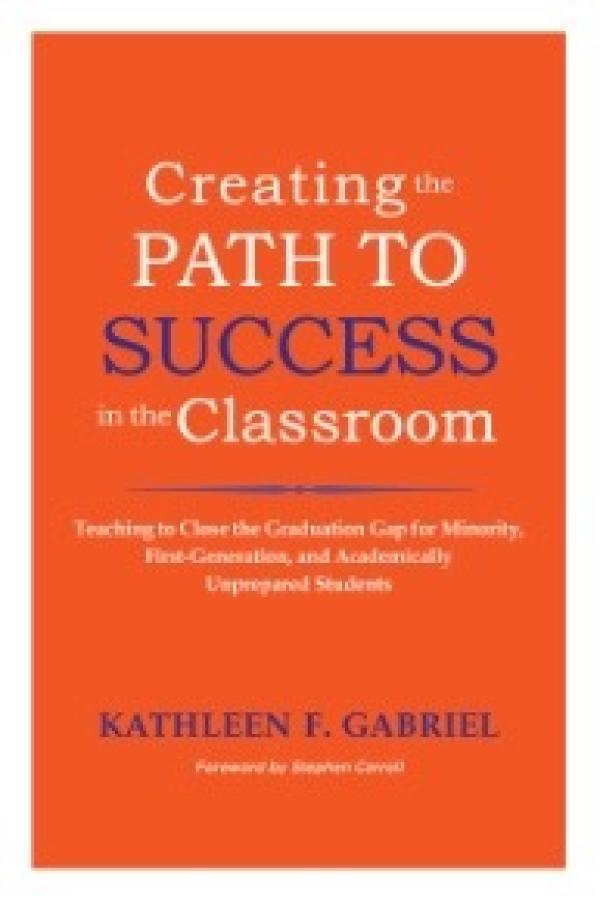
Kathleen Gabriel’s Creating the Path to Success in the Classroom is a clear, engaging, and practical book that will be of use to anyone teaching in a university or community-college classroom. In his forward to the book, Stephen Caroll praises Gabriel’s “deep integration of theory and practice” (xiii). This integration is one of the book’s major strengths. Gabriel introduces the reader to scholarship on barriers to student learning, student mindsets, and effective pedagogy. Extensively referenced and cited, Gabriel’s book is thus a primer on classic and more recent scholarship of teaching and learning. After describing this scholarship, Gabriel then offers practical suggestions of classroom strategies designed to engage students effectively given the data. These range from one-time strategies – reading a particular article on growth mindsets as a class, doing an active-learning activity – to strategies that unfold over the course of an entire semester. Gabriel offers concrete scripts for welcoming students and setting a classroom tone, giving student feedback that encourages persistence and growth, creating and shuffling small groups, and much more. Gabriel not only suggests what to do and why, but also encourages faculty to make those reasons explicit to students, making students intentional partners in their own learning. Gabriel explores strategies for creating a positive classroom climate during the first days of class, engaging students during the first month of the semester, growth mindsets and mental toughness, creating interactive lectures, motivating students to read, think about, and discuss course readings, integrating critical thinking and writing into class activities and assignments, and developing student resilience and persistence. In four appendices, Gabriel offers even more practical suggestions. For example, in her chapter on classroom climate, Gabriel notes that “one way that professors can increase their own cultural competence is to read both nonfiction and fiction material that addresses multicultural issues” (20). Gabriel then directs the reader to Appendix A, a list of nonfiction and fiction readings by authors of color that helped her expand her own “cultural competence and awareness” (131). Gabriel is gentle in encouraging faculty to teach minority, first-generation, and academically unprepared students more effectively, suggesting incremental steps that faculty can take as they become more comfortable with new pedagogical strategies. She insists throughout that inclusive pedagogy not come at the expense of a rigorous academic standards: “We can design our assignments in a way that holds students to high standards, but, at the same time, we can give all our students encouragement, support, and resources so that they have ample opportunity to achieve those standards” (111). Creating the Path to Success in the Classroom will be helpful to teaching veterans and novices alike. In her opening chapter, Gabriel frames the book as designed to help faculty effectively teach and retain minority, first-generation, and academically unprepared students. As is the case with many implementations of universal design principles, however, these strategies ultimately improve student engagement and learning for all students.

Mary Ann Beavis and Hyeran Kim-Cragg, a biblical scholar and a practical theologian, respectively, address a number of topics that are engaged by people outside of the contours of usual religious contexts; those who tacitly or consciously engage with scriptural and religious themes. It is this audience that the authors seem in particular to target: the everyday person whose religious viewpoints are influenced by media and popular culture, without their realizing the underlying misconceptions borne of poor theologies, or uncritical appropriation of traditions with little or no basis either on sound doctrine or biblical knowledge. In juxtaposing biblical themes such as creation and apocalypse, sin and salvation, Moses and Jesus, Jews and Christians, God and Satan, Christ and Antichrist, gender and God, purity and sex, and suffering and sacrifice, in a creative dialogue with cinematic culture, the authors seek to dispel many of these aforementioned misconceptions. Beavis and Kim-Cragg have succeeded in making scholarly information accessible, taking pains to define technical terms – whether Hebrew, Greek, or theological jargon – that would otherwise be foreign to nonexperts. They provide solid exegetical and theological analysis of the themes they have chosen. Readers and teachers will find the creative way in which they use movies from a wide array of genres to further their discussion helpful. “Before viewing” and “after viewing” questions allow one to link their cinematic selections with the theological theme under discussion. This is especially helpful since, for the most part, the authors did not choose religious movies; it is, after all, an engagement with popular culture, not religious media. As a professor of constructive theology, I especially appreciate the discussion of salvation in chapter 2, subtly broadening its meaning by disconnecting it from the notion of sin and at least implicitly relating it to the Reign of God, and their discussion of eschatology in chapter 5, rightly linking it with relationship. Another discussion which I found to be of importance in this time of intolerance and rising tides of anti-Semitic, anti-Muslim, and nativistic impulses, was their discussion on Jews and Christians (chapter 4). While their assertation that “Jesus was a Jew” might seem simplistic, I can attest to the fact that such a statement can be a surprise to some beginning seminary students. Beavis and Kim-Cragg honestly tackle texts in Second Testament that have been interpreted as “anti-Jewish” as well as the history of anti-Semitic interpretations in Christian theology. It is their conclusion that in spite of this persistent prejudice, we stand well to remember that “God blesses all” (62). For teachers in the areas of practical theology, this book can be used in courses that integrate biblical studies with Christian education, theology, or preaching. The authors’ approach to theological themes can prove helpful to beginning seminary students who come with popular misconceptions, only to become disconcerted by learning in the classroom what they believe to be contradictions of faith. The book’s methodology of integrating theological content with media is insightful and consonant with the contemporary world in which our students live and practice ministry. It is particularly useful as teachers become aware of the various learning styles of students and expands their arsenal of creative pedagogical practices. I would hope that this book invites teachers to consider the use of movies, music, photography, and online content such as TED talks in their classroom. This book is a good companion to such sources as Timothy B. Cargal’s, Hearing a Film, Seeing a Sermon, although the latter tends to focus more on homiletical and liturgical integration. I do have some questions. While I assume that the audience for this book is either a lay or church community, the authors themselves never clearly identify their audience: is this meant for a more evangelical or progressive church community, or was it directed primarily to an unchurched community? I would have found it helpful for the authors to have been more explicit about their audience. This leads to a second question: why their particular juxtaposition of selected themes? Was it influenced by context and audience? For example, why discuss God and gender, and not God and justice? Would the latter not have allowed the discussion to be broader than simply whether our God-talk is inclusive in terms of male or female images? At a time of imposition of heteronormativity, homophobia, and rising tide of violence against people of color, it could have led to larger questions about white privilege, and broader assumptions about gender could have been broached. Along those lines, could the discussion have been further enriched with the inclusion of more voices of color, both in the authors’ scholarly sources and in their movie choices? Could some of these very themes have been underscored with such movies as Hidden Stories, The Color Purple, Selma, Even the Rain, The Joy Luck Club, or others that showcase actors of color or LGBTQI persons? These questions, of course, do not detract from the overall importance and value of the book. This book, with its solid theological and biblical analyses, is an important resource particularly for those of us who continuously encounter groups or individuals in our churches, classrooms, and communities that espouse uninformed biblical and theological beliefs influenced by popular culture.

“I’m just so sick of feeling awkward,” I told my spouse the night before the first day of classes this semester. After having taught for eight years in another school across the country, I was about to begin teaching at a new institution. I was bemoaning the fact that everything was different at my new job, and I felt like a fish-out-of-water most of the time. My new colleagues were extremely warm, welcoming, and supportive. But I was still learning the ropes at my new institution. I had to ask questions about nearly everything: how to use the copy machine, if I could use the coffee maker at the end of the hall, how to navigate the learning management system, and who to go to on campus for what. I was also feeling unsure about the new age range of students I’d be teaching. I had been at a small graduate school, comprised of adult students (generally ages 40-70), and I was now at a medium-sized liberal arts institution, teaching mostly undergraduate students (typically 18-21 years old). I hadn’t taught undergraduate students since I had completed my PhD, over 9 years ago. When I was chatting about my nervousness with a friend, she consoled me by saying, “You’ll be fine. Just don’t dress frumpy!” So, when I was getting ready for work on the first day of classes, I went to my closet in search of my least frumpy ensemble. I donned a brightly colored geometric-print skirt and a pair of 3-inch heeled sandals in hopes that my students, over twenty years younger than me, might approve. My first two classes that day went well. I introduced them to the syllabus and assignments, but also sprinkled in some course content. I also tried to introduce them to my teaching style, by using music, 1-min journal writes, and a think-pair-share exercise. By the third class of the day, I was getting into the groove and feeling more confident, which means I began to walk around in the classroom. Then, right in the middle of class, when I was near the front of the room, I stumbled. I lost balance on my right foot—remember: I was wearing 3-inch sandals—and then tried to regain balance by putting all of my weight on my left foot. The next thing I knew, I was tripping around the front of the class and flailing my arms in big circular motions until I went crashing into the whiteboard behind me. The only saving grace was that my skirt remained in place. When I regained my composure and looked up, the 24 students in the room (nearly all of whom were first-years) were staring at me wide-eyed, their mouths gaping. One cried out, “Are you okay?!?!?” I managed to mumble a joke about them not expecting an acrobatics performance in a theology class, but it had no effect. No one laughed. They were, I’m guessing, still in shock. I had to keep talking and teaching, because what else could I do? After class (thankfully my last class for the day), I headed back to my office. I passed my new colleagues in the hall, and did what any self-respecting introvert would do: When they asked me how my first day went, I smiled and said, “Fine!” Then, I went into my office, closed the door, and posted about it on Facebook. The next day, I could laugh about it (and could also tell my new colleagues about it). I laughed about it with my students, which gave them permission to laugh about it too. And now that we are almost at the mid-term mark in the semester, I realize, like most awkward and humbling experiences, there’s a teaching and learning moment in this one too. Here’s what I learned: 1) Embrace the awkward; it may help in relating to students. Even before I fell, I was feeling awkward, but I’m guessing that many of my students were too. As first-year students, it was also their first day of class in a new institution too. Some students had to present me with sheets verifying their learning accommodation needs, which, based on societal stigmas, they might not have preferred to do. Others, I later learned, were first-generation college students and were wondering if they belonged on campus. And a few were single mothers, trying to balance a full course load with parenting and part-time jobs. When I stopped worrying about how I looked and felt, I could be more in tune with their needs. 2) Think about how to help first-year students succeed in a new learning environment. I had been learning the ropes in a new school, but so had they. Many had left home, family, friends, and partners, and they were living away from all of their most stable relationships. They were also learning to manage their time and new freedom. Realizing this, I decided I could do more than simply list on my syllabi the contact information for the Student Success Center. I set some time aside in the course schedule for supportive activities. For example, I had a representative from the Student Success Center come into class and talk about the services they offer; I asked a librarian to demonstrate the research database to them; I led workshops on how to avoid plagiarism, how to read critically, and how to write a theology paper. I also passed around informal evaluations after the first few weeks of class, and I learned that students were feeling nervous about disagreeing (even respectfully) with other students in small groups. So, I led another workshop on respectful, critical dialogue. 3) Be comfortable. I’m back to wearing flats and 1” heels, even if they are frumpy. But it’s not just my shoes that have to feel comfortable, I have learned. So does my teaching style. When I over-plan or am too calculated about what I want to do in any given class session, the delivery usually falls flat (pun fully intended). When I relax, loosen my grip on the lesson place, and let the feel of the room and the students’ questions and concerns guide the way I present the material, it usually works much better. The students are more engaged and take on a more active role in their learning. Have any of you had big embarrassments in the classroom? If so, I’d love to hear about them—not just to stroke my bruised ego, but to hear what you’ve learned from them too! Please comment below.

Actions of Their Own to Learn: Studies in Knowing, Acting, and Being is an edited volume of fourteen essays which explore the question of what it means to take actions of one’s own to learn. Taking action to learn happens within both formal and informal settings; it also happens during the process of building new knowledge as learners pose questions about the world and design new ways to collect and analyze information to answer those questions (4).The researchers argue that “a conception of what it means to learn must be framed as part of a larger process of building understanding that involves more than the mind” (4). In this constructivist worldview, learning “is a process in which learners are actively involved in the mental construction of ideas using prior knowledge and experiences as a foundation” (6). Building understanding (can) include participants working simultaneously as researchers, teachers, and learners (5). The book is divided into three sections: (1) the power and agency of the learner, (2) active learning with others to build knowledge and community, and (3) the environments that support active learning. In section one, through the use of a mutual learning process, researchers themselves take action to learn and understand the emerging values of the communities they study. For example, White uses autoethnography (and a carbon footprint calculator) to document changes needed to reduce her carbon footprint. She then uses her learning to design a curriculum to help her students take action to reduce their own carbon footprints. As a Provincial Parks educator, Den Hoed challenged “top-down, political, disciplined” educational processes by using Mezirow’s basic theory of transformative learning to “teach for change.” In so doing, he helps his students transform sets of fixed assumptions and expectations to be more “inclusive, discriminating, open, reflective, and emotionally able to change” (63, quoting Cranton [Understanding and Promoting Transformative Learning, 2006]). In section two, scholars who construct knowledge-building communities among disparate groups of learners (grade-school children, physics teachers, math students) have discovered that improvisational co-action, in which ideas “become taken up, built upon, developed, reworked, and elaborated upon by others,” enables shared understandings and learnings that are collectively determined: the class as a whole becomes “the body that learns” (138-140). Towers and Martin discover that improvisational learning, listening authentically to children’s ideas, and building trust helps both teachers and students evolve to see themselves as collaborators rather than competitors (12-13). Finally, section three describes environments that support active learning, including classrooms where students are in control of decisions about how scientific inquiries will proceed, and another, where people come together and create film and photographs (photovoice) to educate, build awareness, and encourage political action. These processes help students develop a deeper connection with course content (208). This book presents a variety of qualitative approaches (narrative, interviews, autoethnography, case study) to activist learning in multiple and variegated learning environments. The scholarship affirms teaching that is firmly student-centered, where teacherly authority is decentered, and power between students and teacher is shared throughout the life of the learning cycle.
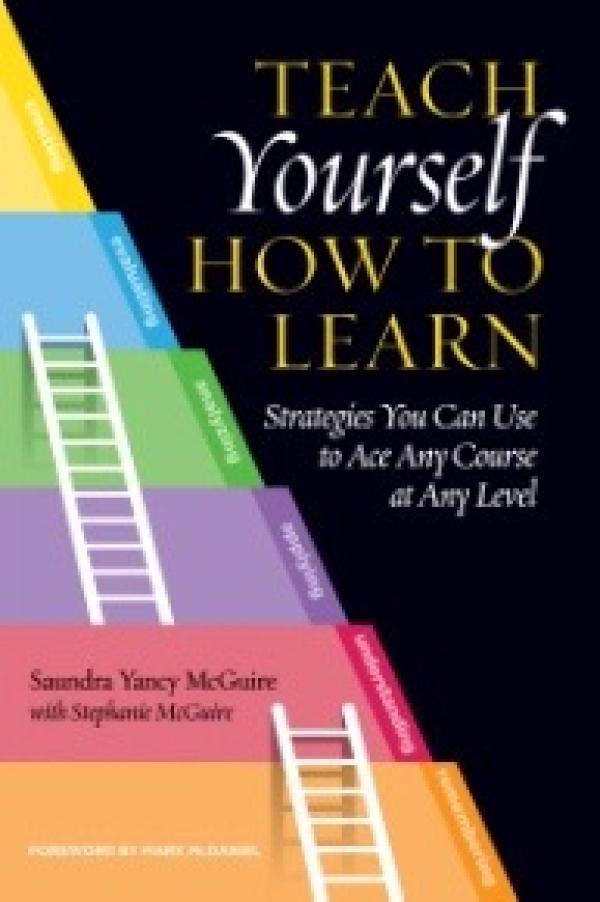
The word “magic” appears several times in this book for students on how to succeed in college and university courses. Co-authored by Saundra McGuire, director emerita of the nationally acclaimed Center for Academic Success at Louisiana State University, and her daughter Stephanie McGuire, the volume is laced with stories of seemingly “magical” immediate and dramatic improvement in student performance after the application of the learning strategies described here in ten short chapters. The metacognitive learning strategies described draw on Bloom’s taxonomy and the neuroscience of learning, such as the work of Mark McDaniel (Make It Stick, 2014). They include strategies on reading textbooks, taking notes in class, reviewing, doing homework assignments, time management, and studying for and writing tests and exams. A handy little learning strategies inventory in Appendix C allows students to “predict” their grades based on the strategies they use. More important than these specific learning strategies for this reviewer are the sections of the book devoted to fostering in students a growth mindset that challenges the deterministic view that intelligence is innate (“I’m just not good at math”), and encourages students instead to believe that they can succeed and motivates them emotionally to do the effective work necessary for success. Monitoring self-talk and attributing results to one’s actions rather than external factors are powerful mental tools for improvement. In order to succeed, however, students need more than just a belief that they can do it and a set of effective strategies; they also need to know as specifically as possible what is expected of them. This is where this book addresses not just students but also instructors. Instructors put obstacles in the way of student success by not clearly articulating their expectations (and by creating unsupportive and discouraging classroom experiences and course structures). The book includes a very helpful section in chapter seven on how students should read a course syllabus. Notably, if a syllabus does not seem to clearly lay out expectations, students are encouraged to meet with the instructor for clarification. In fact, one of the strategies is to make regular use of instructor office hours. The book promises that if students use these strategies they can “ace” any course. Will students be disappointed? While the results may be magical, the method is not – hard work using effective strategies is required. Even reading the book may be a stretch for some students, although it is short and largely written in a very accessible style. It will also likely profit students in sciences and technology, where memorization is important, more than those in the humanities, such as religion and theology majors. The book does very little to address strategies for successful research and writing of papers, for instance, and the anecdotes of student success are drawn overwhelmingly from the sciences. However, much can be gained from this book by both students and instructors in all fields. My biggest take-away is the author’s insistence, “Now hear this: All students are capable of excelling” (65). This book shows how.

When you teach online, you get accustomed to classroom teachers telling you they can’t imagine not being in the same place at the same time as their students. Usually what they dwell on is not being in the same place. They profess difficulty imagining being geographically distant from their students. They question how it’s possible to teach without the body language, visual cues, tone of voice, and the like, that the physical proximity of being together in a classroom affords. Perhaps because I came to online teaching from a background in field education where, by definition, my students left campus to go somewhere else to learn, and in denominational leadership, where leading phone conferences with participants scattered across the country was the norm, I was not overly daunted by the prospect of communicating with people in other places. What I knew would be challenging is the lag in time. I had always relied on the immediacy of classroom teaching. There are some people whose thoughts come out of their mouths perfectly formed into sentences whose meaning is crystal clear. I am not one of them. I tend to economize too much with my words, or make leaps of logic in my head, or have to backtrack to fill in context. When people are taking in what I’m saying at the same time as I’m saying it, however, I can compensate. I am pretty good at quickly sensing what I need to clarify. I am most comfortable when teaching is like a dance and I can use my partner’s responses in real time to make it work. When you teach online, the song can be over by the time you realize that your students never got into the rhythm and have danced a different dance. The hallmark of asynchronous online education is that students are working at different times throughout the week, entering and exiting the class at their own pace and paying you attention on their own time. Their engagement with you and with the material may be just as high as in a classroom, but its timing will be unpredictable. You simply cannot know when a comment or explanation from you will finally reach them. And students experience the same thing, of course, from you. Unless you are willing to log in to the course every hour of every day, their question or confusion might not get addressed right away. Sometimes what happens while you are gone, therefore, is that a misguided thread of discussion can take on a life of its own, a set of odd assumptions can be built up about the reading, or simple errors in the assignment compounded. What I have learned about communication in online teaching—to switch to a different metaphor—is that it bears similarity to letter writing. You write down your thoughts, hit Send and put them into cyberspace, and hope they reach your reader in good time. Then you wait to know whether your words made enough sense and what your correspondent thinks of them. If the correspondence is important, sometimes you find yourself anxiously going to your mailbox over and over again to see whether anything has been delivered back to you yet in the post. The comparison between online education and letter writing is ironic to say the least. Usually we think that technology serves to speed everything up in our lives. But it is instructive as well. In the old days of letter writing, we used to take care with what we wrote, and there were conventions that helped us convey meaning. Usually we started with a few references to our correspondent’s most recent missive to us, commenting on their news. Then we would hit the highlights of our own, sharing some content and then reflecting on it. We often concluded with questions for the other to answer the next time they wrote, in part to encourage a swift reply. In online teaching I have learned to take almost excruciating care to frontload what I am trying to teach and to explain ideas and instructions in detail. I try to learn who is in class before it starts so that I can scaffold my teaching upon their experience. I communicate the most important ideas of the course as clearly as I can and follow with some pointed questions to invite them into the discourse. And then I wait and let time do its work.