Resources
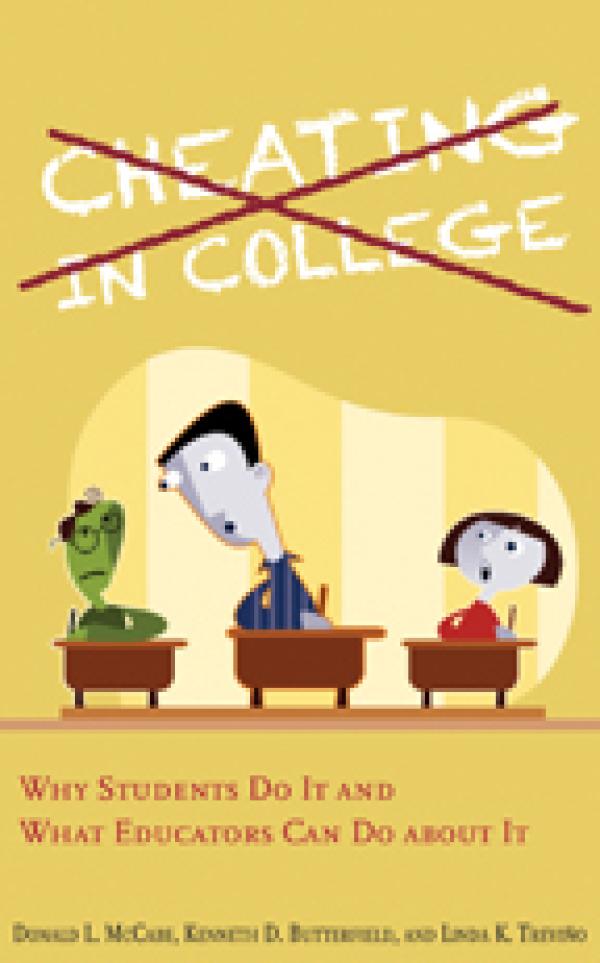
Today's students are tomorrow's leaders, and the college years are a critical period for their development of ethical standards. Cheating in College explores how and why students cheat and what policies, practices, and participation may be useful in promoting academic integrity and reducing cheating. The authors investigate trends over time, including internet-based cheating. They consider personal and situational explanations, such as the culture of groups in which dishonesty is more common (such as business majors) and social settings that support cheating (such as fraternities and sororities). Faculty and administrators are increasing their efforts to promote academic honesty among students. Orientation and training sessions, information on college and university websites, student handbooks that describe codes of conduct, honor codes, and course syllabi all define cheating and establish the consequences. Based on the authors' multiyear, multisite surveys, Cheating in College quantifies and analyzes student cheating to demonstrate why academic integrity is important and to describe the cultural efforts that are effective in restoring it. (From the Publisher)
The first edition of Assessing Student Learning has become the standard reference for college faculty and administrators who are charged with the task of assessing student learning within their institutions. The second edition of this landmark book offers the same practical guidance and is designed to meet ever-increasing demands for improvement and accountability. This edition includes expanded coverage of vital assessment topics such as promoting an assessment culture, characteristics of good assessment, audiences for assessment, organizing and coordinating assessment, assessing attitudes and values, setting benchmarks and standards, and using results to inform and improve teaching, learning, planning, and decision making. (From the Publisher)
The Common Core State Standards clearly define the skills students need for success in college and the 21st century workplace. The question is, how can you measure student mastery of skills like creativity, problem solving, and use of technology? Laura Greenstein demonstrates how teachers can teach and assess 21st century skills using authentic learning experiences and rigorous, varied assessment strategies. Based on the best ideas of renowned experts in education, this book provides a framework and practical ideas for measuring • Thinking skills: critical thinking, problem solving, creativity, and metacognition • Actions: communication, collaboration, digital and technological literacy • Living skills: citizenship, global understanding, leadership, college and career readiness Included are numerous rubrics and checklists, a step-by-step model for developing your own classroom assessments, a lesson planning template, and sample completed lesson plans. Assessing 21st Century Skills gives you the tools and strategies you need to prepare students to succeed in a rapidly changing world. (From the Publisher)
This book sets out to help teachers gain a practical understanding of response to student writing---essentially, by examining sample comments by knowledgeable teachers. It displays and analyzes over 30 sets of comments from a variety of settings, by a variety of teachers, all of them informed by composition studies. It defines the strategies these teachers put into practice. And it situates teacher repines in the larger context of writing instruction. (From the Publisher)
This article employs George Lakoff and Mark Johnson's work on metaphor (1980) to examine the current use of the term “learning outcomes” within higher education. It argues that “learning outcomes” is an ontological metaphor (education becomes focused on results that one can understand and measure) that resonates with contemporary academic capitalism. Yet because metaphors highlight some things and conceal others, thinking about teaching and disciplines using “learning outcomes” hides other dimensions of academic capitalism and obscures unquantifiable and highly complex aspects of education. Finally, the article explores ways in which an emphasis upon outcomes has consequences for the field of Religious Studies.
Synthesizing the best current thinking about learning, course design, and promoting student achievement, this is a guide to developing college instruction that has clear purpose, is well integrated into the curriculum, and improves student learning in predictable and measurable ways. The process involves developing a transparent course blueprint, focused on a limited number of key concepts and ideas, related tasks, and corresponding performance criteria; as well as on frequent practice opportunities, and early identification of potential learning barriers. Idea-based Learning takes as its point of departure the big conceptual ideas of a discipline that give structure and unity to a course and even to the curriculum, as opposed to a focus on content that can lead to teaching sequences of loosely-related topics; and aligns with notions of student-centered and outcomes-based learning environments. Adopting a backwards design model, it begins with three parallel processes: first, identifying the material that is crucial for conceptual understanding; second, articulating a clear rationale for how to choose learning outcomes based on student needs and intellectual readiness; and finally, aligning the learning outcomes with the instructional requirements of the authentic performance tasks. The resulting syllabi ensure cohesion between sections of the same course as well as between courses within a whole curriculum, assuring the progressive development of students’ skills and knowledge. Key elements of IBL include: * Helping students see the big picture * Building courses around one or more authentic performance tasks that illuminate the core concepts of the discipline * Clearly identifying performance criteria for all tasks * Incorporating practice in the competencies that are deemed important for students’ success * By placing the onus of learning on the student, liberating faculty to take on the role of learning coaches * Designing tasks that help students unlearn simplistic ideas and replace them with improved understandings Edmund Hansen expertly guides the reader through the steps of the process, providing examples along the way, and concluding with a sample course design document and syllabus that illustrate the principles he propounds. (From the Publisher)
How can the average educator who teaches online, without experience in evaluating emerging technologies, build on what is successful and modify what is not? Written for educators who feel ill-prepared when required to evaluate e-learning initiatives, Evaluating e-Learning offers step-by-step guidance for conducting an evaluation plan of e-learning technologies. It builds on and adapts familiar research methodology to offer a robust and accessible approach to effectively evaluate a range of innovative initiatives, including those covered in other books in the connecting with e-learning series. This useful guide offers a multi-level approach that allows both beginners and experienced professionals to follow the level of text that suits their current needs. Practical applications discussed include: • how to develop broad evaluation questions • how to use an evaluation framework • how to determine the sources of data to be used • how to develop an evaluation matrix • how to collect, analyze and interpret the data. Readers will find this jargon-free guide is a must-have resource that provides the proper tools for evaluating their own e-learning practices with ease. (From the Publisher)
"This guide is primarily for the Master of Divinity degree program ... and the M.Div. concentrations"--P. 1.
One page Teaching Tactic: building review into a lecture.
This book provides a provocative look at the issues and controversies surrounding grade inflation, and, more generally, grading practices in American higher education. The contributors confront the issues from a number of different disciplines and varying points of view. Topics explored include empirical evidence for and against the claim that there is a general upward trend in grading, whether grade inflation (if it exists) is a problem, which ethical considerations are relevant to grading, and whether heavy reliance on anonymous student evaluations of teaching excellence has a distorting effect on grading practices. Finally, the contributors offer contrasting perspectives on the prospects for reform. "As state and federal agencies begin to talk about accountability for universities, the topic of grade inflation could become even more politicized. This timely book addresses a topic of significant public interest and does it well. The fact that the contributors disagree, take different approaches, and address different aspects of grade inflation is a virtue." - Kenneth A. Strike, author of Ethical Leadership in Schools: Creating Community in an Environment of Accountability "This book encourages academic communities to engage in constructive debate over their professional responsibilities as evaluators of student academic work. Its greatest strength is that it presents disparate perspectives on the complex topics of grading and grade inflation. The contributors are in a real sense engaged in a discussion on the subject, which makes the book refreshing and intellectually stimulating." - Matthew Hartley, University of Pennsylvania Contributors include CliffordAdelman, David T. Beito, Mary Biggs, Harry Brighouse, Lester H. Hunt, Richard Kamber, Alfie Kohn, Charles W. Nuckolls, Francis K. Schrag, and John D. Wiley. (From the Publisher)