Home » Resources » Scholarship on Teaching » Cheating in College: Why Students Do It and What Educators Can Do about It
Scholarship
March 29, 2017
Cheating in College: Why Students Do It and What Educators Can Do about It
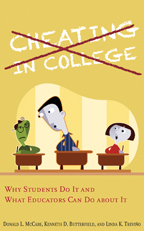
- Author
- McCabe, Donald L., Butterfield, Kenneth D., and Trevino, Linda K.
- Publisher
- Johns Hopkins University Press, Baltimore, MD
- ISBN
- 9781421407166
- Table of Contents
-
ch. 1 A Journey and a Commitment to Action
ch. 2 Where to Begin: Academic Dishonesty among High School Students
ch. 3 Prevalence, Types, and Methods of Cheating in College
ch. 4 Individual Student Characteristics That Influence Cheating
ch. 5 Institutional Factors That Influence Academic Integrity: The Role of Honor Codes
ch. 6 Institutional Factors That Influence Academic Integrity: Other Contextual Influences
ch. 7 The Faculty Role in Creating a Strong Environment of Academic Integrity
ch. 8 Academic Integrity in Business and Professional Schools
ch. 9 Creating a Culture of Integrity: Practical Advice for Faculty and Administrators
References
Index
Today's students are tomorrow's leaders, and the college years are a critical period for their development of ethical standards. Cheating in College explores how and why students cheat and what policies, practices, and participation may be useful in promoting academic integrity and reducing cheating.
The authors investigate trends over time, including internet-based cheating. They consider personal and situational explanations, such as the culture of groups in which dishonesty is more common (such as business majors) and social settings that support cheating (such as fraternities and sororities).
Faculty and administrators are increasing their efforts to promote academic honesty among students. Orientation and training sessions, information on college and university websites, student handbooks that describe codes of conduct, honor codes, and course syllabi all define cheating and establish the consequences.
Based on the authors' multiyear, multisite surveys, Cheating in College quantifies and analyzes student cheating to demonstrate why academic integrity is important and to describe the cultural efforts that are effective in restoring it. (From the Publisher)
The authors investigate trends over time, including internet-based cheating. They consider personal and situational explanations, such as the culture of groups in which dishonesty is more common (such as business majors) and social settings that support cheating (such as fraternities and sororities).
Faculty and administrators are increasing their efforts to promote academic honesty among students. Orientation and training sessions, information on college and university websites, student handbooks that describe codes of conduct, honor codes, and course syllabi all define cheating and establish the consequences.
Based on the authors' multiyear, multisite surveys, Cheating in College quantifies and analyzes student cheating to demonstrate why academic integrity is important and to describe the cultural efforts that are effective in restoring it. (From the Publisher)