Resources
Interview with L. Lee Knefelkamp, a professor of psychology and education at Columbia University. Stresses the diversity of higher education learners, including adult learners. Emphasizes the notion of faculty as co-learners with students. Notes the importance of the work of K. Patricia Cross regarding adult learners.
Blog post at Faculty Focus. Highlights five elements to create a better learning environment for adult learners: treat them as adults; be aware of skills gap; consider technology gap; be efficient; and be creative.
Two-page PDF from the College of Education at the University of Texas at Austin. Provides brief tips on adult learning in three categories: motivation to learn; curriculum design; and learning environment.
Extensive workbook reviews differences in adult and child learners and discusses adult learning styles. Offers strategies on presentation, facilitation, course design, and course evaluation. Includes sample materials in appendices.
Provides biographical information on Malcolm Knowles, one of the pioneers in teaching adult learners. Discusses his contributions to adult learning theory and highlights desired adult learning outcomes. Outlines key differences in teaching adult learners and child learners.
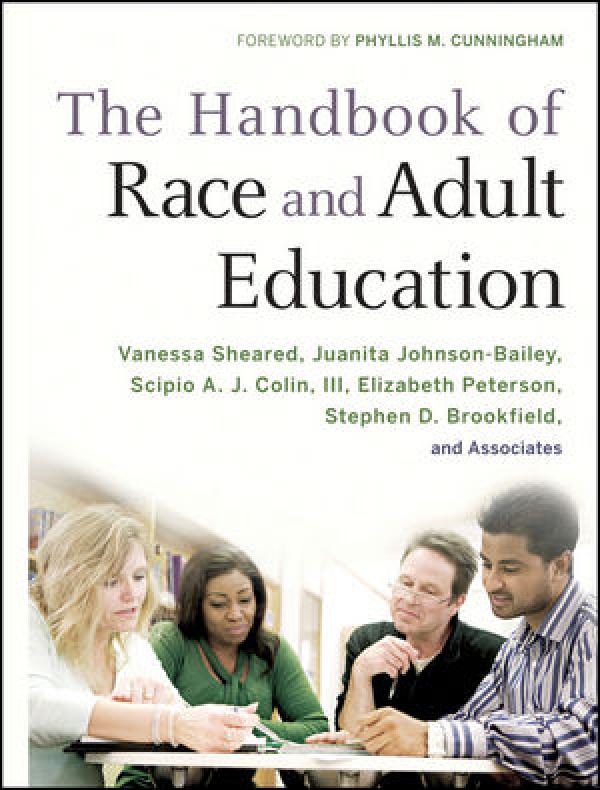
The Handbook of Race and Adult Education provides a discourse on the theory, the real-life experiences, and the structure of privileges within race and racism. Edited by leaders in this field, the unique resource presents ways for changes in classrooms, communities, and homes for marginalized or oppressed groups and individuals. As the first comprehensive resource on race, racism, and adult education, this book is essential for introductory level graduate students in understanding the complexity of race and racism in an educational context. (From the Publisher)
Click Here for Book Review Abstract: Solidly grounded in theory and research, but concise and practice-oriented, Adult Learning: Linking Theory and Practice is perfect for master’s-level students and practitioners alike. Sharan Merriam and Laura Bierema have infused each chapter with practical applications for instruction which will help readers personally relate to the material. The contents covers: Adult Learning in Today’s World Traditional Learning Theories Andragogy Self-Directed Learning Transformative Learning Experience and Learning Body and Spirit in Learning Motivation and Learning The Brain and Cognitive Functioning Adult Learning in the Digital Age Critical Thinking and Critical Perspectives Culture and Context Discussion questions and activities for reflection are included at the end of each chapter. (From the Publisher)
Extensive discussion of how to promote effective online learning, and the design challenges for adult learners. Lots of bibliography.
Reviews the literature on characteristics of adult learners and implications for teaching. Idea Paper no. 29, from the series developed by the Center for Faculty Evaluation and Development, Kansas State University.
This book is written at a time when our own field of adult education is under assault from a variety of capitalist and neoconservative forces pressuring us... to turn away from the causes of criticality, lifelong learning, and education for freedom. Rather than succumb to these pressures, we have hope that our long term goals of education for life and living can and will be accomplished alongside professional and vocational education. This book offers new insight into what is a very dark moment of our human civilization. From the preface by Dr Carlos Alberto Torres, Professor, GSEIS, Director, Paulo Freire Institute, University of California at Los Angeles The book offers decidedly critical and international perspectives on various aspects of adult education, especially on state, citizenship and neoliberal policies. Critical in both content and method, it is at the same time the part of the collective work needed to advance the Belém call to action by furthering awareness and capacity in the field of adult education. Dr Katarina Popovic, Professor,Universität Duisburg-Essen, University of Belgrade & DBB International, In the midst of diminishing resources and growing inequalities, English and Mayo provide an incisive and much needed critique of adult education in ways that highlight not only its historical and philosophical roots but also its major significance to the practice of democracy. In a direct challenge to the neoliberal accountability craze, Learning with Adults offers a rigorous political reading of the field—one that systematically challenges oppressive educational policies and practices, while affirming an emancipatory vision of civic engagement. Truly an informative treatise that sheds new light on the education of adults. Dr Antonia Darder Professor & Leavey Presidential Endowed Chair in Education Loyola Marymount University Los Angeles Leona English and Peter Mayo challenge hegemonic assumptions and ideas, while offering a constructive alternative based on the principle of working with learners and not just for them. Their analysis is accessible enough for newcomers to the field, while the authors’ wide-ranging coverage and radical approach provide refreshing and challenging messages for the most experienced adult educator. Up-to-date, genuinely international and passionately committed, Learning with Adults is a great book. (From the Publisher)