Resources
At some point in one’s teaching career, perhaps every teacher is confronted by disruptive behavior from a student that interferes with the processes of teaching and learning. Many faculty are challenged daily by common disruptive behaviors ranging from using social media during class to acts of physical and psychological aggression. On occasion, faculty find themselves afraid of a student, yet rarely do teachers receive training for these situations. Many assume a “do-it-yourself” mentality, believing it to be one’s sole responsibility to handle what happens within the classroom. At most, faculty may discuss it with departmental colleagues, but often fail to report disruptive student behaviors to appropriate university officials. It is precisely this approach that Brunt and Lewis discourage in A Faculty Guide to Addressing Disruptive and Dangerous Behavior. They encourage faculty at community colleges, technical schools, and four-year colleges and universities to expand their categories of what constitutes disruptive and potentially dangerous student behavior, to manage such behavior with both sensitivity and firmness, and to learn when and how to make use of institutional resources for dealing with student conduct problems. The book is immensely practical, drawing upon the authors’ expertise as a university counseling center director and a higher education risk management professional. The issues and techniques discussed in each chapter are illuminated by case studies contributed by faculty and administrators from a wide array of institutions. Each chapter also includes discussion questions that could guide important faculty dialogue around these issues. In part one, Brunt and Lewis operationalize dangerous and disruptive behaviors, teaching faculty how to identify signs of potentially dangerous behaviors and to conduct threat assessments. The authors challenge professors’ tendencies to dismiss, ignore, or take an overly punitive approach to disruptive behavior. Yet they also recognize that contextual factors shape whether a situation is viewed as a crisis and what strategies will be effective. They introduce terms and university resources that ought to be familiar to all faculty, but probably are not. How many teachers know whether their institution has a Behavioral Intervention Team, Risk Assessment Team, Student Conduct Office, or equivalent? More importantly, do faculty know when and how to contact them? Part two focuses on student populations who present a particular challenge. This is the least informative section of the book, as the material on each population is sparse, usually two pages or less. Further, the authors’ approach is confusing. In some cases they identify nontraditional student populations with physical and mental health problems, generational characteristics, or life circumstances that may impede their academic progress and thus predispose them to acting out in frustration: military veterans, international students, millennial and older students, and distance learning students. In other cases, however, they problematize groups whom they describe as likely to be victims of discrimination: African Americans and GLBTQ students. For example, their explanation of the micro-aggressions that African Americans may experience on campuses is commendable, but they regrettably frame the problem as being occasioned by the presence of African American students rather than by the cultural myopia of White students. In part three, Brunt and Lewis advise faculty not to “reinvent the wheel” but rather to take advantage of campus resources for assisting students. They begin with a helpful description of FERPA, HIPAA, and Title IX regulations, clearly outlining the limits of and exemptions to privacy laws that faculty often perceive as obstacles to discussing student issues with colleagues. They then discuss the various resources available to faculty and how to make use of them. In part four, they review ten “core concepts,” that is, characteristics and skills that will assist faculty in managing their classrooms, reducing the likelihood of dangerous and disruptive behavior, and handling it effectively when it occurs. I highly recommend this book for postsecondary faculty. This is a book that needs to be read, but also needs to be discussed with colleagues. Many faculty will find similarities between the scenarios described in the case studies and issues confronted in their teaching experience. As a licensed psychologist, I have usually felt confident in my capacity to address most student issues, but reading this text helped me to recognize occasions when I may have missed clear student distress signals. It has prompted me to investigate the resources available on my own campus.
The “final vocabulary” is the network of meanings that our students bring into the classroom − that are true to them, and our job is to open that vocabulary to change. “All good teaching entails some kidnapping,” Edmundson writes; “there is a touch of malice involved . . . As well as some sorrow.” Mark Edmundson makes this remark in thinking about the teacher who introduced him to the intellectual life, Doug Meyers. Meyers sounds like most of us who love to teach: “strange, uncool,” “offbeat,” willing to be a little silly to make a point, and “counterintuitive” (181), as well as passionate about what we love, and, yes, a bit self-centered. Yet, Meyers’s gift as a teacher was to enter a high school classroom − in the same way that Wittgenstein entered elementary school classrooms − and, in his philosophy class, to probe, to adjust, to meet the students where they were, and to provoke. In Why Teach? Edmundson is well aware of what professors face in the “corporate city.” My university has never hosted monster trucks, as the University of Virginia did, but, like all colleges and universities, in its quest for the best students, highest awards, and so on, it is consumer driven. Sounding like Augustine of Hippo, Edmundson urges all of us − for this book is as much about being a student as being a teacher or being a student/teacher − to move within the corporate city to find the scholarly enclave, where one will be challenged. He asks us to stop thinking of teaching as “training and entertaining” (188). Edmundson is aware that teaching and learning is not the heart for most in the corporate city, but he urges us to make it so. Part of this is slowing students (and professors) down, turning students from their hyper fast-paced, technology-centered lives, powered by coffee, energy drinks, and endless choice − their desires always to be elsewhere (36) − towards something deeper. For Edmundson, whose father, a working-class man who had not had a college education and who urged Edmundson to follow his passions, education is to resist being the “intersections of many evaluative and potentially determining discourses” (59) and to seek to imagine and to interrogate whom we might become (63). This process − and Edmundson stresses process, with its necessary failures − is powered by finding our key interlocutors. For Edmundson, Freud (whose interlocutor is the Greek tragedians but, mostly, Shakespeare), Emerson, Plato, and others provide this role: “The best reason to read them is to see if they know you better than you know yourself. You may find your own suppressed and rejected thoughts following back to you with an ‘alienated majesty’” (61). As teachers, we should urge students − and ourselves − to face the challenges of those who do not agree with us and reason our ways through their power. We will find life thickened in this “soul making” (xiii) activity. Two things about this book are important for all teachers to know. First, our students are not dumb; they are overwhelmed by the desire for success: theirs, their parents’, and society’s emphasis on material wealth. Second, they are 9/11 babies, who live by carpe diem: avoiding closure, wanting endless choice (in terms of education: long drop-add periods, pass-fail options, and the ability to drop a class as late as possible with the “innocuous W” but also double and triple majors, with a minor or two thrown in), and always wanting to know everything and to be elsewhere. And, faced with this daunting configuration, they, ironically, avoid challenge. Edmundson begins his book with every professor’s worst day: the teaching evaluation day. He thinks about how these little exercises in “consumer expertise” (4), and good evaluations, unfortunately, often reflect how well we met the criteria of enjoyment (entertainment) and interest (consumption). This makes educational institutions like “northern outposts of Club Med” (26). To feed, therefore, the illusion of busyness and excellence, we may issue no challenges − in short, we may pander. To really try to educate this generation (and, I would add, to avoid the censure of their parents), to urge them to read, to which I will return, “to be influenced, to learn something new, to be thrown off . . . course and onto another, better way” (63) is risky. Edmundson demonstrates how he was thrown off and challenged by Meyers and by his experience of his own interlocutors. Homer, whom he uses to think about football and Lawrence Taylor, Plato, Emerson, William James, Malcolm X (whose book stressed Malcolm’s love for learning, oddly, was the book for a white, Irish Catholic working-class kid from Boston), William Blake, who had to deal with the corporate city in his own way because of his patron, and football, Ludacris, and Biggie Smalls all led Edmundson to and let him interrogate the life he lives. His endless curiosity reminds me of something Historian of Religions Charles H. Long once told me, that the intellectual is interested in everything. Edmundson urges us away from excellence, from always measuring and being in hierarchy, which our success-driven students have experienced in elementary and high school, to eloquence. If every subject, every major, is a language, and a student is adopting one, or more, of these languages as her own, she will “want to know how to speak it expertly” but also know its limitations: “how it fails to deal with those concerns for which it has no adequate words.” He continues, “You’ll be looking into the reach of every metaphor that every discipline offers, and you’ll be trying to see around their corners” (65). Edmundson shows us that teaching and learning and research and living are not separate. He makes a powerful case for a holistic and very human vision of the liberal arts: The quest at the center of a liberal arts education is not a luxury quest; it’s a necessity quest. If you do not undertake it, you risk leading a life of desperation − maybe quiet; maybe in time, very loud − and I am not exaggerating. For you risk trying to be someone other than who you are, which in the long run is killing. (59) What do the arguments of a professor of literature and theory have to do with those of us who teach religion? Edmundson cites Matthew Arnold’s recognition that underscores my area of Arts, Literature, and Religion: that if religion wanes, literature will be the site that holds meaning. But Edmundson knows that religion has not waned. He recognizes − comparing and contrasting the task of the University of Virginia, to develop the head, with the task of Jerry Falwell’s Liberty University, to develop the heart − that students do not divorce those. They are deeply concerned with the meaning of their lives; therefore, we cannot leave the heart (198) to Jerry Falwell. Students may put their experiences in a facile, non-interrogated way as “spirituality,” but, more often, they have deep commitments for which someone else has articulated the meaning. Edmundson recognizes that it is in religion that we most often encounter students’ “final vocabularies.” Edmundson reminds us that students bring these narratives into the classroom. They are “where our principles lie”; they are “the core” of being, and “the point beyond which mere analysis cannot go” (192). So, how do we go beyond them? We start with the head: reason and critical thinking. What religious studies and literature have in common, he suggests, is the love of books, of words. Both “attempt to teach one essential power, and they often do so with marked success”: reading (194). Through teaching students to read with care, we bring those “final vocabularies,” which really are only “for now” (193), into contact with other “final vocabularies,” not as a test or to create new hierarchies, but to generate critical reflection − to ignite what I call the moral imagination. Our aim in teaching students to read is not conversion. It is to move students to encounter with the “other”: to “encounter between the transcendental and the worldly” (198). Edmundson writes, “The objective is to help the students place their ultimate narratives in the foreground and render them susceptible to influence” (198). To get students to interrogate those held truths, Edmundson asks us to move beyond mere interpretation to meaning, asking the Platonic question: “Is it true?” (195). He is not asking us to deal in ultimate truths − the sense that we hold those is what encounter unsettles − but to teach so that our students interrogate the “live options” of a text − or for us, of another’s religious way of life (195). This sort of teaching does not replace religion, but teaches one to recognize that “a most pressing spiritual and intellectual task of the moment is to create a dialogue between religious and secular approaches to life” (197). Students may leave “with their religious convictions deepened,” but they are more “thoughtful believers than when they began” (197-198). We begin, therefore, in “secular dialogue” and move to what Edmondson calls “impersonation” or advocacy (201-202) for the text, in which we, the teachers, “offer an inspiring version of what is most vital in the author,” tempting our students into making the “past available to the uses of the present” (202). This lets us deal with the heart and spirit, not doing our students the “injustice” of leaving that to the Jerry Falwells of the world. I must say here that Edmundson does not dismiss what is new. He does not dismiss theory; he just asks readers to be wary of supplying “a standing set of terms to every text” (203). Theory, he suggests, reminds us of the power of books to persuade; that is why it is so careful of them. And he does not dismiss diversity and multiculturalism. He worries that we breaks boundaries too fast, “asking students to know others before they know themselves” (208) and supplying our students with just enough knowledge to be exploitative of the “other” in the global marketplace (208). Edmundson insists that the intellectual quest offers to our students the joy and passion we felt when we started out as students. This passion, he argues, is about the freedom of self-making in democracy, in articulating the self amid and in relation to the multiplicity of ways of being that we experience in the world. Using a metaphor familiar to those of us who teach religion, Edmundson speaks of maps. He argues that books can map or transform lives and that our students are in need of maps that both locate and challenge “their existing sense of the territory” (205), and that, with our carefully adversarial and joyful guidance, lead them into “self-aware self-revision” (207). I very much admire the courage and spirit of this book. Edmundson does not throw anything away: he, himself, is learning digital techniques for his classroom even as he insists on the “old-timey” practice of close reading. I hope that I have not made this book sound like a curmudgeonly defense of the “old days.” It is not. It is a beautifully written and often funny but careful reflection on what we gain by holding fast to and what we lose by abandoning the basics of a liberal arts education: reading, writing, fluency, and ongoing engagement in self- and world-reflection. There is an ongoing bass note that sounds through the book: Can you live it? That reminded me of a student in one of my religion and literature classes who told the class one day that he was trying to live out the ethos of each author as we read: “That D. H. Lawrence week,” he moaned, “was hell.” We all laughed, but learned something: that the trangressive, always-in-tension D. H. Lawrence, did not articulate as whole a vision of the good life as he thought he did. That student conquered what Edmundson calls “knowingness”: the sense that we know everything − or can find it on the web − and that we are in charge (181). He shows us a powerful way, one that continually reminds us of our useable past, to crack that tendency in ourselves and in our students. He speaks with the integrity of one willing to risk his own ultimate map all the time. This is a man, after all, who found one key interlocutor and intellectual companion in Malcolm X. Patricia O’Connell Killen always asks professors in workshops and colloquies two questions: “What is your passion?” and “When did you know you had asked a good question?” Killen’s second question points to what Edmundson is asking of us: not to dwell in certainty but to surrender to the joy of doubt and curiosity and to read, read, read. That path, perhaps, will lead us (back) to the answer for Killen’s second question, to our passions.
Best known for his Pedagogy of the Oppressed (New York, N.Y.: Herder, 1970), Paulo Freire (1921-1997) criticized a “banking model” of education − the deposit of knowledge possessed by the teacher into the vacant minds of students. Education should enable students to discover the knowledge they need to become free participants of their society, Freire argued, but the banking model reinforced subordination and acquiescence. Beginning in the 1950s in his native Brazil, before exile made him internationally important, Freire spent his career developing a vision of teaching as a dialogical encounter between teacher(s) and student(s): both have knowledge, and teachers cannot know what and how to teach their students for freedom unless they submit to be taught by the students, too. Freire reflected on this experience and vision at length in the first chapter of Pedagogy of Hope (New York, N.Y.: Continuum, 1993), and a nice feature of the present volume is the inclusion of that chapter as an epilogue. This volume corrects a distorted perception of Freire’s thought. Too often, Freire’s dialogic approach is taken in an anti-intellectualistic way to mean that the teacher has no particularly privileged knowledge to impart; consequently, the deep meaning of Freire’s pedagogy as a critical praxis by which students can appropriate the knowledge of privilege to liberate themselves is lost. This point is central to the introduction by Stanley Aronowitz, “Paulo Freire’s Pedagogy: Not Mainly a Teaching Method.” In addition, the prologue by Henry Giroux and the afterword by Peter McLaren provide orientation to the spirit and urgency of Freire’s work. McLaren puts well the necessity of a volume such as this by stating, “Without a careful reading of Freire’s intellectual roots, one can only witness the collision [between dreams of a better future and the supposed reality of the present situation] without understanding the systems of intelligibility that make such a collision inevitable and without understanding the possibilities of sublating such a collision in order to bring about alternative futures linked to the sustainability of the planet and humanity as a whole” (235-36). Thirteen writers contribute ten essays on thinkers, movements, and concepts crucial to Freire’s philosophy. They cover Hegel, Marx, Gramsci, Habermas, Buber, Fromm, Latin American liberation theology, praxis, conscientizaçao (“conscientization”), and oppression. With one serious exception, the authors manage to balance two important purposes: to introduce their subject in the subject’s own right for readers familiar with Freire but not with intellectual history, and to focus on illuminating in Freire’s work their subject’s influence. Some authors even carry out a valuable third task of criticizing and reconstructing Freire’s ideas so as to extend his thought. Especially noteworthy in this regard are Raymond Morrow in the Habermas chapter, and Sandy Grande, who, in the chapter on oppression, turns Freire’s idea to confront the dispossession of indigenous peoples. Although this is a useful volume, the significance of “historicity in praxis” could have been explicated more forthrightly to knit the entire collection together. Some unevenness means there is still room to improve on our appreciation of Freire’s thoughtworld. Still, this collection is an important contribution to scholarship and teaching practice.

Higher education is in a state of flux amidst a cache of challenges that might be cast as a new set of unanticipated three R’s: recruitment, retention, and reserves. As college administrators strategize for the future, the shifting demographics in traditionally student-rich areas and the overall decreased pool of potential students because of birth rate trends will make sustaining college operations increasingly difficult. The challenge is more acute for private colleges and universities, whose sticker price tends to be substantially more than those of public institutions. It is perhaps even more poignant for Catholic institutions of higher learning that educate students in a particular religious environment. No two Catholic schools are the same and most wrestle with what it means to be Catholic. Some institutions boldly proclaim strong Catholic identity while others loosely reference their Catholic tradition or grounding. The number of students, faculty, and administrators on campuses self-identifying as Catholic complemented by the frequency of Catholic activities and choice of campus speakers have tended to serve as the metric for determining “how Catholic” an institution is. The first measure is reasonable. Without a critical mass of Catholic students, a Catholic school risks losing its identity. What precise percentage of Catholic students is needed for an institution to call itself Catholic, however, remains unsettled, but the ongoing admission of non-Catholic students merely to sustain rolls cannot bode well for the future of Catholic schools. As an example of the second metric, Notre Dame in South Bend, Indiana, often recognized as “the” Catholic university in the United States, received a maelstrom of criticism when it invited President Barack Obama to give its 2009 commencement address. Its detractors believed engaging an individual who holds views contrary to the Catholic faith lessens the Catholicity of the school. In Education in a Catholic Perspective, Stephen J. McKinney from the University of Glasgow, U.K., and John Sullivan from Liverpool Hope University, U.K., recognize that the identity of Catholic schools is at stake. They state that “there is an increasing distance between Catholic education, in its many forms, and the rich intellectual heritage of the Catholic Church” (3). Rather than engaging in a polemic against post-modern neoliberal ideas that can threaten the preservation of Catholic identity, their text seeks to retrieve the philosophical and theological roots of Catholic education. The book is divided into five parts. In the first section, the “Introduction,” two chapters written by Stephen J. McKinney orient the reader to the overall thrust of the text. McKinney’s first describes “education” in the Western world and then moves onto to discussing “Catholic education” using post-Vatican II teachings of the Catholic Church. McKinney admits the ongoing challenges Catholic education faces as it moves forward amidst the steady barrage of criticisms including charges of proselytizing and of being elitist and anachronistic. His assessment is honest and builds on critical scholarship in this area. The second part, “Theological Foundations,” consists of three articles that shore up the religious supports of Catholic education. John Sullivan writes on the import of St. Augustine and Maurice Blondel to Christian education. Vivian Boland considers Thomas Aquinas’s contribution to Catholic education through his understanding of transcendental properties of truth, goodness, beauty, and integrity. Clare Watkins considers revelation, scripture, and truth vis-à-vis truth in its beauty and love in its tenderness as formidable underpinning for Catholic education. In Part III, “Theology and Education,” Stephen McKinney and Robert Hill propose Jesus as a Teacher and reading the gospel from new perspectives to inform learning and teaching. David Torevell writes on epiphany, worship, and the contemplative body in Catholic education suggesting inward silence and embodiment as a distinctive import from Catholic tradition for education. David Evans demonstrates that the intersection of faith and reason is the “route to wisdom” and a holistic appreciation of education. Clare Watkins examines the role of conscience formation in education and teachers’ critical responsibility in fostering that in their students as well as in their own search for God. The fourth part of the text considers “The Ecclesial and Social Dimension” of Catholic education. In the first two articles of this section, John Sullivan considers the tension between the individual and institution and then moves to discuss the Church and the World. Sullivan refrains from an “over and against” attitude of Catholic education towards society. Sullivan proposes a participative engagement model in service of the world for all involved in the project of Catholic education. Christine Forde concludes this section by considering “the troublesome concept of ‘gender’” and offering challenges from feminist theology. Forde’s work here can serve as a prelude to further discussion about other disquieting contemporary moral issues such as medical coverage, homosexuality, divorce and remarriage, and investment policies, to name a few. The concluding fifth part, “Mission into Practice,” considers how to make the proposals in the text a sustainable reality. Kevin Williams suggests the development of a “Catholic” curriculum that incorporates specific teaching and learning goals. William’s piece seems out of place with the rest of the rather conciliatory text, but perhaps further development of his work is needed to fully appreciate his suggestions. Finally, John Sullivan and Stephen McKinney explore practical implications of strengthening the internal core of Catholic education in an effort to make it a viable educational option for the future. As Catholic school leaders strive to understand their institution’s Catholic identity, they would be wise to reference this text. Students of philosophy and theology will also find this book of interest in relation to their respective fields of study. It could be useful for educational specialists seeking to understand Catholic education. The book provides a rich critical assessment of some of the major thinkers in the history of Catholic education and their import for today. It includes a resource-rich bibliography and a detailed index. Leaders concerned with the future of Catholic education have to pay sharp attention to the externals that challenge institutional growth. However, what McKinney and Sullivan have assembled here offers another no less important and, perhaps, even more critical investigation into how to chart the future of Catholic education in a more meaningful way.
The integration of technology into classroom instruction is an oft-mentioned topic in modern pedagogical discussions. This collection of essays enters into the fray very broadly, by postulating productive ways of integrating various technologies into a wide variety of educational settings, covering an incredibly diverse set of subjects. Despite the dizzying variety inherent to this collection, there are two primary areas in which this volume is helpful to those interested in teaching theology or religion: First, for individual instructors intent on enhancing student learning, this volumes offers an overview of technologies instructors are using successfully, as well as effective summaries of educational theory justifying their approach to technology integration. Second, for departments or department chairs interested in broadening the use of technology within their course offerings, this volume includes many essays discussing methods with which teachers can recognize relevant technologies and their usefulness in the classroom. Several important and foundational principles about the integration of technology into classroom instruction undergird each chapter. Most foundationally, integrating technology into the classroom for the sake of integrating technology is over and over again shown to be ineffective (see esp. 45-46). There is a pernicious assumption in many sectors that classrooms need technology to be effective. Several chapters in this volume offer a very important caution: Technology is a tool, which when used well can serve to help students engage in classroom content more readily and thereby to learn more effectively, but the mere use of any technology does not ensure student engagement or learning. Two other theoretical sections are of note: A helpful overview of several learning theories is provided (informal and incidental learning, relational mentoring, and situated learning) which provides a helpful framework for the integration of technology into a classroom (233-236). Chapter 15 also offers an interesting survey of TPACK (technological, pedagogical, and content knowledge) research-based course design. Though this particular chapter relates this theoretical model to math education, the model has many important implications for theological and religious education. In addition to theoretical contributions, several specific technological tools are discussed with a view to their productive use in the classroom. A few technologies deserve specific mention here: Anonymous student polling either through clickers or Poll Everywhere is offered as an effective tool to enhance student discussion (46-51). Productive use of social media in a classroom setting is discussed (8-11 and 217-228), and its implications for privacy are covered in chapter 16. The role of games in learning is also considered (11-14 and 178-191). The specific games discussed in this volume are not really relevant to theological education; however, readers may be able to draw connections between the book and the Reacting to the Past (RTTP) group. RTTP has a few games dealing with theological or religious material (see RTTP). Several articles are focused on training instructors to use technology effectively while engaged with teaching. The authors contend that successful integration of technology into educational institutions requires first, the establishment of a culture of innovation, then the modeling of effective technological use by administrators and supervisors, and finally continuing support for instructors seeking to integrate technology into their classroom through both ongoing technological education and mentoring. In sum, Keengwe’s Research Perspectives is an all too broad entry into this complicated but important topic. It offers a good, but brief, survey of the theoretical foundation for technological integration, but the specific technologies mentioned, and the training models presented, seem like a preliminary attempt at integration rather than a proscriptive model to be adapted immediately in any classroom.
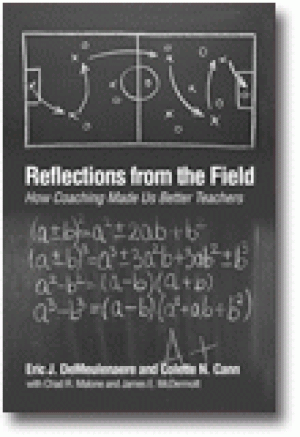
Who looks to middle or high school athletic coaches for innovations in pedagogy? Our stereotype of the coach in the classroom is of someone in a polo shirt with a whistle on a lanyard, teaching health class or low-tracked sections of history. In Reflections from the Field: How Coaching Made Us Better Teachers, Eric J. DeMeulenaere and Colette N. Cann, along with Chad R. Malone and James E. McDermott, undermine this image and offer glimpses of master coach-educators who are adept at discerning the unique needs of a team or class of students and crafting a coaching/teaching style that fosters not only athletic success and acquisition of knowledge, but also growth in students’ interpersonal skills and sense of their own potential. At the heart of the book are essays by each of the four named above, recounting how the narrators addressed difficult coaching situations and then applied what they had learned on the court or field to transform their classroom pedagogy. After each coaching essay, DeMeulenaere and Cann analyze the team and classroom dynamics in light of educational theory. They also supply an introduction and two chapters of concluding analysis and reflection. The athletes/students in question were all “at risk” or otherwise unpromising. McDermott’s principal had called one of his baseball players the “worst piece of ____[expletive deleted]” the principal had ever seen. Malone agreed to coach the Highland Park Lady Cougars basketball team after they had lost a game 90-6. Cann coached a volleyball team with no height, no strength, and no stars. And DeMeulenaere took on a fledgling girls’ soccer team whose members were more concerned about the boys watching practice from the bleachers than about training to win. The brilliant strategies crafted by each of these coaches go beyond inspirational speeches. McDermott persuaded his athletes to stop using foul language by making himself the “designated swearer”: when a player felt a need to cuss, he would raise his hand (one finger for English and two for Spanish) and McDermott would oblige, shouting at practice but speaking into his hand during actual games (13). This use of a humorous method to encourage professional demeanor complemented other techniques McDermott employed to convince players that they could be serious athletes -- and, in McDermott’s English classroom, serious students. But to use the word “techniques” to refer to what McDermott and the other three coaches did suggests a bag of pedagogical tricks. What the narrators offer are not miscellaneous tips or even best practices, but testimonies about how acting as servant-leaders on practice and playing fields and in the classroom transformed all involved. Teaching, for these coach-educators, is never paint-by-numbers, but requires capacity to read the situation, listen to those being coached or taught, and innovate in courageous ways. Although the word does not figure prominently in their narratives, coaching and teaching in this vein require extraordinary love. Reflections from the Field is relevant for theological educators. Despite the seeming disjuncture between the contexts described in this book and those of a religion classroom or theological seminary, readers will find analogies. They will also be prompted to think about ways that students -- and faculties -- could be strengthened by higher emphasis on collaboration and mutual support (the “team” aspect). Finally, the book will renew conviction that great teaching matters, and renew inspiration that it is more than worth all that it costs.

Roger S. Nam In my last post, I advocated for open source final exams, which focused on one’s ability to sort through the mass of information readily available on an iPhone. The response to that post was overwhelming, so I offer a follow-up conversation. Below I have paraphrased some of... Read more →
Most doctoral programs recognize the need to provide pedagogical training for their students, and yet, as Stanley Porter notes, rigorous and well-coordinated pedagogical formation is often still lacking (2). Those Who Can, Teach addresses many of the challenges faced by new teachers – particularly, though not exclusively, in seminaries and theological schools.Originating from two colloquies held at McMaster Divinity College, this is a rich volume filled with useful advice, concrete and practical examples, and compelling accounts of what theological education can be. The essays cover a wide range of topics, from developing a teaching philosophy to designing a lesson plan to teaching introductory Hebrew. As with most edited volumes, the distinctiveness of each author’s voice is heard without any attempt to offer a uniform message – and this is to the benefit to the book. Since the authors all teach at McMaster, the essays reflect the institution’s holistic emphasis on cognitive, formative, and practical learning goals. The book is especially strong in three areas. First, many of the essays offer helpful discussions about how to design courses and effective learning experiences. Chapters 2 through 7 consider course and lesson plan design from different angles and specializations. The best of the group is Lee Beach’s chapter, “Sculpting a Lesson.” This essay addresses many of the most frequent pitfalls for new (and not so new!) teachers and provides clear, practical advice for structuring an effective and manageable class session. Although the chapters on teaching Greek and Hebrew from Lois K. Fuller Dow and Paul Evans are obviously more narrowly focused, they offer not only useful accounts of how to teach introductory language courses, but also exemplary models of how to design courses with the vocational aspirations of one’s students in mind. The second strength of the volume is its concern for teachers. This concern runs through almost every essay, but it is the central topic of the concluding essays. As the subtitle of the book suggests, teaching here is seen as a vocation, as a task undertaken in response to God’s gracious love and for the sake of the Kingdom. The essays from Wendy Porter, Gordon Heath, and Phil Zylla propose strong visions for what conceiving of teaching as a vocation might look like, but in ways that open up a fruitful space of self-reflection for the reader. The third strength builds on the second: although Those Who Can, Teach covers topics applicable to almost anyone teaching theology or religion, it would be particularly beneficial to those who are teaching or who plan to teach in the setting of a seminary or theological school. The holistic emphasis throughout the volume on “Knowing,” “Being,” and “Doing” is essential for those who train future pastors and ministers in the church. Most of the example courses and materials in appendices are from courses designed with this audience in mind. I do have two reservations worth mentioning. First, several of the essays tend to over-emphasize the need to attend to different learning styles. The jury is still out on this, but recent research has questioned how decisive such differences are for student learning – even if adopting diverse instructional methods remains important. Second, in the opening essay Stanley Porter, after working through a number of teaching philosophies, ultimately strongly favors the model of the teacher as “colleague or collaborator” for almost any context (30-31). This choice is certainly defensible, but the essay fails to mention the risks of adopting this model for new (and younger) teachers (students may not immediately assume their expertise and competence). Many of the later essays prefer the model of the teacher as the creator of an effective learning environment (29, 58, 108, 181), which in my judgment offers a lower-risk and effective starting point for newer teachers. Obviously not all the essays in a book like this will be equally relevant to all readers. Overall, I would highly recommend this book to anyone who trains doctoral students in teaching – particularly doctoral students who may go on to teach in a seminary context. Individual essays would be very effective for teaching workshops for doctoral students as well.

Kate Blanchard It’s a new year! Perhaps some of you, like me, have just spent a large chunk of time celebrating a holiday (or two) with your families of origin. And perhaps some of you, like me, have recently been pondering the distinct and all-encompassing weirdness that is being middle-aged...

My engineer son has a mantra: “Fix the problem.” As mantras go, it’s a pretty good one. Simple, memorable, intuitive, and to the point. The mantra refers to our tendency to go about addressing issues and problems by doing a...