Resources

Theological schools and seminaries have been relative latecomers to rigorous practices of educational assessment. There are varied and plausible reasons for that which "make sense." However, in the current age of higher accountability to accrediting agencies, stakeholders, and educational consumers,...

Dr. Efrain Agosto New York Theological Seminary We gathered for our regular summer session class on a Thursday evening at New York Theological Seminary, June 18, the night after the horrific shootings in an AME Church in Charleston, South Carolina. Three of my six students for the class were out sick; no doubt saddened by the tragedy of the night before, perhaps even so adversely affected that they had a kind of visceral, physical reaction that affected their health. Six of the nine African Americans murdered Wednesday night in Charleston were women, by all accounts gifted and faithful leaders of

Nyasha Junior, Ph.D Assistant Professor of Hebrew Bible Temple University Department of Religion The Rachel Dolezal story is all over the news. The story is a horror show for many reasons, but as Dolezal was an African-American Studies instructor at Eastern Washington University, her story brings up important issues of race in the classroom. It has me wondering how my colleagues think about and handle these issues. What does the Dolezal story bring up for you as an educator? What assumptions do your students make about you based on your body? What assumptions do students or other scholars make about
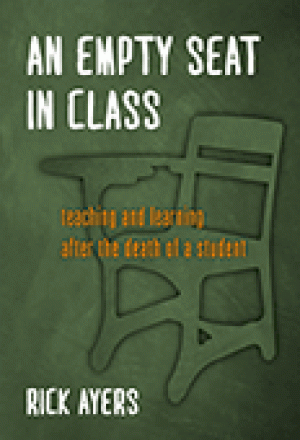
An Empty Seat in Class emerges in the midst of the increasing deaths of young black and brown men and women around the country, and it seems rather prescient as the debate about responses to this violence emerges and takes center stage. While Ayers addresses the larger context of death and particularly the deaths of marginalized students in oppressed communities, this book is a shared meditation on grief and the role of the secondary school teacher in processing, responding to, and teaching alongside death and grief. It is shared because Ayers not only reflects on his personal stories and experiences in the classroom, but he invites a broad selection of teachers involved in secondary education to reflect on their experiences of and responses to the loss of a student. The book is framed around the recent death of one of Ayers’s students and his community and school’s response to this loss. Ayers is clear that it is not a how-to book and rather than focus on prescriptions or even overt psychological or pedagogical advice he turns to the practice and ritual of writing and reflecting. Ayers reminds that “our salvation lies more in literature and stories than psychological and political analysis”(6) and provides us with stories, engaging literature, and reflections as the reader proceeds through the tragic life cycle of a community’s, specifically a teacher’s, response to the death of student. The first half of the book outlines the complexity of dealing with urban violence and identifies the multiple issues faced by teachers, specifically those from vastly different socio-economic and political contexts than their students. Ayers does not shy away from the myriad ways that students and teachers respond to the “mystery” of death. He and his contributors look at the emergence of “murder economies” (23), individual and institution missteps, white privilege, and the simplistic and problematic assignation of blame and innocence that often permeates responses to death in urban communities and classrooms. While the first half of the book explicitly examines death and dying in urban, marginalized communities, the last section looks at mass school shootings and mortality in its many forms. By the end of the text, Ayers is clear that death is a specter that no one can escape and that all teachers and schools need to critically reflect on it together. Ayers emphasizes that “There are so many other ways that the terrible finger of fate points at our students. And for each of these tragedies, there is a classroom; there is a teacher” (88). I am deeply sympathetic to Ayer’s project, and the book makes a convincing argument for this type of intervention and its format. His work succeeds as a “meditation with and for teachers” (7) during these tragic times. However, the text also suggests that there is a better way to deal with death in our school communities, and I think more explicit engagement with successful models of intervention and more context about Ayers’s school and community would strengthen the book and would add nuance and depth to its focus on and argument for the inclusion of narrative and literature in our responses to death. Overall, Ayers’s multi-layered analysis that includes reflection, memorial, research, and deep attention to literature on death and grief will be an invaluable resource for teachers and will hopefully spur additional research on the practical and pedagogical issues that arise as a result of a student’s death.
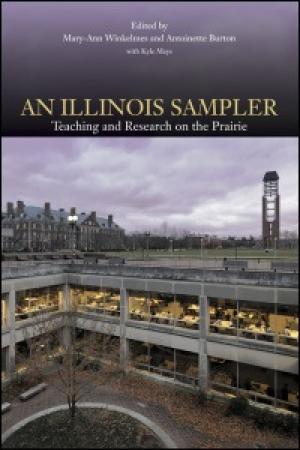
While this book is dedicated to students, chapters showcase the dedication of professors to providing effective learning formats in diverse fields. An Illinois Sampler: Teaching and Research on the Prairie highlights teaching methods at the University of Illinois that can be applied elsewhere. It would be an excellent book for a new professor, including one looking for field opportunities for their students. The nineteen chapters are very short, but in essence provide quickly consumable case studies of everything from inmate education and research abroad to flipped classrooms and the standard lecture format. It would work well for a small group discussion of education students who could read it together while in session. Topics for small group discussion could include holistic education, teaching from the sciences and humanities, and student-centered learning. Higher education administrators might also appreciate an overview of some of the programs at the University of Illinois. However, these chapters are just glimpses of the authors’ insights; some readers might need to pursue further research. Examples like Rosu’s highlights of the iFoundry program created by the engineering faculty and Denofrio-Corrales and Lu’s innovative Chemistry and Biology of Everyday Life (CBEL) course structure organize around students’ interests. Precisely how they do it could be the theme for another book. Instead of a recipe, we are given a taste of the passion and flavor of University of Illinois teaching practices. This book is dedicated to students. The authors capture a learning environment that alumni and current students can be proud of, but the Illinois Sampler shows that across the spectrum, the professors dedicate their work to their students. In pages of reflection by faculty in the humanities and sciences serving traditional and nontraditional students, teaching with traditional and nontraditional methods, An Illinois Sampler teaches what it means to teach: It is a statistics professor trying to make numbers lead to a better quality of life. It is a lecturer uncovering the living complexity of once simple fairy tales. It is an education behind bars professor who liberates minds. It is the professor learning from collaboration with their students, and reigniting a teaching passion for and by them. This book acts as a sampler in its composition, moving from highlights in music to math to literature to science to dance. Unconventionally juxtaposed, one discipline does not outweigh the other. Everyone will be able to find something appealing in it because of the broad inclusion, and, readers will gain knowledge from perspectives across disciplines. It should also be noted that contributors “vary not only by expertise but also in age, gender, nationality, career stage, and even their position in the academic hierarchy” (ix). The real success of this book is the variety. An Illinois Sampler is both a recommended read and endeavor.

There is a loss of confidence in college education today that is arguably unmatched at any point in modern American history. Government officials and the general public express concern about the goals and directions of higher education and the degree to which its institutions succeed or fail to meet the needs of society. Business leaders and state legislatures charge that our colleges and universities are overpriced, underperforming, and unaccountable to the public. Moreover, the modern institution of higher education faces declining growth and increasing operational complexity; meanwhile, costs continue to soar and resources become ever more difficult to secure. Indeed, the role and very definition of higher education has changed significantly in recent years. The focus now is on issues of relevance, applicability, and preparation for working life outside the academy’s protective walls, and difficult questions are being asked about cost, efficiency, productivity, and effectiveness. One educator, however, in a heartfelt culmination of a lifetime’s devotion to the classroom, offers a vision of education in the deepest sense: “a vision of what education is for in an existential, not merely an instrumental, sense” (4). Marshall Gregory’s posthumous Teaching Excellence in Higher Education is a beautifully written, insightful, humorous, and jargon-free reflection on pedagogical theory and an ethical vision for teaching as it should be, not necessarily as it is. “Excellence,” too-often a vapid buzzword deployed in the literature on higher education today – suitably vague as to commit to nothing, really – is anything but lifeless with Gregory’s masterful handling. The book, edited by his daughter, Melissa Valiska Gregory, associate professor of English at the University of Toledo, after the untimely death of her father, Harry Ice Professor of English, Liberal Education, and Pedagogy at Butler University for many years, reads like a teacher’s memoir, tracing the way he came to think about his students, his vocation, and his vision for education over the years. “Excellence” for Gregory is the “‘extra’ burden of helping students become the kind of citizens, neighbors, voters, spouses, parents, and general thinkers who play all of their life roles with judiciousness, thoughtfulness, and the ability to endure cognitive dissonance, ambiguity, and complexity” (18). A tall order indeed, but anything less, he insists, “is merely the training of expertise.” While higher education has acknowledged for some time that it is woefully deficient in teaching young graduate students to teach, Gregory takes this concern in a refreshing direction, not simply as a matter of classroom mechanics (protocols such as classroom management, syllabus design, testing, grading, and so forth) and the structures of our disciplines; rather, he digs deeper. Our training as researchers and scholars, Gregory argues, have obscured what we, as educators, really need to know in the classroom. He offers the seemingly startling claim that our individual disciplines are, in effect, beside the point; they are, rather, a means to something far more complex. Teaching excellence, he suggests, depends on our awareness of the difference between the intellectual content of our disciplines – the subject matter of our courses – and what he identifies as the “background issues” of ethical dynamics: “The deepest kind of learning is the learning that makes persons desire not some particular thing or some particular doctrine, but instead makes them desire to become someone different – more self-aware, more autonomous, more self-critical, more judicious, more thoughtful, less impulsive, and less in thrall to the clichés of their day and moment” (61). His is a vision informed by cognitive psychology and by the lasting wisdom of the humanist tradition itself. Gregory does this by coupling (re-coupling) intellect with ethics: “The ‘who’ that any of us is ethically is in large part a function of the ‘what’ that any of us knows intellectually” (79). Ethics, in other words, is not something to be grafted onto our teaching, as in statements of classroom conduct for students and guidelines for ethical behavior for faculty; rather, it is part of the very ether of the classroom experience, “running in the background like software code” (6). He sums up this negotiation quite nicely in a set of unspoken questions students ask of teachers and teachers ask of their students: “Are you honest? Are you kind?… Are you sensitive and fair, or are you a selfish pig and an insensitive butt head” (82). The ethical demands on teachers are many, and they are exacting dispositions: “open mindedness, creativity, curiosity, intellectual flexibility, civility, making good arguments, having a nose for evidence, making defensible judgments, and so on” (75). But these demands for ethical commitment – fairness, respect, charity, and civility – are not, Gregory reminds himself as well as his readers, some Hallmark card version of classroom kumbaya. They are defenses, in a sense, in the struggle against a notion of education as narrow utilitarianism and credentialing. It is not that those who have entered the profession with some genuine sense of vocation are unaware of these principles; rather, the disciplinary focus and scholarly commitment to content have obscured them, or trained teachers not to pay them much mind. The reclaiming of “excellence” for higher education is, for Gregory, a teacher of teachers, the performing of an “authentic, autonomous, thoughtful, socially responsible, and morally defensible life” (113).
During a recent conversation among deans they commiserated over how difficult it was to bring about changes in their schools. Despite their best efforts at communicating the need for change, cultivating support, and implementing strategies, change was happening too slow...
For our final post, we each cover an overarching reflection or two from the 2014-15 academic year. Look for fresh content from the Wabash Center in the fall. In the meantime, feel free to visit our ongoing blog Race Matters...
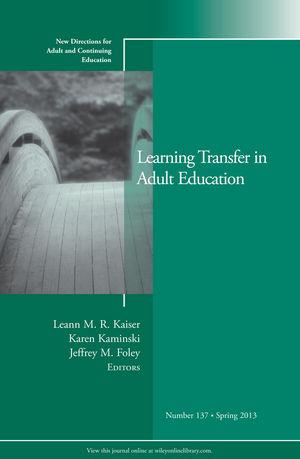
Learning Transfer in Adult Education (New Directions for Adult and Continuing Education, Number 137)
Leann M. R. Kaiser, Karen Kaminski, and Jeffrey M. Foley’s edited volume Learning Transfer in Adult Education offers a concise and readable entry point into the topic of learning transfer. While the stated focus of the volume is adult education, many of the themes and strategies considered will be of interest to those teaching traditional undergraduates as well. According to the editors, “Learning transfer, simply stated, is the ability of a learner to apply skills and knowledge learned in one situation or setting to another” (1). This goal, they suggest, is fundamental to any educational enterprise. In the first chapter, Foley and Kaiser introduce learning transfer and concepts associated with it, providing a useful framing for the chapters that follow. In particular, Foley and Kaiser explain the distinction between “near transfer,” in which the new situation closely resembles the original learning context, and “far transfer,” in which it does not. These and a handful of other key terms reappear throughout the essays; this chapter deserves a careful reading. The chapter also offers a brief overview of some tools available to instructors, many of which reappear or are discussed in greater detail in later chapters. Chapters 2 through 7 offer a variety of perspectives. Nate Furman and Jim Sibthorp (chapter 2) consider experiential learning techniques. These include problem-based learning, project-based learning, cooperative learning, service learning, and reflective learning. Three strong case studies are offered in this chapter, which help demonstrate the techniques in action. One of the techniques, problem-based learning (PBL), is the focus of the contribution by Woei Hung (chapter 3). Hung introduces the distinction between “well-structured” and “ill-structured” problems; the latter are more commonly found in the workplace and thus are productively used in PBL. Hung also comments on the cognitive processes that underlie effective learning transfer; these are complemented nicely by Jacqueline McGinty, Jean Radin, and Karen Kaminski’s study of “Brain-Friendly Teaching” (chapter 5). As the phrase “brain-friendly” suggests, the chapter skews toward pop psychology, but many of the techniques seem to hold potential. Patricia L. Hardré’s contribution (chapter 4), meanwhile, offers a serious engagement with the question of authenticity as it plays out in technology design. The remaining two case studies take up broader concerns. Rosemary Closson (chapter 6) offers a nuanced review of issues surrounding race and cultural difference in learning transfer, combining theoretical and practical discussion. This chapter is especially valuable for instructors interested in race, cultural difference, and pedagogy. Jeani C. Young (chapter 7) offers an equally sensitive treatment of personal change. The volume concludes with a discussion by the editors on “applying transfer in practice.” While those teaching adult learners will especially benefit from the specific examples and case studies, all interested readers stand to profit from this volume. In particular, its wealth of practical examples and classroom strategies offer quick and immediate value to the busy reader.

Published seven years after its first edition, Revisiting the Great White North? reframes the persistence of white privilege in Canadian educational context. As with the first edition, this book interrogates Canadian identity, multicultural discourse, and color-blindness mythologies that serve to hide and maintain white normativity. “It fills a gap in the Canadian literature on the ways Whiteness masquerades in our institutions and within Canadian mythologies” (xxvii). Each of the original chapters from the 2007 edition is reproduced in this volume and is appended by new reflection questions and a brief reframing piece, written by the original author. One author revised her original piece, and one new chapter is added by a scholar from the province of Québec. With the exception of one scholar who taught Canadian students in Buffalo, N.Y., all of the authors are Canadian and represent nearly all of the provinces. The authors are all leaders in anti-racist education, including George Sefa Dei. Their perspectives are diverse not only in terms of region, but also in racial identity, ethnicity, discipline, and gender. Each author shares his or her implication in whiteness through both personal testimony and critical inquiry, contributing to the book’s engaging style and accessibility. This volume contains five sections comprising three to five chapters. The first section focuses on conceptualizing whiteness; its chapters examine how white identity is constructed and reinforced in Canada, and how it presents barriers to teaching and learning. Section two is entitled “Whiteness and Second Peoples,” a phrase referring to the “colonizers of the First Nations” (7). These chapters consider the place of both non-white and white people in antiracism work. The danger of white scholars doing work that is motivated primarily by guilt is noted, pointing to the inadvertent reproduction of white power or an “overly optimistic representation of disadvantaged groups” (91). Section three is concerned with the development and deconstruction of white identity, including the “ability to be colour-blind and not colour-blind simultaneously” as “the hallmark of the achievement of a mature, anti-racist White identity” (119). While the whole book is focused on whiteness and education, it is peppered with references to teaching experience and students’ comments. The last two sections are specifically concerned with teaching and learning. Section four spotlights the pervasive beliefs of white, middle-class university students that Canada is a raceless society and a pure meritocracy. The final section, “The Institutional Merit of Whiteness,” addresses race and identity related issues in education, exposing how whiteness is emphasized in school codes, administration, and policy development. Revisiting the Great White North? is not limited to its Canadian context. It will be of interest to anyone who works to expose white privilege and promote anti-racism in the educational arena. While its attention is given to whiteness and race, it is critically aware of and makes reference to the intersection of race with ethnicity, class, and gender. The book is a must-read for those who wish to participate in an educational discourse that moves beyond liberal platitudes of “sympathetic knowledge about racial and cultural Others,” which “once again re-inscribe Whiteness as goodness and rationality” (186).15