Resources
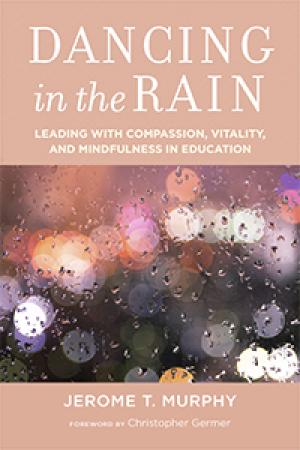
Click Here for Book Review Dancing in the Rain offers a lively and accessible guide aimed at helping education leaders thrive under pressure by developing the inner strengths of mindfulness and self-compassion, expressing emotions wisely, and maintaining a clear focus on the values that matter most. Jerome T. Murphy, a scholar and former dean who has written and taught about the inner life of education leaders, argues that the main barrier to thriving as leaders is not the outside pressures we face, but how we respond to them inside our minds and hearts. In this concise volume, Murphy draws on a combination of Eastern contemplative traditions and Western psychology, as well as his own experience and research in the field of education leadership. He presents a series of exercises and activities to help educators take discomfort more in stride, savor the joys and satisfactions of leadership work, and thrive as effective leaders guided by heartfelt values. Every day, education leaders find themselves swamped in a maelstrom of pressures that add to the complex challenges of educating all students to a high level. With humor and compassion, Dancing in the Rain shows educators how to lead lives of consequence and purpose in the face of life’s inescapable downpours. (From the Publisher)
In a low and pensive voice, the young woman student posed her question to the all-women course. Her question sent a gentle shockwave through the room. After some far ranging discussion, my response to her question was this – “Black women all over the world make passionate love all night long, and then in the morning, go to their jobs looking fabulous!” I admit that I had never previously had this kind discussion in a classroom, but I was intrigued. I was, with this conversation, in uncharted territory in my own classroom discussion – and loving every moment of it! There are reasons, good reasons, why discussion is not a preferable learning activity in higher education. Teachers know from experience that discussion leans toward the will and want of the student. Discussions can and do “get out of hand.” Discussions can move into territory not on the syllabus or beyond the scope of expertise of the teacher. Methods to control and orchestrate classroom conversation are in all of our teaching repertoires. We must resist thinking of the moments of questions after a lecture as “discussion.” A posed question and a response is not a conversation. Q & A is not discussion. As a professor in a seminary, it has been apparent to me for many years that students come to class with “churchy” agendas and “churchified” discussions. Students are well aware of the standards of “acceptable” discussions. Students also have the habit of making a study of the teacher as much or more than they study the topic at-hand. In the study of the teacher, the student makes a concerted effort to ask questions and provide answers which are a match to the sensitivities of the teacher. In these instances, the lesson of the leaner has more to do with mimicking the masks and personas of the teacher than exposing and plumbing her own curiosity. Some teachers enjoy this gaslighting. Given the pitfalls and dangerous possibilities, I still work hard to engineer conversations in my classrooms which will be life changing, thought provoking, and courage summoning. Wielding the transformative power of deep conversation is my cautious aim. I want to engineer conversations which evoke astonishment and amazement. I want my students to experience, as I have experienced, conversations which heal, convict, and rescue. I yearn to choreograph conversations which allow students to ask the questions which they are genuinely wondering about, rather than the question they know is acceptable, palatable, and often benign. When we get it right, discussion can bring a magical kind of encounter resulting in insight, revelation, new perspective. The moments when students listen to and for each other as mutually shared engagement on tough issues is the moment of shared truth and ah-hah! The shared experience, as if something important is being cracked-opened as if new light is entering in, as if the world expanded a tiny bit, is the result of deep, risky discussion. For two courses, over the last eighteen years, I have had the good fortune of registration exclusively by women. I had not made a Mary Daly rule for registration, so in both instances, I was surprised and delighted. Each time I have taught an all-women course, I have wanted the exclusive presence of women to be more than a novel classroom experience. I wanted the conversation to be substantively different. I wanted to create space for a conversation by women for women about women. In both courses, once I realized registration was exclusively women, I made changes in the syllabus. I rethought the learning activities and created exercises which considered and honored the all-women group. I changed the readings of the course to exclusively readings of women authors. I shifted the cornerstone questions of the course to take into account issues of female identity, femininity, misogyny, and womanist approaches to self, community, and power. The discussion which evoked my comment about the love making habits of Black woman around the world happened in one of the all women courses. Our discussion about gender and womanhood was provoked by a new learning activity. I had instructed each woman to create a timeline of her own hair. It was a straightforward and simple exercise that uncorked a mammoth discussion. For those women whose hair had been a living symbol of maturity, personal growth, and participation in beauty culture – this assignment was a guide for recollection, reminiscing, and reflection. For those women whose hair had been a place of ongoing authentication of imposed inferiority, a constant tethering to a beauty standard which is unyielding in abuse, a site of verification for worthlessness and ugliness, this assignment was fraught with danger, ire, and tales of unhealed wounds. The political is personal and the personal is political if we can find ways to hold this viscous phenomenon for discussion. Discussing the body is a discussion of creating ourselves, including our politics, and has the potential to teach us how to summon moral courage. A discussion about our hair, for women, is potentially a discussion which moves into the arena of authentic reflection on sexism, racism, classism – the politic of superiority and inferiority which permeates the society. Since the body is the site of gender politics, racial politics, class politics, and the politics of sexual orientation - it is precisely the body which should be discussed. I am not saying other professors need to ask students to create a hair timeline. I am suggesting that the tool of discussion in our classrooms warrants our deepest attention if we are to move toward the conversations which are politically necessary for social change and healing. In so doing, I want to suggest that conversations among certain particularities are valuable and necessary, yet underutilized in classroom strategies. There is great merit in discussions on race and racism among only-white students. There is tremendous benefit for all-male groups to discuss issues of sexism and misogyny. I am a witness that the all-women conversation in two courses was life-giving.
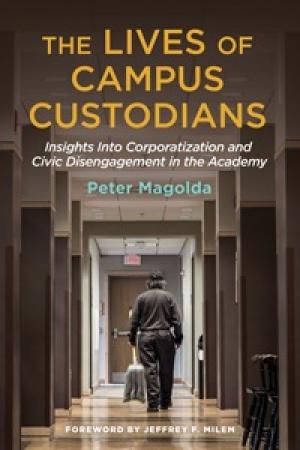
I decided to review this book because of a story one of my professors, Kenneth A.R. Kennedy, told me in college. While he was doing his dissertation research at a university in India, he learned the most not from the esteemed faculty, but from an “untouchable” custodian. Similarly, in the preface to this book, Peter Magolda describes Juanita “Pat” Denton, the head custodian of the residence hall Magolda was directing for his first full-time job, as his mentor: “I learned that custodians knew as much, if not more, about the residents and the condition of the residence hall than I did” (xix). The invaluable lessons he learned from Pat, combined with frustration that higher education scholars have virtually ignored custodians as subjects worthy of study, led Magolda, a professor emeritus of educational leadership at Miami University, to write The Lives of Campus Custodians. Magolda combines more than a year of participant observation, ethnographic interviews, and literature review to give us a valuable glimpse into what daily life is like for custodians on two different college campuses. I especially enjoyed the many tell-it-like-it-is quotes from custodians that Magolda includes, such as this one from George: “In 1974, HU was like a new world for me. . . . [Recently] I heard that the president thought the wages here were comparable with other jobs in the region. Comparable to what? They [new custodians] are still starting off at $9.35 an hour. And health care premiums continue to rise. . . . It’s not much higher than minimum wage. The university mismanages its budget, and custodians have to pay the price” (107). Such first-hand observations highlight the usually hidden impacts of cost-cutting measures and other corporate managerial practices on campus custodians, many of whom do not earn a living wage, and who, like Samuel, have to watch their money so carefully that he will only buy his mother her favorite kind of cake for her birthday if it is on sale (71). The book is also eye-opening about “community engagement,” and offers new ways to think about it. I teach a service-learning class every spring and have helped lead the faculty advisory group for our Office for Community Engagement. Yet until reading The Lives of Campus Custodians, I had never thought about having our students engage with an important but largely invisible community: the low-wage staff working at our university. As Magolda thoughtfully puts it: “Typically, higher education civic engagement involves working with communities outside the university, such as service-learning excursions to address societal ills. Yet the findings from this study suggest that subcultures within universities are equally in need of civic revitalization” (173). Moreover, Magolda challenges readers to consider, “Why does civic engagement by those on the margins, such as custodians, seem odd?” (188; Magolda provides several examples of civic engagement by custodians in the book). Toward the end of the book, Magolda offers a series of concrete suggestions for how to improve matters for both custodians and the university, directed at administrators, supervisors, students, faculty, and custodians themselves. These range from “sponsoring professional development workshops that provide custodians with essential human relations and communication skills to share their wisdom with the larger campus community” (198) to encouraging custodians to unionize (or find other ways to band together and bargain collectively). Unfortunately, there are also some serious problems with The Lives of Campus Custodians. First, the book is often quite repetitive, with the same phrases used almost verbatim in subsequent paragraphs (61, for example), and later chapters repeating previous material, even including the same quotes from custodians. Second, the book too often simply summarizes its findings, rather than analyzing them using relevant theoretical frames. For example, given the topic of this book, it seems very strange that structural and symbolic violence, internalized oppression, positionality, and even labor and immigrant history (many of the custodians Magolda interviewed were refugees from Eastern Europe) are never mentioned. Third, the book often feels heavy-handed in its critique of the growing turn toward “corporate managerialism” in contemporary American universities (a trend which I also find deeply disturbing); at times it seems as if Magolda wrote the book more as an opportunity to critique campus corporatization than to illuminate the lives of campus custodians. And fourth, the vast majority of the custodians Magolda interviewed and worked with were White – 99 percent at one campus, and at least 78 percent at the other (18-26). This means that the book has relatively little to say about racial inequality, which is a serious issue for custodians on many campuses (one welcome exception is a spot-on quote about how racial politics affects custodians by self-described “huge-ass Black man” Calvin [104]).
This is the fourth and last installment of a series of posts on the theme of “teaching theory without theory talk” in an introductory course on Islam. To review, I have explored ways in which one might present to students in an introductory course important theoretical arguments (e.g., complicating binaries like tradition/modernity or religion/secular; appreciating the intimacy of discourse, power, and material conditions; interrogating the legacy of colonial modernity in the formation of contemporary categories of life) that are by now commonplace in the study of religion. How might one advance such conceptual tasks without burying students in the often intimidating and prohibitive protocols and operations of theoretical discourse? In the last three posts, I shared my experience wrestling with this challenge at different moments in an introductory Islam course. In this post, I want to take a step back. Rather than reflecting on teaching theory through teaching Islam, I wish to think through some of the theoretical assumptions that often sustain the teaching of Islam within the study of religion. More specifically, I wish to ponder aloud a certain discomfort I have often experienced on the first day of a course, especially the introductory Islam course. On day one, as is common practice among religion scholars, I try explaining to students what the study of religion is and how it differs from theological studies. This usually involves making a list of contrastive attributes. The study of religion (and Islam) is historical, non-confessional, non-normative, and analytical as opposed to the normative confessional study of religion as an object of faith. This sentiment is usefully captured in the formula of drawing the contrast between studying religion and studying about religion. There is obviously much merit in these explanatory gestures. One would not want the academic classroom to become a space for resolving competing truth claims or of passing certificates of normativity and heresy. However, there is nonetheless an underlying secularity at work in this exercise that I find not only conceptually troubling but also a potential roadblock to teaching Islam. To begin with, the act of contrasting the historical, academic, and non-confessional study of religion with the allegedly confessional character of theological studies risks reducing the latter to a caricatured representation. Surely, despite their normative preoccupations, seminaries and madrasas also often engage in analytically sharp and historically informed scholarship, even if their logics of history and critical thinking might differ. Making a conscious and concerted effort to distinguish religion studies from theological studies might have the unintended effect of smugly suggesting the superiority of the former over the latter. “We are cooler than those people who are unable to separate personal faith from scholarly inquiry.” Even if not intended as such, it is hard to imagine this not being among the implicit messages communicated by the assertion of the religion/theological studies dichotomy. Making such a contrast also embraces and replicates the secular/religious binary, which as many scholars have argued, is a very problematic binary. “We the critical historians of religion will undertake for the next fourteen weeks the secular study and inquiry of this religion and these religious subjects.” That is the upshot of the eager disclaimer that the study of religion is not theological/seminary studies. There is an underlying nod to the virtues of secularity at the heart of the promise of historicizing religion. This secular gesture does bring the benefits of absolving a course on Islam from the sins of establishing orthodoxy, encouraging piety, or of promoting confessional bias. But, it also carries certain limitations that are important to acknowledge and engage if not resolve. Let me highlight just one such limitation. The positioning of an introductory course as a non-confessional (read secular) inquiry into Islam can hamper the effectiveness of discussions on the affective and phenomenological aspects of a religion. An important moment in the introductory Islam course that speaks to this point is that of the revelation of Islam to Muhammad. This is a powerful moment. It combines awe, terror, anticipation, physical pain, and marks a permanent cleavage in time and history. But the history of religion approach deflates the power of this moment. Having taken their position as detached (even if sympathetic) observers of a tradition, students are unburdened from the weight of entangling their beings with the experiential registers of the religion. They are absolved of feeling, perhaps even suffering, the mixture of perplexity and wonder that suffuses and accompanies moments like Muhammad's revelation. They might sympathize with such moments or be fascinated by them, but the thick crust of secular historicism makes even the attempt at inhabiting the experience of such moments almost impossible. My point, or perhaps more accurately, my attempt at articulating a less than fully formulated doubt and discomfort, is not a rehearsal of predictable musings on the insider/outsider problem. Rather, I am after the implications and effects of a pedagogical orientation towards Islam that renders it a foreign object of secular historicist inquiry and consumption. Such an orientation, animated by the assumptions and logics of secularity, captured most prominently by the secular imperative of historicizing and desacralizing life, can produce rather deleterious effects. Most notably, it relies on and perpetuates a binary between the enlightened critical investigator and the tradition bound uncritical religious subject who is the former’s object of investigation. In other words, the history of religion approach to teaching Islam is a decisively secular approach that replicates and advances the religion-secular binary. Obviously, recourse to a confessional approach is hardly the solution; that is both untenable and undesirable. Perhaps what is needed is a pedagogical orientation that is thoroughly unaccepting of the religion-secular binary in all its manifestations. Being more critical of the critical historical study of religion, especially when set in contrast to traditionalist theological studies, might be a useful step towards the cultivation of such an orientation.
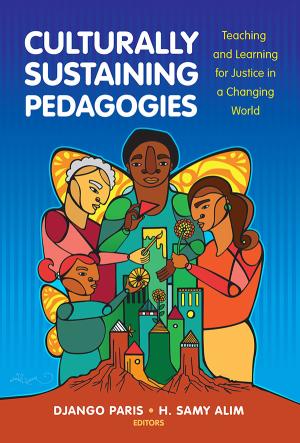
Culturally Sustaining Pedagogies raises fundamental questions about the purpose of schooling in changing societies. Bringing together an intergenerational group of prominent educators and researchers, this volume engages and extends the concept of culturally sustaining pedagogy (CSP)—teaching that perpetuates and fosters linguistic, literate, and cultural pluralism as part of schooling for positive social transformation. The authors propose that schooling should be a site for sustaining the cultural practices of communities of color, rather than eradicating them. Chapters present theoretically grounded examples of how educators and scholars can support Black, Indigenous, Latinx, Asian/Pacific Islander, South African, and immigrant students as part of a collective movement towards educational justice in a changing world. (From the Publisher)
Click Here for Book Review When religious diversity is our reality, radical hospitality to people of other faiths is not a luxury but a necessity. More than necessary for our survival, radical hospitality to religious diversity is necessary if we are to thrive as a global society. By no means does the practice of hospitality in a multifaith world require that we be oblivious of our differences. On the contrary, it demands a respectful embrace of our differences because that's who we are. Neither does radical hospitality require that we water down our commitment, because faithfulness and openness are not contradictory. We must be able to say with burning passion that we are open to the claims of other faiths because we are faithful to our religious heritage. The essays in this book do not offer simply theological exhortations; they offer specific ways of how we can become religiously competent citizens in a multifaith world. Let's take the bold steps of radical openness with this book on our side! (From the Publisher)
Workshop for Theological School Faculty Teaching Online In this workshop, theological school faculty will design, build, implement, assess, and redesign an online or hybrid course to be taught in the 2018-19 academic year. The workshop will be offered as a hybrid experience, blending elements of individual work, three face-to-face sessions, and collaborative work as part of a virtual learning community. During the first summer, participants will engage in an intensive program that includes online content (developed in collaboration with the University of Wisconsin - Madison), bookended by two of the face-to-face gatherings with peers on the Wabash College campus. During the 2018-19 academic year, participants will teach and assess the course they designed. In the final face-to-face session during the summer of 2019, each participant will review their assessment information, share best practices, wrestle with deeper issues of pedagogy and sociology of learning, and complete a plan for revising their course. Goals Participants will be able to: Design, construct, implement, assess, and revise a well-conceived and pedagogically sound course for delivery in an online or hybrid format Assess the unique opportunities and challenges for effective teaching and learning posed by traditional, hybrid, and online teaching environments Apply sound principles of pedagogy and the sociology of learning communities to the design of an online or hybrid course Make informed decisions about how to shape effective pedagogical and sociological strategies for the venue in which they will be used, in order to achieve the desired learning outcomes Design and facilitate learning activities and processes in order to achieve effective, relational, and formational learning outcomes Contribute in positive ways to institutional exploration of online and hybrid learning environments Honorarium Participants will receive an honorarium of $3400 for full participation in the three f2f and online course sessions. In addition, all participants will be reimbursed for local expenses and travel. Read More aboutPayment of Participants Participants Front Row: *Steve Delamarter (Portland Seminary), Valentin Ekiaka Nzai (Mexican American Catholic College), Jeffery Tribble (Columbia Theological Seminary), Tim Westbrook (Harding University). Second Row: Rachel Miller Jacobs (Anabaptist Mennonite Biblical Seminary), *Stacy Williams-Duncan (Virginia Theological Seminary), Catherine Williams (Lancaster Theological Seminary), Carmichael Crutchfield (Memphis Theological Seminary), *Bridget Powell (University of Wisconsin – Madison), S. Tamar Kamionkowski (Reconstructionist Rabbinical College), Kent Kersey (Corban University). Third Row: Kristel Clayville (Lexington Theological Seminary), Elias Ortega-Aponte (Drew Theological School), Lee Beach (McMaster Divinity College), Mariano Avila (Calvin Theological Seminary), Max Lee (North Park Theological Seminary), G. Alan Overstreet (Anderson University). Back Row: Zachary Tackett (Southeastern University), *Tom Pearson (Wabash Center). *leadership/staff position. Dates Online Start-up: May 8-21, 2018 (5-8 total hours of work) F2f session #1: May 29-June 1, 2018, Wabash College Online course: June 5-July 31, 2018 (15-20 hours/week) F2f session #2: August 1-4, 2018, Wabash College F2f session #3: May 28-31, 2019, Wabash College Leadership Team Steve Delamarter, Director,Portland Seminary Stacy Williams-Duncan, Virginia Theological Seminary Bridget Powell, University of Wisconsin-Madison Thomas Pearson, Associate Director, Wabash Center Important Information Travel and Accommodations for Summer Sessions at the Wabash Center Philosophy of Workshops Policy on Participation Map of Wabash College Campus Travel Reimbursement Form Foreign National Information Form Payment of Honorarium For More Information, Please Contact: Thomas Pearson, Associate Director Wabash Center 301 West Wabash Ave. Crawfordsville, IN 47933 800-655-7117 pearsont@wabash.edu
Workshop for Early Career Theological School Faculty This workshop invites those in their first years of teaching in theological schools to join a community of generosity and hospitality that responds to early career professional and vocational development. Together they will: Wrestle with generative questions about teaching and learning Learn how to live a life of the mind without losing one’s mind Discover ways to engage institutional and cultural realities that are liberative and life-giving Imagine teaching that constructively engages and transforms the larger world through creative thinking and risk-taking The workshop will gather 14 faculty members for a week in two successive summers at Wabash College, and a weekend winter retreat in a warm location. There will be a balance of plenaries, small group discussions, workshops, social time, and opportunities for relaxation, exercise, laughter, and lots of good food and drink. Goals Participants will join a collaborative cohort in which they will: Reflect critically on processes of learning that foster intellectual curiosity Discover ways to sustain practices of teaching and learning with passion Understand and navigate institutional cultures Explore deepest convictions about teaching and learning in theological schools Honorarium and Fellowship Participants will receive an honorarium of $3400 for full participation in the three workshop sessions, plus local expenses and travel. In addition, participants are eligible to apply for a $5000 workshopfellowship for work on a teaching project during the following academic year (2019-20). Read More aboutPayment of Participants Read More about the Workshop Fellowship Program Participants Front Row: Paul Monson (Sacred Heart Seminary and School of Theology), Rebecca Esterson (Graduate Theological Union), *Rolf A. Jacobson (Luther Seminary), *Bar J. McClure (Brite Divinity School at TCU), Daniel Orlando Álvarez (Pentecostal Theological Seminary). Second Row: Joseph Gordon (Johnson University), Sunggu Yang (George Fox University), Emily Peck-McClain (Wesley Theological Seminary), Ashley Hicks White (Louisville Presbyterian Theological Seminary), Timone Davis (Loyola University Chicago), Christine J. Hong (Columbia Theological Seminary), Helen Kim (Candler School of Theology – Emory University). Back Row: *Paul O. Myhre (Wabash Center), Scott Hagley (Pittsburgh Theological Seminary), Jennifer Awes-Freeman (United Theological Seminary of Twin Cities), *Andrea C. White (Union Theological Seminary, NY), *Eduardo C. Fernández (Jesuit School of Theology of Santa Clara University), Jeney Park-Hearn (Seattle University). *leadership/staff position. Dates First session: July 9-14, 2018, Wabash College Second session: January 24-27, 2019, Corpus Christi, Texas Third session: June 17-22, 2019, Wabash College Leadership Team Rolf A. Jacobson, Director,Luther Seminary Barbara J. McClure, Brite Divinity School Andrea C. White, Union Theological Seminary-NYC Eduardo C. Fernandez, Jesuit School of Theology, Santa Clara University Paul O. Myhre, Associate Director, Wabash Center Important Information Travel and Accommodations for Summer Sessions at the Wabash Center Travel and Accommodations for Winter Sessions in Texas Philosophy of Workshops Policy on Participation Map of Wabash College Campus Travel Reimbursement Form Things To Do In Crawfordsville - Recreation Foreign National Information Form Payment of Honorarium Fellowship Program For More Information, Please Contact: Paul Myhre, Associate Director Wabash Center 301 West Wabash Ave. Crawfordsville, IN 47933 800-655-7117 myhrep@wabash.edu
This article focuses on Reflective Structured Dialogue as a set of practices developed in the context of conflict resolution that are well suited to handling quotidian uneasiness and extraordinary moments of disruption in religious studies classrooms. After introducing Reflective Structured Dialogue's history, goals, and general practices, the authors consider its uses in classroom settings. They argue that a classroom in which teachers understand themselves as facilitators, and in which students are experienced in structured dialogue practices – including being comfortable in a state of intellectual “wobble” – is one more apt to be able to engage with, and more likely to benefit from, disruptive events.
A panel at the 2016 American Academy of Religion conference staged, taped, transcribed, and edited this conversation about the challenges and opportunities of teaching in a “nano department” – an undergraduate religion or religious studies department (or combined religion and philosophy department) with only one, two, or three faculty members. Two things quickly become evident: one is the impossibility of coverage of the full religious studies curriculum, and the other is the necessity for collaboration with other departments. Neither of these is unique to nano departments, but there exists an intimacy between students and faculty in small departments, a necessary freedom to rethink the place of the study of religion in the liberal arts curriculum, and a disruptive value in what can be critiqued and contributed from a marginalized position. Arguably, nano departments are the canaries in the academic coal mine, charting the future of the humanities that cannot be discerned from the vantage point of Research-1 contexts.