Book Reviews
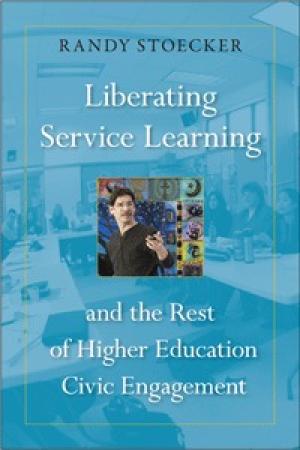
The double entendre in this book’s title may be clichéd but it is often apt, and in this case Randy Stoecker makes a strong argument that service learning and the rest of higher education civic engagement (“service learning” functions as a catch-all term) is in need of liberating so that it can be liberating. Stoecker accuses “institutionalized service learning” (ISL), as he calls the prevailing practice, of reinforcing an oppressive neoliberal political-economic order. As a faculty member of the University of Wisconsin, he speaks from experience. What keeps most service-learning practitioners captive, Stoecker asserts, is a failure to theorize about how service learning does and/or could operate. He offers a theoretical view that enables him to (1) reflect on and criticize ideas in current practice and (2) project alternative ideas as points of articulation for liberating service learning – in both senses alluded to above. Stoecker develops his vision in twelve chapters divided into three parts. A “prelude,” “interlude,” and “postlude” provide other vantage points, ironizing Stoecker’s implied authority on the matters at stake and illustrating metaphorically the problems and promises of service learning. An index of names and topics is also provided. Part I, “The Problem and Its Context,” surveys the current state of ISL. In chapter 1, beginning with a critical incident from September 2013 – a disciplinary hearing for students who, in support of labor unionization efforts at the University of Wisconsin, occupied the Chancellor’s office – Stoecker explicates his worries about who ISL truly serves. In chapter 2 he recounts the emergence and eventual institutionalization of service learning in U.S. colleges and universities from the late nineteenth to early twenty-first century, emphasizing evidence that suggests ISL has come to serve bureaucratic requirements rather than community initiatives. Chapter 3 makes a preliminary analysis of the avowed and actual theoretical commitments of current practice, pointing to a need for sustained examination of the meaning of four core concepts: learning, service, community, and change. Part II deepens the analysis. The author argues that ISL supposes “learning” is for students to accrue from service. “Service,” then, means charitable giving, rather than helping communities learn how they might wield their own power. So concepts of “community” in ISL neglect political-economic issues of structural injustice. Accordingly, “change” comes to be seen as a matter of advancing individuals within an unquestioned neoliberal order. Part III re-envisions the core concepts. The crucial move is to start with a critical theory of “change” as social change. In this light “community” may be grasped not as a vague given but as a goal; “service”is seen not as charity but as casting our lot together to form community and effect change; and “learning” means learning to be learners in service to a shared struggle for change – in short, learning to be liberated. Although Stoecker offers something to annoy everyone, I still recommend Liberating Service Learning for its challenging examination of the spirit of service learning, in its present state and as it might be in future.
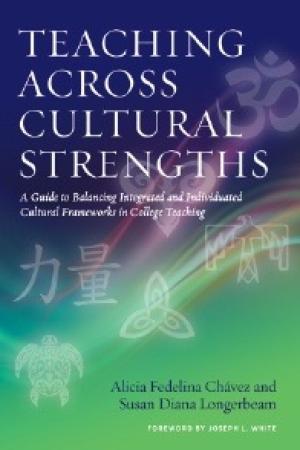
Teaching Across Cultural Strengths is a guide for faculty seeking to apply a cultural lens to their teaching practice; the goal is to learn how to “draw from the cultural strengths of all peoples in service toward equitable and effective teaching and learning” (xx). Chávez and Longerbeam adopt a complex definition of culture visualized in successive layers: artifacts and behaviors, beliefs, values, norms, and underlying assumptions (71). A central thesis is that university teaching in the United States follows an Oxford or Germanic model that has not adequately served students of color. The authors describe a dissonance between an individuated cultural framework characterized by private, compartmentalized, and linear learning and an integrated cultural framework characterized by mutual, cyclical, and contextually-dependent learning. The intent is not to favor one cultural approach over another but to stress the strengths and potential rewards of pedagogy combining a wider array of cultural norms. Based on research and faculty development conducted in Arizona and New Mexico, the book emphasizes Native and Hispano/Latino American students (12). Faculty interested in how their teaching is responsive to religious diversity in the classroom will find more than enough tools for reflection in this volume but only a small number of direct examples. The teaching of evolution in the biology classroom is mentioned as an example of potential incongruence between course content and student beliefs. Immediately following this case is the fascinating story of accommodations made for a medical student who dropped out due to a spiritual injunction against handling human remains (154-55). In their first chapter, the authors introduce their data-supported Cultural Frameworks in Teaching and Learning Model with activities and vignettes meant to help the reader transform their own pedagogy. This chapter has a workbook feel with four graphics in the first eight pages. The second chapter, “Culture in College Teaching,” offers a more readable treatment of the basic principles of the book and I would advise reading it first. The next three chapters offer extended explanations of how to implement culturally balanced teaching supported by a large number of classroom narratives. The sixth chapter is particularly useful since it is organized as “The Top 10 Things Faculty Can Do to Teach Across Cultures.” The final two chapters discuss the authors’ own work in faculty development and how others might initiate similar projects. The book contains a helpful index and two appendices: one describing how to create a “culture and teaching autobiography” and a second containing a short list of books for further learning. When I was in grade school, “Choose Your Own Adventure” books were all the rage. These titles were formatted in a way that let the reader jump around in the text to create her own story. In Teaching Across Cultural Strengths, Chávez and Longerbeam capture a similar spirit by arranging advice, questions, and activity prompts so that faculty can create their own workshop experience either individually or as a group. No one can be a perfect teacher but we are all called to be reflective teachers. In form and content, this book can be a useful asset on that journey and it is highly recommended.
This book is pitched to college and university faculty at all career stages, and it stands out from other books in this category because of its research-based findings and its thoughtful case studies. The authors based their guidance on a year-long research study of 688 faculty from a wide range of institutions as well as on years of personal professional experience. The book covers the major aspects of an academic career: effective teaching and promoting student success, defining and facilitating collegiality and positive relationships within departments and with administration, conducting research, performing effective service to the institution or guild, and moving through the ranks to tenure and beyond. This book’s strengths include the liberal use of longer case studies and shorter scenarios, each of which works through a series of questions and proposed resolutions (for case studies) and a challenge question and outcome (for scenarios). The initial warm-up questions are often quite broad (for example, “Is there any general advice you think might be helpful to your friend?” [6]) while later questions tend to be more specific and thoughtful, requiring the reader to consider multiple factors and angles within one scenario. These vignettes were well written and thoughtfully prepared, and on the whole they engage the reader quite effectively. That the scenarios are so clearly taken from actual experience makes them more valuable, especially to newer faculty members who haven’t yet seen it all. Two chapters of this guide focus specifically on teaching. The first, titled “Teaching Effectively in the Classroom,” strongly promotes active learning over lecturing. The case studies in this section deal with common problems, such as how to respond to poor results in student evaluations and what to do when the entire class fails an exam. This chapter emphasizes the importance of learning how to teach large courses effectively, although the authors do include a section at the end of the chapter on “teachniques” for teaching smaller courses. Many new faculty and older faculty who are retooling will find this chapter a useful primer. The second chapter focuses on “Promoting Student Success and Engagement,” with a focus on developing friendly but not-too-familiar relationships with students. Using research and experience, the authors explain the pivotal importance of faculty in shaping students’ lives and ways of thinking well beyond the classroom. Taken together, these two chapters address many issues of interest to readers of this journal, and the remainder of the book is equally valuable for those looking for guidance and food for thought. As a guide designed for all faculty, this book necessarily elides issues of race and gender, for instance, that significantly shape faculty experience. That said, the book accomplishes much in a short space, and each chapter of the book is short and well-structured. Above all, this book uses the very techniques it suggests for effective teaching, and new faculty members in particular will find themselves better prepared for everyday faculty life after thinking through these realistic case studies.
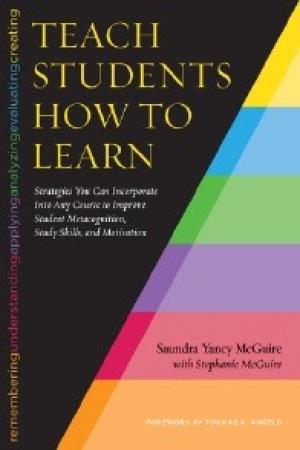
It shouldn’t be surprising that a volume intent on teaching students how to learn is just as intent on teaching the reader how to do just that, but it is still refreshing to read a book that lays out its goals, sticks to the promises it makes, and even creates its own study guide based on how much time the reader has to give to the text. Well-structured and clear, Saundra Yancy McGuire’s Teach Students How to Learn is as thoughtful about itself as it is about the content it presents. McGuire has composed this book to reflect her own response to and engagement with a pressing problem in higher education: namely, that many students, even those who qualify for admission at prestigious institutions, arrive without ever having been taught to learn by anything but rote memorization. Faced with college’s demands of skills higher in Bloom’s Taxonomy, they find themselves struggling and even failing. With this book McGuire gives teachers the tools they need to move their students past the high school model of retention until regurgitation, helping them instead to internalize a more nuanced, flexible understanding of learning. To convey this understanding, McGuire focuses on student mindset, encouraging educators to bring in everything from neurobiological models to fellow student success stories in order to help learners see that they are not stuck being “bad” at something – that change is not only possible, but already well within reach. One potentially significant drawback, depending on one’s perspective, is how the techniques are not out-of-the-box geared to address the concerns of humanities classes. Despite the fact that most of her experience comes from teaching chemistry – and how, relatedly, most of the examples in this book are from students of the sciences – McGuire insists that the techniques here are useful outside of STEM fields. While I have no difficulty believing that claim, it is clear that most of the methods in the book are geared toward content-focused disciplines. Fortunately, McGuire’s significant focus on critical and creative thinking on top of factual learning makes these strategies flexible and worth adapting. Most of all, McGuire is a fun writer. Personal and plainspoken, her style makes the pages fly by. (Any worries that this book might drown the reader in jargon should be alleviated by the appearance of the words “metacognition, schmetacognition” [17].) While perhaps not the most sophisticated text on the subject, Teaching Students How to Learn has hints and information appropriate to instructors at all levels of familiarity with metacognitive concepts, including none at all. I would recommend this book in particular to educators working with students from underserved communities, as giving students access to these techniques will help ensure their success far beyond the boundaries of a single classroom.

David I. Smith and Susan M. Felch remind their readers that they are offering “not a ‘how-to’ manual or collection of tips” but “lenses . . . opening possibilities” for effective “learning and teaching” (2). Teaching is not a transaction to dispense knowledge but a multivalent art that should not be reduced to gimmicks. As Smith and Felch conceive of it, teaching is a living process shaped by the imagination of both teacher and student – an experience directed by “visions, not just beliefs and techniques” (1). It is an organic life shaped by theological journeying, farming, and building metaphors. To bolster their argument, Smith and Felch carry their readers through a three-dimensional rubric that reimagines teaching as a biblical hermeneutic – a teaching life that undulates between “journeys and pilgrimages,” “gardens and wildernesses,” and “buildings and walls.” Reading this book as a teacher, I was drawn into the teaching world the authors invite all instructors to enter – it is a world where one hears, sees, thinks, and reimagines inexhaustible possibilities of shaping minds. The authors draw examples from biblical characters and Christian leaders to illustrate the multifaceted and meandrous journey each of their teaching metaphors conveys. First as pilgrim, the teacher is advised to rely on God, the divine GPS, for the journey (84) – an act that includes rest but does not preclude imagination on the part of the pilgrim. Second, insights and actionable ideas are not caught in vacuum. They are caught in surprising places like gardens, deserts, and classrooms where both teacher and students, like the first humans and liberated communities (Gen 1-3; Exod 1:1-15:27), learned to rethink, develop new perceptions, and take new steps as they journeyed with God. Third, edifices and walls speak about the role and construction of space. Though both building and walls may have a positive role as a course syllabus might (168), one is reminded that spaces delineated by the twin metaphor, buildings and walls, are often vigorously contested in the Bible, as is evidenced in the Household Codes (Eph 5:11-6:11; Col 3:18-4:1; 1 Peter 2:13-3:33) – a reality that did much to reduce many women to a subservient status and silence in the church to this day. As a Senegalese transnational biblical scholar shaped by African, Islamic, and Christian faith traditions, I find the journeying, farming, and building metaphors that Smith and Felch apply to teaching in not just Christian, but in every faith tradition. In spite of my reservations about limiting such powerful metaphors to only the Christian imagination, this book makes an invaluable contribution for educators. I agree with Smith and Felch, that Teaching and Christian Imagination is indeed an invitation to focus on what kind of person (and therefore what kind of teacher) we are gradually becoming and the place our vision of the world plays in the process . . . to wonder what teaching and learning might look like by those who know that they live in a world created by God who has filled it with beauty and story and song and who talks with us through the vale of tears and draws us toward future glory. (206) Put differently, Christian educators, and I would add all instructors of any discipline, are invited to take seriously their function as learners and teachers whose growth is inextricably bound to the growth of those they teach. In spite of my minor objection, this book should be in the library or office of any serious teacher, educator, or leader committed to the future of humanity.
Teacher, Scholar, Mother accomplishes its stated goal – to re-envision motherhood in the Academy. The grim statistics facing women in the Academy who are (or wish to be) mothers are not mere numbers, but a lived reality for many, either personally or through the lives of colleagues. These facts mirror institutional, social, and cultural inequities that cause “the consistent talent leak in the professional pipeline” (Young, ix) which forces so many scholar-mothers to leave the Academy. While this grim reality may not be changing fast enough, the essays in this volume offer fresh and innovative perspectives that address these challenges with fortitude and vision; therefore, this book is a must-read for those in the field of higher education – administrators, male and female colleagues, teacher-scholar-mothers, and graduate students. The seven essays in “Section 1: Motherhood, Feminism, and Gendered Work” explore the “pipeline problem” through multiple theoretical and disciplinary approaches. Andrea Hunt argues that the normative ideologies reinforcing separate models of gendered work need to change to integrative models which can “help lay the groundwork for a new model of academic life and work-family balance” (10). Tracy Rundstrom Williams’ essay examines the confusing rhetoric and divisive language on breastfeeding which can undermine women’s confidence. “Mama’s Boy” poignantly discusses issues of masculinity, mothering, and white privilege through an interview conducted by feminist scholar Catherine MacGillivray with her son Merlin, a conversation that continues with an added interlocutor – Merlin’s step-father, Jason Fly – in “Mama’s Boy II” (section 3). Erin Tremblay Ponnou-Delaffon turns to Emmanuel Levinas’s philosophy on encountering the Other as a model to re-envision reading, writing, teaching, and parenting. Susan Iverson and Christin Seher’s qualitative study of mothers’ sabbatical experiences accounts for disciplinary distinctions between Humanities and STEM faculty and suggests that faculty professional development must consider needs of academic mothers in sabbatical planning. Brook Sattler, Jennifer Turns, and Cynthia Atman explore motherhood from an engineering design perspective as an opportunity for reflection and self-authorship. Dustin Harp’s essay critically analyzes how media consumption shapes our lives and understandings of gender and identity. The five essays in “Section 2: Identity and Performance in Academic Motherhood” document case studies of teacher-mother-scholars. Sara Childers’s essay queries the performative alignment between the objects and actions of motherhood and scholarship. Reflecting on her own subject position, M. Cristina Alcalde’s piece engages literature on non-violent masculinities to develop theories to create a safer world for today’s youth. Allison Antink-Meyer shows how the epistemology of science can be a bridge to connect the historical gap between the culture of academia and family-life. Erin Graybill Ellis and Jessica Smartt Gullion’s ground-breaking study examines how graduate student mothers negotiate the conflicting roles of “good mother” and “good graduate student.” The final contribution in this section, by Caroline Smith and Celeste Hanna, argues that Betty Draper of AMC’s television series, Mad Men, should be recognized as a cultural icon rather than the world’s worst mother. The essays in Section 3 give voice to topics frequently silenced in the Academy. Elisabeth Kraus poignantly shares her experiences to give new life to the narrative of stillbirth. Marissa McClure’s article “s/m/othering” addresses infertility and cultural constructions of motherhood through artistic practice and academia. Ama Oforiwaa Aduonum’s article, written in a mix of prose and verse, voices institutional and cultural biases that can support and also hinder mother-scholars in Ghana and the U.S. In “Dropped Stitches,” Martha Kalnin Diede weaves together stories of female monsters, challenges of motherhood in the Academy, and fighting cancer. Layne Parish Craig analyzes narratives on IVF and Assisted Reproduction Therapy (ART) that disrupt the heteronormative focus on infertility. The essays in the section are especially welcome as fresh approaches to underrepresented topics in the Academy. Read as a whole, these essays are greater than the sum of the parts despite the fact that the arrangement of the articles seems extemporaneous – for example, the addendum interview by MacGillivray in section 3, and Ama Oforiwaa Aduonum’s article on identity and performance which would have been more suited to section 2. This minor point aside, Teacher, Scholar, Mother is a refreshing must-read that intelligently re-envisions motherhood in the Academy.
This book presents readers with eleven compelling autoethnographies that combine critical theory and scholars’ lived experiences. Each contributor deserves its own recognition for the courageous act of opening up private spaces for public discussion, utilizing their own experiences as data. Described as a “nontraditional way of knowing,” autoethnography, as a form, “challenges the criticism of traditional positivist epistemologies regarding ‘objectivity, absolute truth, and ‘validity’’” (13, 7). The text’s editors, Felicia M. Briscoe and Muhammad A. Khalifa, remark that they choose critical autoethnography as a genre because it “allows us to represent knowledge outside a traditional European framework” (13). Western academe is itself a culture – one historically dictated by White middle-class male norms. Autoenthographies produced by those belonging to marginalized and often silenced groups counter and disrupt narratives of the dominant academic discourse. Each of these scholars tells their own story and documents their experience of ‘becoming critical’ when they recognized the oppressive power of relationships at work in their worlds, reacted to them, and in the end, endeavored to steer society towards “greater social, political, and economic equity” each in their own way (10). These autoethnographies are, in short, counter-narratives for social justice within higher education. Drawing from such disparate sources as Comedy Central’s Chapelle’s Show to renowned theorists such as Patricia Hill Collins, Paulo Freire, and Pierre Bourdieu, these texts pull from a diverse range of mediums. While the experiences are varied and multifaceted, much of the theory drawn upon overlaps. Many of the authors use a Foucauldian understanding of the power/knowledge relationship (splendidly illustrated in Briscoe’s chapter) which suggests that power is not totally in the hands of one person. As Briscoe states, “people cannot be neatly divided into oppressors and the oppressed... we are oppressors in other ways” (120-121). Other common theories pervade the series, such as CRT (Critical Race Theory) which highlights the endemic nature of racism in American society. Many of the authors give a cursory nod to Judith Bulter’s concept of one’s identity as performative. However, Miguel De Oliver’s “We’re All Half-Breeds Now…in a Not so Ivory Tower” describes how, for the “racially ambiguous,” the space that one occupies becomes the “key to presumptions of identity” (228). In his experience, he need only occupy a particular space to be ascribed a specific identity (foreigner, Latino, “White,” Navajo, “Black athlete,” and so forth) (225-241). Whether the chapter is about a Gusii woman (Damaris Moraa Choti) living in a world of male domination, experiencing cultural pressures (from primarily women relatives) to undergo clitoridectomy, who finds solace in her family’s Christian faith and love of education or a Black, male, Muslim’s (Muhammad A. Khalifa’s) encounter of being automatically singled out in class to respond to a Boyz N the Hood trailer because in the “White imaginative” Black males are expected to identify with the gangster nature, readers will be challenged by the worlds presented and drawn into the experiences described. Sadly, there are no easy answers and speaking out against institutional injustices often has very real material consequences (as noted in the chapter “Too Black, Yet Not Black Enough: Challenging White Supremacy in U.S. Teacher Education and the Making of Two Radical Social Misfits” by Brenda G. Juarez and Cleveland Hayes). The case studies are divvied up by the contributor’s experience based on race and gender but perhaps the most instructive section focuses on the case studies documenting scholars’ intersecting dimensions of identity (race, gender, ethnicity, class, religious, and so forth). The autoethnographies in this section track how the authors embody multiple (sometimes conflicting) identities, occupy a myriad of roles, and negotiate their personal and professional identities amid the confines of higher education. In the chapter, “Working the Hyphens: Ethnographic Snapshots in Becoming Critical-Female-Black-Scholars,” El-Amin, Henry, and Laura fight the notion that there is “no room for real PhDs to take seriously scholarship that is politically, historically, and personally rooted in multiple identities” (208). These scholars’ stories – in fact, their very existence – explode the myth of the monolithic scholarly experience. As the American university becomes exponentially diverse, college professors and administrators will need to be well-versed in critical theory as well as actively engaged in dialogues on difference. This book exposes the reader to both. Readers need not be educational professionals or “theory heads” to benefit from the stories presented here; anyone invested in social justice and educational equity will be rewarded by hearing these voices.
Academic identity, like all identity, is fluid. This volume places questions about academic identity in the equally fluid context of “Europe,” which is here defined as at once united and fragmented, particularly after the economic crises of 2008. This volume pulls together thirteen articles in three sections: Frameworks and Perspectives, Academic Trajectories, and Formations and Re-formations. The authors are not sociologists of life course or scholars who study academic identity; they are, more usefully for this volume, speaking from their own contexts and experiences in European higher education from the late twentieth into the early twenty-first centuries. The editors have done a fine job choosing and grouping these essays, many of which were written by authors in their second or third languages to comply with market demands for English publication. This is one of the many strengths of the book, as it illustrates the kinds of demands that are placed on European academics that are absent in many ways from American contexts. Nevertheless, much is familiar here: academics in neoliberal systems of mass higher education struggle with ever-increasing bureaucracy, top-down management, and the encroachment of academic “professionalism.” Pressure to be represented well in world rankings tends to encourage institutional systems of assessment and auditing of outcomes that shape the academic enterprise as an inward-looking, self-serving part of a labor-driven economy and individual academics as cogs in the machine. As Jon Nixon states in his introduction, treating academic work like labor, as a matter of “pre-specified outcomes and destinations,” produces an unfortunate mismatch: “Academic identity is – to come full circle – a process that is uncertain in direction and indeterminate in outcome” (13). To treat academic work as labor is to misunderstand the potential benefits of outward-looking institutions that value intellectual autonomy and innovation above target-setting and performance measures. Many of the chapters in this volume could stand alone as case studies; each presents its own particular balance of interrogating biographical, institutional, or broader contextual identities and each brings a coherent and defined voice to the shared project. It is impossible to capture the richness of each of these chapters here, and each somehow manages to consider an individual life within the vast institutional, sociocultural, historical, and political contexts in which that life is lived. Although there is nothing specific to either religious studies or theology in this volume, there is much here that will resonate with academics who struggle with being pulled away from research and teaching to comply with institutional mandates. This volume should help academics in all disciplines to reflect on the power of context and particularly institutional context to shape lives and careers. Implicit here is a call to embrace the best in higher education despite the “regulations, financial incentives, rewards, quality standards, as well as academic, public, and professional values” (6) that constrain and give shape to our identities. These essays hint that a mix of resilience and subversion might well be the academic’s best allies.
Joanne Jung’s overview of character formation in online education serves as an introductory resource for the topic. It is primarily intended to be a practical and accessible guide for faculty and administrators at religious institutions that offer online courses. Throughout the book Jung tackles the “skepticism among educators about character formation in online education” (15). The book examines various aspects of online learning and how it contributes to character formation. In the beginning section, Jung addresses the purpose of online education alongside best practices for online pedagogy. She provides an overview of Learning Management Systems, which house online classes, as well as an overview of the course design process, which involves working as a team with a curriculum and instruction expert. The second section discusses best practices of pedagogy within online courses, focusing on a holistic view of human personhood that drives one’s approach to character formation. Jung discusses practical means for using discussion forums, hybrid classroom formats, and social media toward the end of character formation, including an important chapter on integrating faith and learning. The final section addresses assessment and improvements that administrators and faculty can make to online courses in order to achieve learning outcomes for character formation more consistently. Jung also includes an accessible and informative glossary of terms relevant to online education. Faculty who are unfamiliar with teaching online courses will find this book a valuable help in beginning to teach and form character in online modalities. Administrators and accrediting agencies will find many sections useful for their purposes as well, especially chapter three on course design teams, chapter seven on the integration of faith and learning, and chapter nine on assessment. As Jung writes, her purpose in the book is to give “practical ideas for customizing your online courses and improving your pedagogical methodology, irrespective of your discipline” (9). One concern with the text is its basic, introductory approach. For faculty and administration who are experienced with online education, the book will be primarily review, albeit with a clear focus on character formation. Chapter seven on the integration of faith and learning and chapter nine on assessment are important exceptions, and they present insights for any institution concerned with character formation in education. Additional studies could help supplement and add insight to some of the essential points that Jung makes, particularly studies that focus on the creation, delivery, and assessment of learning outcomes specifically designed for the purpose of character formation. Such studies could engage resources on moral or character education and focus on the application of character formation research to online modalities. If one is looking for an introductory guide to forming character in the world of online education, this book provides resourceful and insightful suggestions toward best practices. In order to delve deeper into character formation for online education, there remains a need for further pedagogical study regarding the application of character formation research in general to online education in particular and regarding the means of facilitating character growth in the learning environments of online education.
The first volume of Theory and Method in Higher Education Research, editedby Jeroen Huisman and Malcolm Tight, is an important contribution to the body of pedagogical literature. The volume focuses on researchers’ engagement with theory and contemporary utilization of methods in educational research. Generally, the book highlights contemporary theories and offers summaries pertaining to innovative methods in educational research. This is the first volume of a series that will attend to theoretical perspectives and methodological approaches for researchers. With fifteen chapters from a diverse group of international scholars, the book is a potential handbook for researchers to strengthen their research designs, methods, and analyses. In the first chapter, Yuzhao Cai and Yohannes Mehari provide a review of how institutional theory has been studied and applied in higher education research. Andrew Gunn, in the second chapter, argues that political factors, theories, and concepts from the field of political science can be applied to higher education policy analysis and matters related to the association between universities and the state. Next, Murray Saunders, Christina Sin, and Steven Dempster utilize a case study from Scottish higher education to describe the use of evaluation theory in policy research and methodologies. In a subsequent chapter, T. Austin Lacy describes a useful analytical tool for longitudinal studies, namely event history analysis, and offers a practical application for higher education. In the following chapter, Matthias Klumpp discusses the theoretical perspectives that can help stakeholders understand and measure performance and efficiency in higher education. In the sixth chapter, Mareike Landmann, Emilia Kmiotek-Meier, Daniel Lachmann and Jennifer Lorenz discuss reliability and validity in competence scales in graduate surveys. Brett Bligh and Michelle Flood’s contribution to the book is an illustration of the application of Change Laboratory theory to higher education research methodology. In the next chapter, Lynn Clouder and Virgina King present a case for further engagement with Appreciative Inquiry in higher education research. Erika Lofstrom, Anne Nevgi, Elisabeth Wegner, and Mari Karm offer a valuable explanation of how images may be utilized in research methods in the following chapter. Neville Clement, Terence Lovat, Allyson Holbrook, Margaret Kiley, Sid Bourke, Brian Patridge, Sue Starfield, Hedy Fairbairn, and Dennis M. McInerney wrote the next chapter that conceptualizes judgment, epistemic cognition and the quality of doctoral examinations. The following chapter, written by Megan Y.C.A. Kek and Sara Hammer, presents a meta-analysis centering on academic development research.The next chapters describe the application of important theories to higher education: Two-Dimensional Participatory Theory (Andrew Morrison) and capability approach (Ana Sofia Ribeiro). The final two chapters focus on qualitative approaches in higher education. Peter Gibbings, John Lidstone, and Christine Bruce offer a discussion about presenting phenomenographic research to technology-based audiences and Antonio Magalhaes and Amelia Veiga describe the utilization of the narrative approach in higher education research. Theory and Method in Higher Education Research: Volume 1 is a must have for anyone with an interest in contemporary theoretical perspectives, epistemological advancement, and methodological approaches in higher education research.